

Quarterbacking in Cooperative Board Games: How to Help Without Taking Over
Learn how to recognize quarterbacking, offer useful advice without taking over, teach new players while preserving agency, and choose co-op structures that fit your group.
Learn how to recognize quarterbacking, offer useful advice without taking over, teach new players while preserving agency, and choose co-op structures that fit your group.

House rules can solve real problems for a particular group, but they can also disrupt balance, confuse new players, and create arguments. Here is how to change a game without breaking trust at the table.

Board game weight is a useful estimate of how demanding a game may feel, but the number cannot tell you whether its challenge will suit your group.

A board game expansion earns its shelf space when it solves a real problem, creates meaningful variety, and fits your group’s tolerance for added rules and setup.

A box’s playing-time estimate rarely tells you how long the entire event will occupy. Use a full-session time budget to choose games your group can finish comfortably.
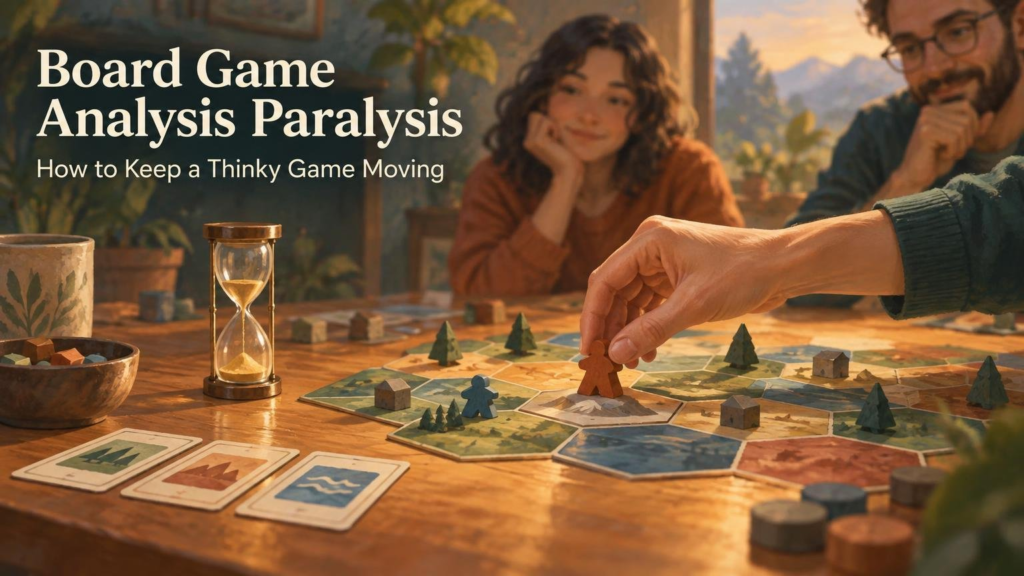
Slow turns do not have to ruin a thoughtful game. Use clearer teaching, manageable choices, and a shared pace agreement to reduce downtime without rushing players.

A practical framework for evaluating a new trading card game, from local events and preferred formats to recurring costs, rotation, reprints, and low-risk testing.

A practical teaching sequence that gets new players making meaningful decisions without turning game night into a rulebook recital.
TLDR A “best TCG 2025” ranking is a little like ranking snacks at a game store. Everyone has strong opinions,
Last updated: March 21, 2026 A dead card game usually looks dead. No new sets. No balance changes. No world