
TLDR
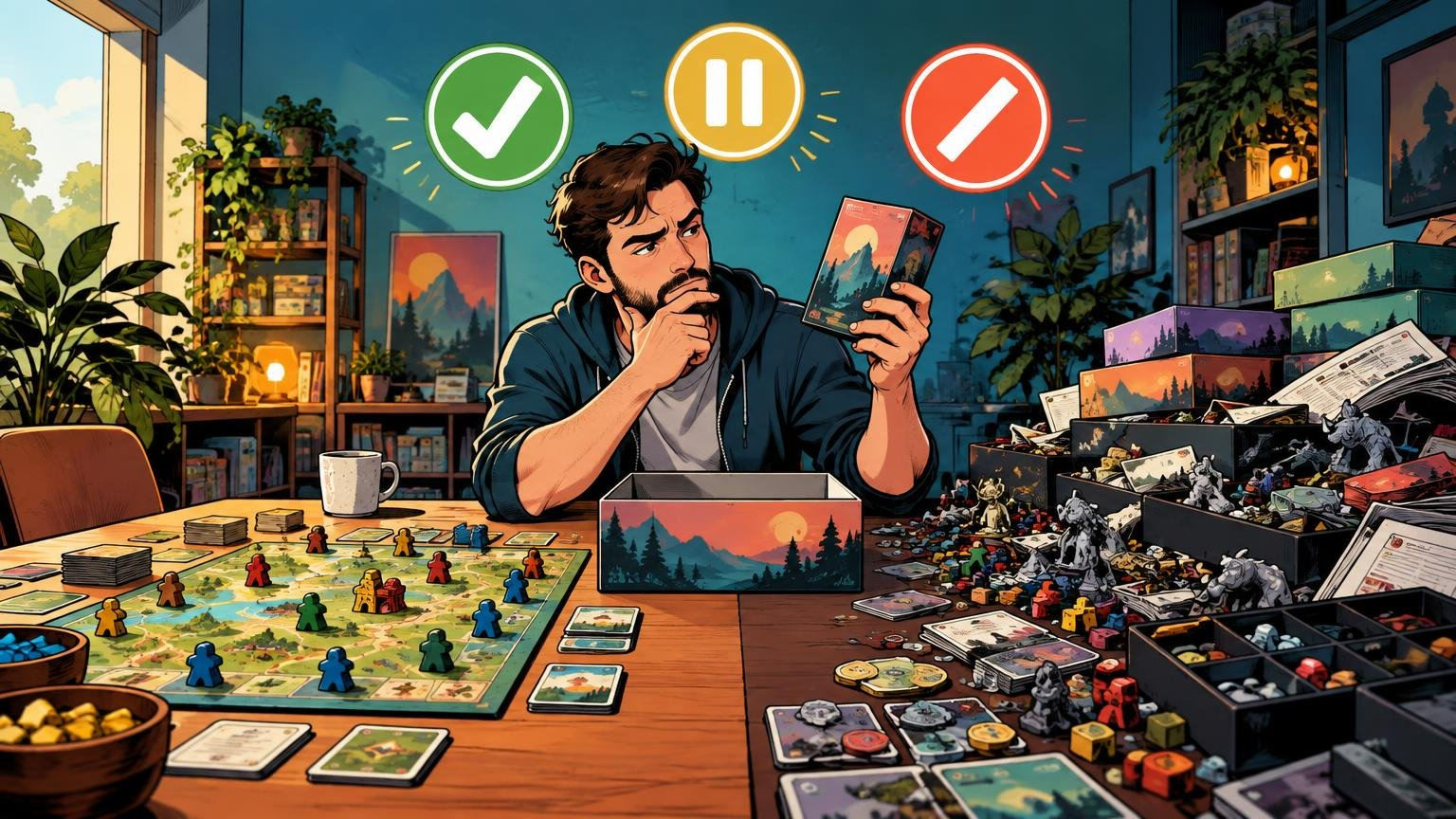
A board game expansion is worth buying when it improves a game your group already plays by solving a specific problem, supporting your usual player count, or adding meaningful decisions without creating more overhead than your table will tolerate. Buy when you can name the benefit. Wait when the base game still feels fresh. Skip when you mainly feel compelled to complete the collection.
If you are wondering whether board game expansions worth it is a question with a universal answer, it is not. An expansion that revitalizes one group’s favorite game can turn another group’s comfortable weeknight choice into a 40-minute setup ritual followed by a rules seminar.
The best test is not whether an expansion contains plenty of components. Ask what it changes about playing the game. More cards, factions, maps, and tokens only matter when they create choices or experiences your group will actually enjoy.
The quick answer: buy, wait, or skip
| Decision | Choose it when | Warning sign | Best next step |
|---|---|---|---|
| Buy | Your group plays the base game regularly and can name a change it wants | You are assuming more content automatically means a better game | Confirm compatibility and introduce one module at a time |
| Wait | The expansion sounds appealing, but the base game remains underexplored | You have played only once or twice or have not settled on a regular group | Play the base game again and note what actually feels repetitive |
| Skip | The added rules, setup, or player-count focus conflicts with how your group plays | The main motivation is fear of missing out or collection completion | Put the same budget toward a game that fills a genuine gap |
This framework deliberately treats a purchase as a table decision rather than a collector’s obligation. Collecting can be enjoyable in its own right, but it is a different goal from improving game night.
Seven checks for deciding whether a board game expansion is worth it
1. Identify the problem it solves
Start with a sentence: “We want this expansion because…” A persuasive answer might be that your cooperative group wants harder adversaries, your regular duo needs stronger two-player support, or experienced players want more asymmetric factions. “It has more stuff” is less useful because it does not predict whether that stuff will reach the table.
Do not buy a solution to somebody else’s problem. If online discussions complain that a game lacks variety but your group still discovers new strategies every session, you do not currently have a variety problem.
2. Separate meaningful change from content volume
Some expansions widen an existing content pool. Others modify the game’s economy, turn structure, objectives, map, or campaign progression. Neither approach is inherently better. A deck of additional cards may be perfect for a streamlined family game, while a veteran strategy group may want a system that changes how decisions interact.
Ask whether the new material creates different decisions or merely changes the names and artwork attached to familiar effects. Variety is valuable when players must adapt. It is less valuable when everybody follows the same plan and simply draws from a thicker deck.
3. Count the teaching cost
Rules overhead is paid more than once. Someone must learn the expansion, explain it, remember its exceptions, and help returning players reconstruct it after a month away. That cost matters even when the additional rules are individually simple.
For a stable group of enthusiasts, extra mechanisms can be the attraction. For rotating game nights with frequent newcomers, they may make a formerly welcoming game harder to recommend. If teaching is already your main friction point, use a deliberate sequence such as the one in our guide to teaching a board game without reciting the entire rulebook.
4. Judge replay value from actual plays
Replay value is not the number of theoretical combinations in the box. It is the likelihood that your group will choose the game again. Look at recent behavior: How often did you play the base game? Did sessions stop because the design became predictable, or because scheduling, length, and competing games got in the way?
An expansion can help with predictability. It cannot repair a group that dislikes the central mechanism. If nobody enjoys negotiation, adding six new negotiation powers is unlikely to produce a heartwarming conversion.
5. Check integration and reversibility
A modular expansion is easier to justify when you can add one element, assess it, and remove it without rebuilding the entire game. Check whether cards are intended to be permanently mixed, whether setup lets you choose modules, and whether the added material depends on other expansions.
Reversibility is especially helpful for mixed-experience groups. You can use the fuller version with regular players and return to the base game when teaching newcomers. Before combining modules, read the publisher’s current rules rather than relying on a half-remembered forum post from three editions ago.
6. Include setup, storage, and table space
The purchase price is only one cost. Expansion boxes can add sorting, setup, teardown, storage decisions, and a larger table footprint. A module that creates 15 minutes of preparation for a 45-minute game has a very different practical impact from one that adds a deck and starts immediately.
Estimate the whole event rather than trusting play time alone. Our setup time versus play time guide offers a simple way to include unpacking, teaching, breaks, and cleanup in your group’s time budget.
7. Verify the exact product requirements
Before buying, confirm whether the product requires the base game, works as a standalone title, matches your edition and language, and needs any intermediate expansion. Also check whether replacement components, revised rules, or official errata affect integration.
Names can be misleading. “Expansion” usually means another product is required, while a “standalone expansion” normally works independently but may also combine with related content. A big box may be a storage solution, a compilation, a new edition, or an empty box with organizers. Read the contents rather than letting the box become an expensive nesting doll.
Know what type of expansion you are buying
- Variety expansions add cards, characters, maps, factions, objectives, or scenarios while preserving the central structure. These suit groups that enjoy the base game and want fewer repeated situations.
- System expansions introduce mechanisms such as events, campaigns, asymmetric powers, alternate economies, or new phases. They can transform play, but usually impose the largest learning cost.
- Player-count expansions add seats or provide tools for solo, two-player, or lower-count sessions. Check whether they genuinely support your usual count rather than merely allowing it on the box.
- Convenience products include organizers, upgraded components, playmats, and storage boxes. They may improve readability or setup without changing gameplay. Judge them by usability, not strategic depth.
A product can belong to several categories. The useful question is which function matters to your group. If setup prevents a favorite game from reaching the table, an organizer may provide more practical value than another stack of scenario cards.
Three examples of different expansion tradeoffs
These examples are not universal recommendations or rankings. They illustrate why reading the contents and requirements matters more than searching for an “essential” expansion.
Wingspan: Oceania Expansion
Stonemaier states that Wingspan: Oceania Expansion requires the core Wingspan game. Its listed contents include 95 bird cards, new player mats, nectar, bonus cards, goals, and Automa material. The bird cards can be mixed with the base game whether or not other expansions are present.
That makes it more than a simple stack of additional birds: it also introduces components that touch broader parts of play. A prospective buyer should therefore ask whether the group wants changes to familiar systems, not merely more card variety. The official Wingspan: Oceania product page is the appropriate place to confirm current contents and requirements before buying.
Root: The Marauder Expansion
Leder Games describes Root: The Marauder Expansion as requiring Root and adding two factions, hirelings, and a setup draft. The publisher presents hirelings as particularly suited to games at lower player counts.
This is a useful player-count example. A group that commonly plays with fewer people may value the hireling system differently from a group already happy with larger sessions. Root also has substantial faction and rules interactions, so consult Leder’s current Root rules and learning resources when evaluating how an expansion fits the material you own.
Spirit Island: Jagged Earth
Greater Than Games lists Jagged Earth as requiring Spirit Island and adding ten Spirits, two adversaries, additional token types, scenarios, events, cards, and extra island boards. That is a broad package of content rather than a narrow module.
The attraction is clear for a group that wants many more combinations and challenges. The corresponding question is whether that group wants to absorb the additional concepts and components. Players still learning their original Spirits may gain more from another base-game session first. Players actively seeking new interactions have a stronger reason to investigate the expansion.
When waiting is the smarter choice
Wait if the base game has only reached the table once or twice, unless the expansion directly supports a player count or mode you need. Early novelty makes it difficult to distinguish a genuine limitation from ordinary unfamiliarity.
You should also wait when your group already struggles with session length, rules retention, or slow turns. More options can enrich a strategy game, but they can also intensify analysis paralysis and downtime. Deal with the existing friction before increasing the decision space.
Finally, wait when you do not have a stable group for the game. A campaign expansion is not much use if the same players cannot meet, and advanced asymmetric content is difficult to appreciate when every session begins with a new-player teach.
When a different game is the better purchase
Buy another standalone game when your desired experience lies outside the base game’s identity. An expansion can deepen or redirect a design, but it rarely turns a confrontational negotiation game into a peaceful puzzle or a two-hour strategy game into a reliable 30-minute filler.
Compare the two purchases by the gap they fill. An expansion is attractive when your group wants more of a proven favorite with a specific change. A new game is stronger when you need a different player count, mood, complexity level, or session length. Shelf variety often creates more useful options than maximum depth in one system.
Pre-purchase checklist
- Can we name the specific table problem or desire this product addresses?
- Do we already play and enjoy the base game often enough to use it?
- Does it add meaningful decisions, useful variety, or a needed mode?
- Will our regular players tolerate the extra rules and teaching time?
- What will it add to setup, teardown, storage, and table space?
- Can we introduce or remove its modules separately?
- Does it support our usual player count rather than a hypothetical group?
- Does it require the base game or any other expansion?
- Is it compatible with our edition, language, and existing components?
- Would a different standalone game fill a more important gap?
Common questions about board game expansions
Do expansions usually make games longer?
Not necessarily. Extra setup, phases, choices, or players can lengthen a session, but some modules leave the turn structure largely intact. Treat the publisher’s rules and setup instructions as a starting point, then consider how quickly your own group makes decisions.
Can an expansion fix a game?
It can address a specific concern, but “fix” is subjective. A new player-count system, revised economy, or alternative objective may suit your group better. It will not help if players dislike the game’s central loop. Buy for a documented change, not the vague hope that a different box will create different people.
Should I buy a big box without owning every expansion?
Only when its listed contents and storage plan serve what you own. Verify whether it includes gameplay material, duplicates products, or merely provides storage. Also check whether the larger box will fit your shelf and remain practical to carry to game night.
How many times should I play the base game first?
There is no magic number. Play until your group understands the core decisions well enough to identify what it wants next. That may happen quickly for experienced players or take many sessions for a dense strategy game. The quality of the diagnosis matters more than the play count.
Choose for the table you actually have
The best expansion is not the one with the most components or the loudest reputation. It is the one that gives your real group a reason to bring a game back to the table while keeping the added rules, setup, and storage within acceptable limits.
Before buying, name the change you want and verify that the product delivers it. If you cannot do both, play the base game again or choose a different game. Your shelf will survive the indignity of an incomplete collection, and your game nights may be better for it.
