
Stardew Valley turns a collection of ordinary chores into one of gaming’s richest expressions of personal choice. Farming, friendship, exploration, combat, and community life all compete for the same limited days, but the game never insists that efficiency is the only measure of success. Its quiet brilliance lies in making a modest life feel genuinely self-directed.
Our verdict Stardew Valley is a masterful life simulation whose gentle atmosphere conceals wonderfully interconnected choices. Its opaque edges and unhurried routines require patience, but few games make building a small, self-directed life feel so rewarding.

Stardew Valley (2016)
That freedom does not mean an absence of pressure. Seasons advance, opportunities compete for attention, and neglected plans wait patiently to become tomorrow’s problem. Yet these constraints give each decision meaning. Stardew Valley earns its highest possible recommendation because it understands that a satisfying routine is not one without demands; it is one whose demands reflect the life a player has chosen to build.
TLDR: A quiet routine with remarkable depth
Stardew Valley is an essential life simulation for players who enjoy setting their own priorities. Its farming, relationships, exploration, combat, and town activities reinforce one another, creating long-term goals without prescribing one correct route through them. The slow pace and opaque mechanics will frustrate some newcomers, while co-op has platform and host-player limitations. For patient players, however, few games make gradual progress feel so personal or rewarding.
Every ordinary day becomes a meaningful choice
The premise is deliberately simple: the player inherits an overgrown farm and begins building a new life in the valley, where the town’s old ways and neglected community center are under pressure. Nintendo’s official description frames that setup around farming, relationships, and participation in the wider community. Stardew Valley could have treated those elements as separate activity menus. Instead, they form a web of competing priorities.
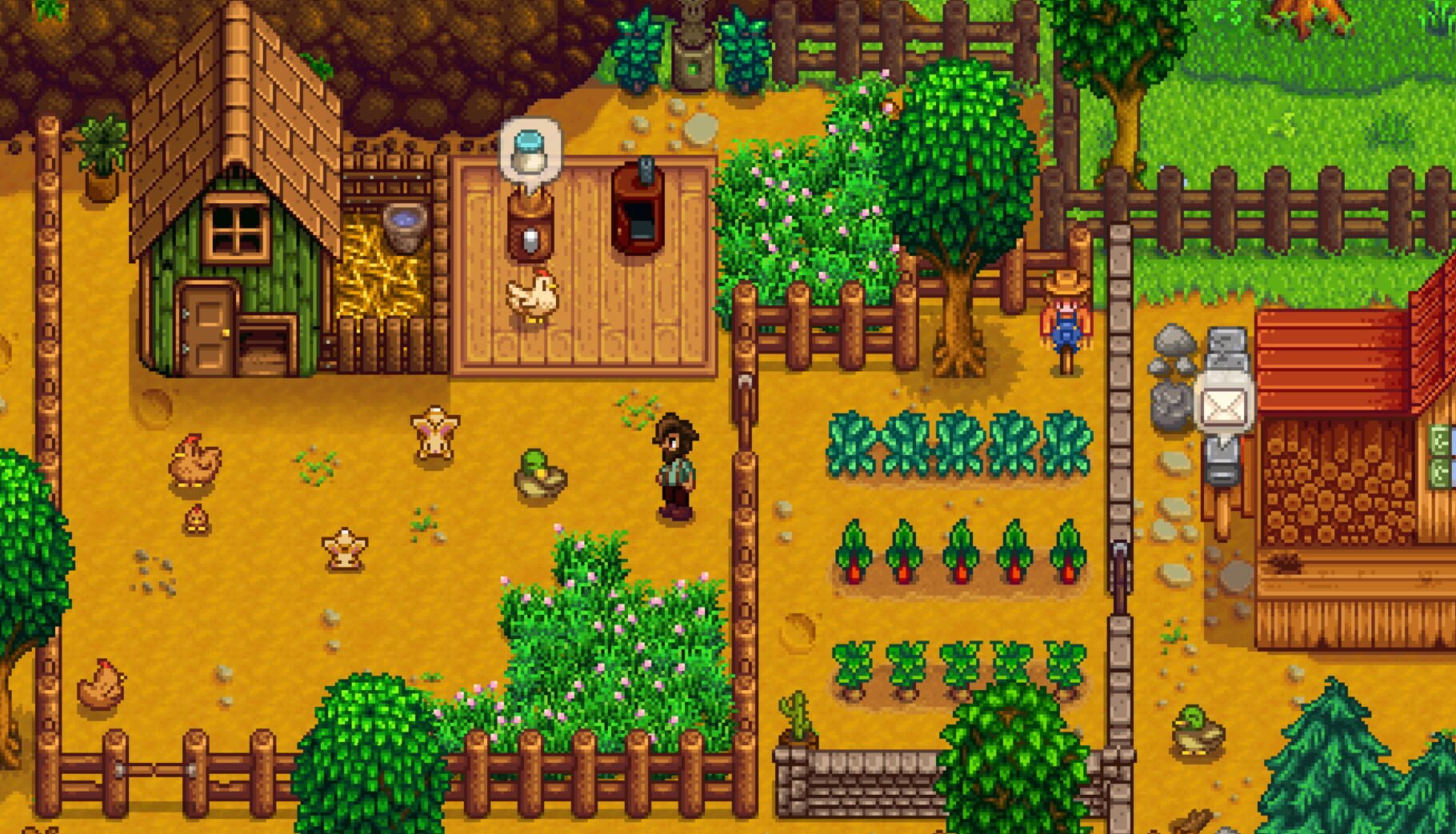
A day spent developing the farm is also a day not spent strengthening relationships, exploring, fighting, or joining town activities. That tension turns time into the game’s most important resource. It gives apparently minor decisions consequence without making every choice feel like a punishment. There is usually another morning coming, but never enough time to do absolutely everything today.
For me, this balance between freedom and constraint is Stardew Valley’s defining achievement. Players who enjoy optimization can organize each day around seasonal objectives and long-term efficiency. Players who would rather concentrate on animals, customization, relationships, or exploration can let other opportunities pass. The game supports planning without declaring that a perfectly optimized farm is the only respectable outcome. Your spreadsheet may disagree, but Stardew Valley itself is less judgmental.
That makes its progression feel less like completing a checklist and more like watching a life acquire a shape. Individual gains may be small, but they accumulate across connected systems. The farm changes, priorities shift, relationships develop, and familiar routines gain context. Progress matters because it reflects repeated choices rather than a single prescribed advancement track. The result is a game about agency built from limitations rather than limitless possibility.
The valley moves to one cohesive rhythm
Stardew Valley’s gentle atmosphere would not be enough on its own. Plenty of games are pleasant until repetition reveals how little lies beneath the surface. Here, the calendar, people, places, and farm routines belong to the same rhythm. Seasonal demands affect planning; town life competes with private ambitions; exploration and combat sit alongside cultivation rather than feeling imported from another game. Critical coverage has similarly emphasized the interplay among time, townspeople, and the wider community as central to the design. GameSpot’s original PC review called attention to that interconnected structure, and it remains the key to why the game’s routines hold together.
This cohesion gives the valley an identity stronger than the nostalgic promise of leaving a dreary old life behind. The farm is not an isolated optimization puzzle with a decorative town attached. Community activities and relationships broaden the meaning of progress, while farming provides a recurring structure that draws the player back into each day. The fantasy works because private and communal goals continually overlap.
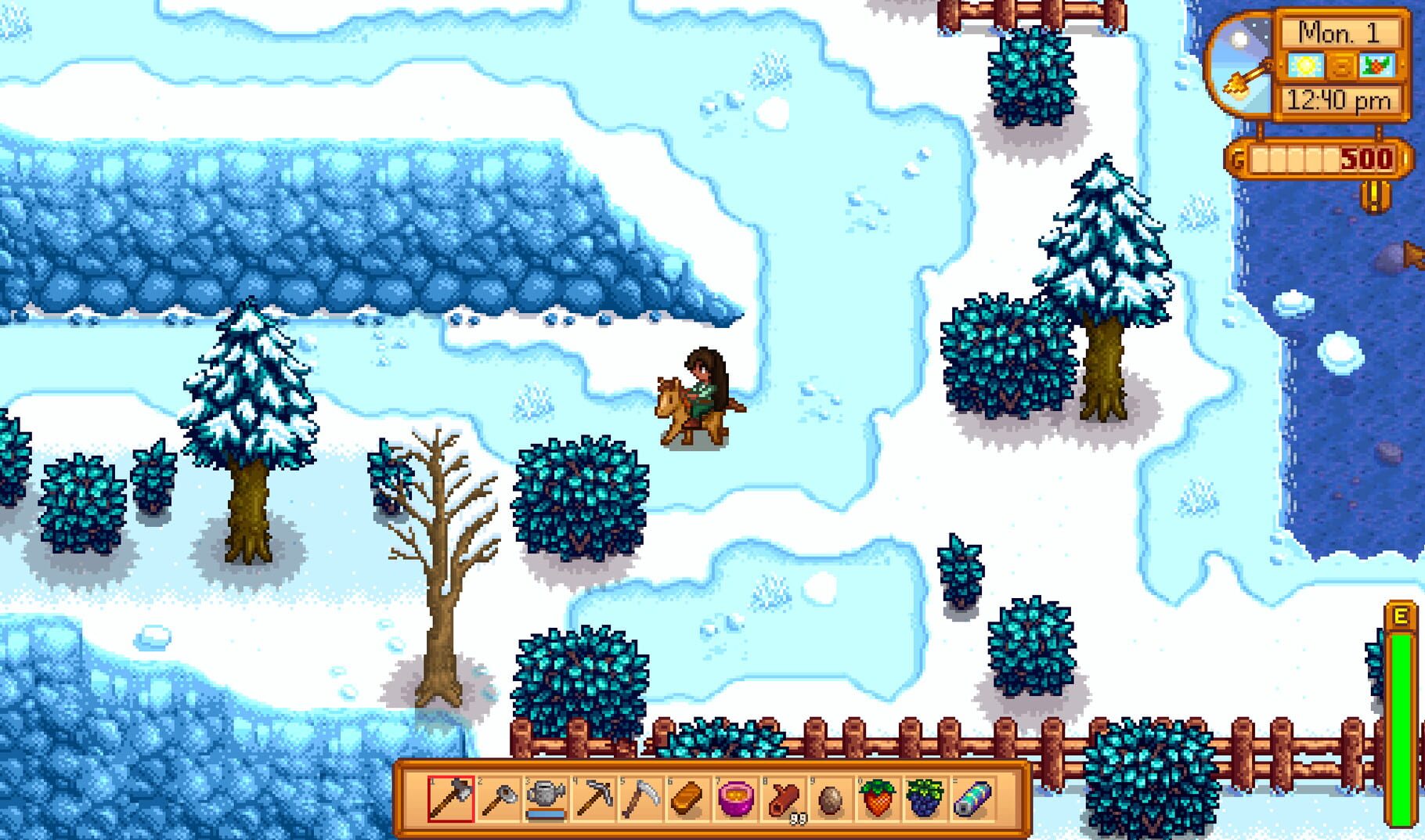
The pace also leaves room for players to define what matters. Stardew Valley does not need constant spectacle because anticipation becomes part of its texture. A goal can take time, and a routine can evolve gradually rather than being discarded as soon as its rewards are claimed. That patience makes the game unusually good at producing personal stories from systems. Two farms can begin with the same neglected plot yet reflect very different priorities after their players have settled into the valley.
Relaxation and optimization are always negotiating
Calling Stardew Valley cozy is accurate, but incomplete. Its inviting presentation surrounds systems that can be demanding, and its limited days naturally encourage players to think about efficiency. The difference is that most of this pressure comes from personal ambition. The game offers enough simultaneous possibilities that players can turn a peaceful routine into an exacting schedule if they choose.
That tension is not a design failure. It is part of the appeal. Relaxation here comes from ownership over priorities, not from the removal of meaningful consequences. A player can pursue an elaborate long-term plan or accept a less efficient day because another activity seemed more appealing. Stardew Valley respects both approaches, which is why it works for meticulous planners and more improvisational players without flattening itself into a consequence-free sandbox.
Its structure also makes an interesting companion to management games such as The Alters, where schedules and competing needs carry far harsher consequences. Stardew Valley’s choices are gentler, but the underlying pleasure is related: deciding what deserves attention when time will not accommodate everything. Here, that pressure supports self-expression rather than survival.
The invitation is warmer than the explanation
Stardew Valley’s weakest quality is its opacity. Light guidance preserves discovery, but some mechanics and relationships between systems can be cryptic before their logic settles into place. For a game so welcoming in tone, it can be surprisingly willing to let newcomers wonder whether they have overlooked something important.
That ambiguity sometimes strengthens the pleasure of discovery, but it also creates avoidable friction. Players comfortable with experimentation—or with consulting outside information—will push through it. Those expecting clear onboarding may find the early learning process less relaxing than the pastoral atmosphere suggests. The game’s depth eventually justifies the effort, but the path to understanding could be more graceful.
The routine itself is another legitimate dividing line. Repeated chores and incremental gains are foundational, not temporary hurdles before the “real” game begins. Players seeking immediate action, a tightly directed campaign, or frequent dramatic rewards may experience the same rhythm as laborious rather than soothing. Stardew Valley offers considerable freedom within its structure, but it does not apologize for moving slowly.
Solo play offers the clearest ownership of the day
Stardew Valley is especially powerful as a solo game because every compromise belongs to one player. The farm’s direction, the day’s priorities, and the balance between planning and wandering all express an individual temperament. That makes gradual progress unusually intimate: the resulting life feels authored through hundreds of small decisions rather than selected from a few major branches.
Co-op broadens the experience by turning those priorities into a shared negotiation. Conventional multiplayer uses a host farm and cabins for farmhands, with the official configuration supporting a host and up to three additional players. Participants also need to be on the same game version. The official multiplayer guide documents those requirements. Friends can divide responsibilities or pursue different interests, making the farm feel like a genuine group project rather than several players merely occupying the same map.
The collaboration is not entirely egalitarian, however. Official multiplayer notes assign certain shared decisions—including sleeping, festivals, and the Joja route—to the main player. Broader cross-platform multiplayer is also unavailable, with ConcernedApe citing platform restrictions and technical limitations. These caveats matter for groups choosing where and how to play: friendship may be powerful, but it still cannot make incompatible versions shake hands.
Platform-specific features require particular care. The separate Nintendo Switch 2 Edition advertises expanded options including online play for up to eight participants, local wireless play, four-player split-screen, GameShare, and mouse controls. Those features should not be assumed to exist in every edition. The safest practical advice is to confirm that everyone owns compatible versions and that the chosen platform supports the intended group setup before starting a shared farm.
A small life worth inhabiting
Stardew Valley succeeds because its atmosphere and mechanics make the same argument: a meaningful life emerges from attention. Crops, relationships, exploration, community, and personal projects matter because they ask for time that could have gone elsewhere. The game does not remove that conflict. It makes choosing among those possibilities rewarding.
Its slow routines will not suit everyone, and its inadequate explanations occasionally work against its generous spirit. Co-op also brings practical restrictions that groups should understand in advance. None of those reservations diminish the extraordinary unity of its design. Stardew Valley gives planners enough structure to master, wanderers enough freedom to improvise, and social players a world worth sharing.
The strongest recommendation goes to anyone who enjoys gradual progress, self-directed goals, gentle atmosphere, and games that allow ordinary decisions to become personal stories. Players seeking rapid pacing or explicit direction should approach with adjusted expectations. For everyone receptive to its rhythm, Stardew Valley is not merely a charming farming game. It is a masterful simulation of deciding what makes a day—and eventually a life—feel well spent.
References
- Stardew Valley: Nintendo Switch 2 Edition for Nintendo Switch 2 – Nintendo Official Site
- Stardew Valley Reviews – GameSpot
- Stardew Valley Reviews – Metacritic
- Stardew Valley – Multiplayer Troubleshooting Guide
- Stardew Valley – Stardew Valley Multiplayer News
- Stardew Valley – News
- Stardew Valley – Stardew Valley 1.5 Update out now on PC!
