
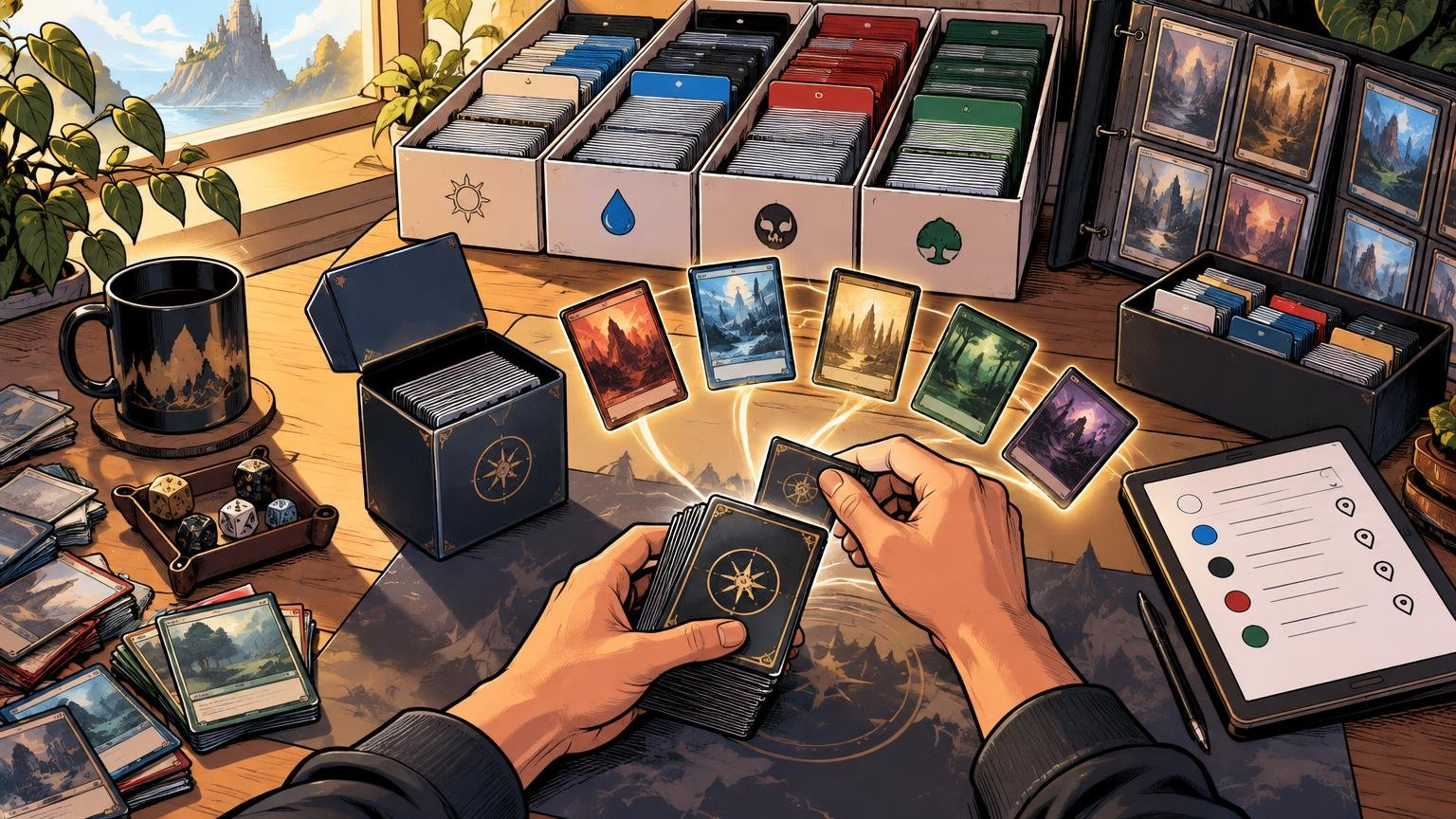
TLDR: Organize for retrieval, not display
The best deckbuilding system separates complete decks, frequently used cards, the searchable collection, and unsorted arrivals. Within your main collection, sort cards into broad color and card-type sections, then alphabetize them. Keep a simple digital inventory for valuable cards and anything you regularly brew with. Most importantly, create a return tray so cards removed from decks do not become archaeological discoveries.
Sorting every card by set may look wonderfully official, but it often makes deckbuilding slower. If you want a removal spell, mana rock, or particular creature, you probably remember its name, color, or function before you remember its collector number. Build your system around how you search.
Start by dividing the collection into useful zones
Before sorting individual cards, decide what role each part of the collection serves. Mixing finished decks, trade cards, draft leftovers, and speculative maybes in the same boxes creates most of the usual chaos.
| Zone | What belongs there | How to organize it |
|---|---|---|
| Active decks | Complete decks currently in use | One labeled deck box per deck, with tokens and notes kept separately or in a divided compartment |
| Deckbuilding library | Cards you realistically expect to use | Color, then card type or function, then alphabetical order |
| High-use staples | Cards frequently moved between decks | A small, clearly labeled section near the main library |
| Trade or sale cards | Cards available to leave the collection | Separate binder or box, supported by a current inventory |
| Archive and bulk | Duplicates and low-use cards worth retaining | Set-based or broad alphabetical storage, depending on collection size |
| Intake tray | New purchases, opened packs, and dismantled decks | Temporary holding area that gets processed on a regular schedule |
The important distinction is between an active deck and a pile that might become a deck one day. Give complete decks dedicated boxes. Give incomplete ideas a deck list, a maybeboard, and perhaps a small labeled project section. Otherwise, half-built decks quietly capture useful cards while contributing nothing except optimism.
Use a simple hierarchy for the main deckbuilding library
A practical physical hierarchy for a mixed-format collection is:
- Color: white, blue, black, red, and green
- Multicolor cards
- Colorless nonland cards
- Nonbasic lands
- Basic lands and tokens in their own sections
- Within each section, divide by broad card type or deck function
- Alphabetize within the smallest useful category
For a modest collection, color followed by alphabetical order may be enough. As the collection grows, broad subdivisions reduce searching. Creatures and noncreatures are an easy split. A larger library might separate creatures, instants, sorceries, enchantments, artifacts, planeswalkers, and battles, while keeping lands in their own area.
Avoid creating dozens of narrow functional categories unless you enjoy arguing with yourself about whether a card is ramp, fixing, card advantage, or all three. Card type and alphabetical order are objective. Function is useful for a curated staples section, but it becomes inconsistent across an entire collection.
When sorting by set works better
Set and collector-number sorting is useful for complete-set collecting, processing large quantities of newly opened cards, or maintaining an archive. It is less convenient when brewing across Magic’s history because cards serving the same role are scattered among many releases.
A hybrid system often works best: maintain the active deckbuilding library by color and name, while storing deep bulk by set. A digital inventory can then tell you that another copy exists in the archive without forcing every common into your premium browsing space.
Keep format legality in your records, not your permanent dividers
Magic formats use different card pools and deck-construction rules, while bans and restrictions apply by format rather than attaching permanently to a card. Standard also rotates as older sets leave its available card pool. Use the official Magic format pages and banned-and-restricted information when checking a brew rather than assuming a label added months ago remains accurate.
This is one reason to avoid physically filing the entire collection under labels such as “Standard,” “Modern,” or “Commander.” A card can belong to several formats, and its status can change. Record format legality in your collection software or deckbuilding tool, then keep the physical card in one predictable location.
Format rules still affect how many copies you want within easy reach. Constructed decks generally have a 60-card minimum, allow up to four cards with the same English name other than basic lands, and may use a sideboard of up to 15 cards. Commander instead uses exactly 100 cards including the commander, follows singleton construction apart from basic lands, and does not use a sideboard under the official rules. The current Magic Comprehensive Rules should be the final reference when a deckbuilding detail matters.
Different printings of a card do not bypass name-based copy limits. Track set, collector number, language, finish, and condition when you care about locating a specific printing, but file duplicate printings together if speed matters more than collecting by edition.
Create a small staples section without hiding the rest of the collection
A staples section is useful when it contains cards you genuinely reach for across several decks: common interaction, mana fixing, ramp, card selection, or format-specific role players. Organize this smaller section by function, because that is how you browse it while solving a deckbuilding problem.
Keep the categories broad and label them plainly. “Removal,” “draw and selection,” “ramp,” “protection,” and “lands” are more sustainable than an elaborate taxonomy requiring a committee meeting whenever a card does two things.
Treat staples as a browsing shelf, not a declaration that every other card is unworthy. The strange synergy piece hiding in the main library may be exactly what makes a new deck interesting. A good organization system helps you find known tools without reducing every brew to the same familiar package.
Use an inventory that answers where the card is
A digital inventory becomes worthwhile when you own enough cards that memory stops being reliable. At minimum, record the card name, quantity, and physical location. Add set, collector number, finish, language, and condition only when those details matter to you.
Location is the field people most often skip, even though it solves the practical problem. “Owned: 2” is not helpful when one copy is in a Commander deck and the other is somewhere in a five-row box. Use short location codes such as Deck–Dragons, Binder–Trade, Box A–Blue, or Archive–Set Name.
Your inventory does not need to contain every low-value duplicate on day one. Start with active decks, cards in the deckbuilding library, valuable cards, and trade stock. Add bulk gradually as it passes through the intake tray. A partial inventory you maintain is more useful than a perfect database abandoned after one heroic weekend.
Manage cards shared among multiple decks
One physical card cannot be in three decks at once, despite what three deck lists may confidently suggest. Choose one of these approaches and apply it consistently:
- Give the card a permanent home in one deck and mark it as unavailable elsewhere.
- Maintain a shared staples box and place a clearly labeled placeholder in each deck that needs the card.
- Build each deck with separate copies when convenience matters more than minimizing collection cost.
- Use clearly identifiable playtest cards only in casual, proxy-friendly groups that have agreed to them.
Placeholders should name both the card and its current location. A note reading “Borrow from Staples Box: Card Name” is far more useful than an empty sleeve and a vague memory.
For casual testing, playtest cards can help a group evaluate deck ideas before anyone commits to additional copies. Keep them visibly distinct from authentic cards and confirm table expectations first. They are not legal substitutes for authentic cards in sanctioned tournaments.
Give deck projects a controlled amount of space
A brewing station can include one box for active projects, with a divider for each prospective deck. Each section should contain only cards currently under consideration, plus a printed or digital list identifying missing pieces.
Set a limit on simultaneous projects. When the project box is full, finish, dismantle, or pause something before starting another. This is less exciting than opening a fresh section for Deck Idea Number Seventeen, but it returns useful cards to circulation.
Commander projects especially benefit from a list-first approach. Because the format uses 99 cards plus a commander and follows color-identity restrictions, a digital draft can catch structural problems before cards migrate out of half the collection.
Process new cards with the same short routine
An organization system survives through maintenance rather than sorting brilliance. Give every new or returning card the same route:
- Place it in the intake tray instead of dropping it into a random box.
- Identify cards for active decks, trades, the deckbuilding library, or bulk storage.
- Update inventory quantities and locations where necessary.
- File the cards in their permanent sections.
- Empty the tray before it becomes a second unsorted collection.
Use the same process when dismantling a deck. Remove tokens and accessories, update the deck list or archive it, record any valuable cards changing location, and return everything immediately. The glamorous part of deckbuilding is finding the clever interaction. The useful part is being able to find both cards again next month.
Store the collection for access and protection
Choose boxes and binders that fit the cards without excessive movement or pressure. Keep labels visible from the direction in which the containers sit on the shelf. Leave some expansion room in each section so adding a card does not require relocating half the alphabet.
For plastic storage materials used around paper collections, the U.S. Library of Congress recommends stable, additive-free polyester, polyethylene, or polypropylene and advises avoiding PVC and unknown plastics. Its general preservation guidance also warns against keeping valuable paper collections in environmentally unstable attics, basements, or garages where water and temperature changes pose risks. This is broad paper-preservation advice rather than Magic-specific product testing, but the storage principle is sensible. Read the Library of Congress preservation guidance.
The best system is the one you can put back together
Start with four things: dedicated active-deck boxes, a searchable deckbuilding library, an intake tray, and a basic location inventory. Add a staples section or detailed archive only when the collection actually needs one.
The real test is not how impressive the collection looks immediately after sorting. Pull ten cards for a brew, abandon the idea, and see whether you can return them in a few minutes. If you can, the system works. If they remain on the desk until the next set releases, simplify it.
