
TLDR
MTG playtest cards explained in one sentence: a player-made playtest card is a clearly unofficial stand-in used to test a deck or support casual play, but the term can also refer to Wizards’ internal prototypes or the official experimental cards released in Mystery Booster products. Player-made stand-ins are not authorized cards for sanctioned tournaments. At a private table or unsanctioned event, the group or organizer decides whether to allow them.
The practical rule is to identify the setting before arguing about the card. A kitchen-table Commander game, an unsanctioned store league, and a sanctioned tournament can all have different requirements. Ask first, make every stand-in easy to recognize and read, and never present an unofficial card as authentic.
MTG playtest cards explained: three different meanings
Magic players use “playtest card” for three related but distinct objects. Confusion starts when someone applies the rules for one type to another.
1. Player-made casual stand-ins
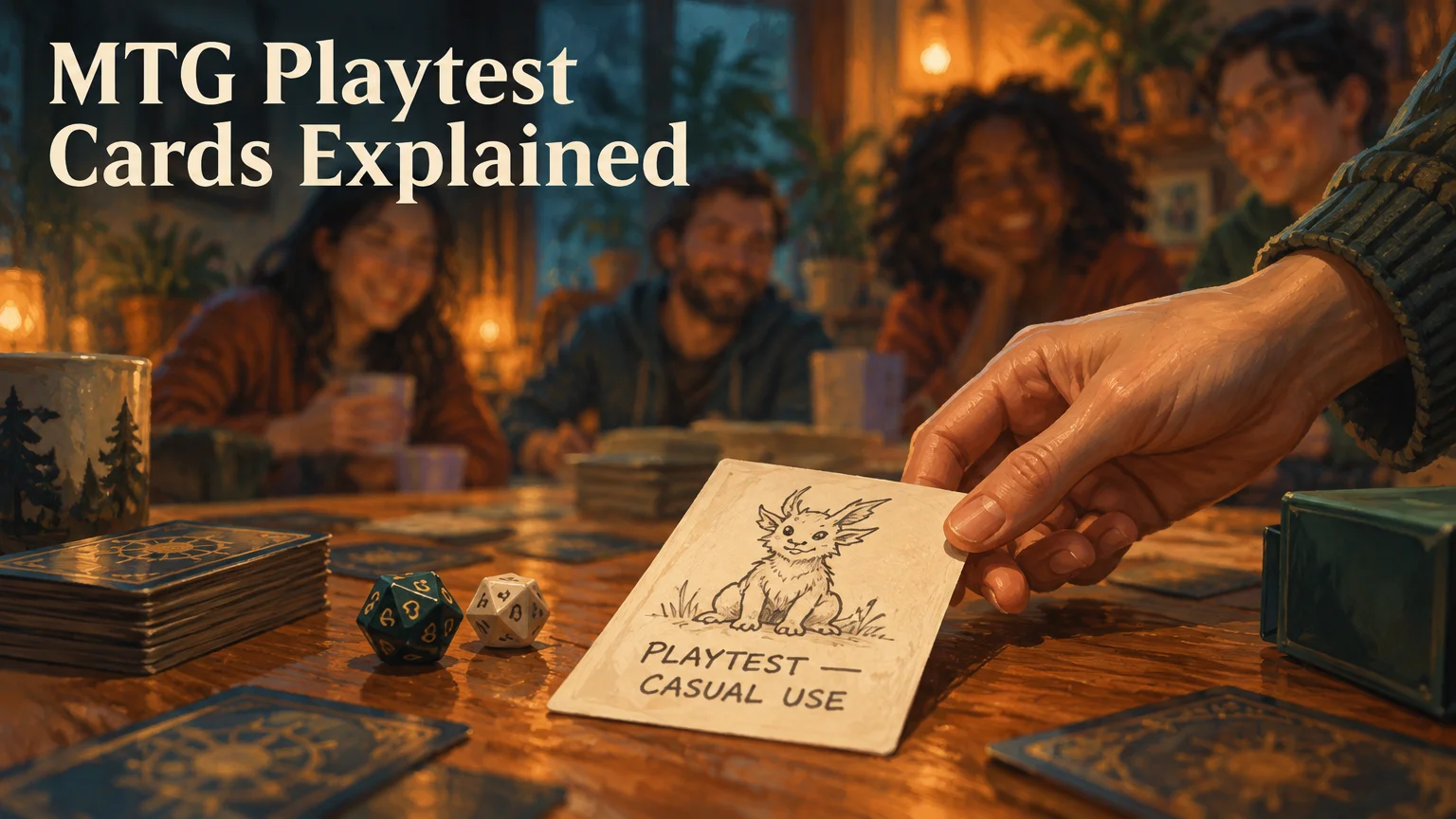
This is what most players mean when discussing proxies at a casual table. A stand-in represents another card so a player can test a deck, teach a format, build a cube, or play within a group that accepts unofficial cards. It might be a basic land with a different card name written on it, a paper insert placed in front of another sleeved card, or a clearly unofficial printed card.
Wizards’ public discussion of proxies used a basic land marked with another card’s name as an example of a personal playtest card. It distinguished clearly non-authentic, non-commercial stand-ins from counterfeits intended to pass as genuine cards. That article is a useful explanation of the terminology rather than a substitute for the current tournament rules. Wizards’ explanation of proxies and personal playtest cards provides the original context.
2. Wizards’ internal design prototypes
Wizards also uses playtest cards while developing Magic. These working prototypes may have temporary names, unfinished wording, placeholder art, or no art at all. Their job is to help designers test mechanics and gameplay before a card becomes a finished product. They are development materials, not a special category of player-created tournament card.
3. Official Mystery Booster playtest cards
Mystery Booster introduced official cards designed to resemble development prototypes. Wizards describes them as experimental designs that did not necessarily receive the normal level of rules and balance scrutiny. Despite their intentionally unfinished appearance, these are official product cards—not homemade substitutes.
Official does not mean usable in every format. Cards labeled “Playtest” or “Not for constructed play,” including cards carrying a playtest sticker, are excluded from Constructed events under the tournament rules. Mystery Booster Limited is the relevant tournament environment for the experimental cards covered by the product’s release notes.
Playtest cards, proxies, and counterfeits are not interchangeable
At casual tables, “proxy” and “playtest card” are often used for the same thing: an unofficial card representing a real Magic card. “Playtest card” emphasizes testing or casual function, while “proxy” is the broader community term. That overlap is normal as long as everyone understands what is being used.
A counterfeit is different. It is made or presented to be mistaken for an authentic card. The relevant line for a player is not whether a stand-in looks tidy; it is whether the card remains clearly unofficial and is represented honestly. A polished casual playtest card should still be identifiable as a stand-in rather than something that could be passed off as genuine.
That distinction protects both opponents and future owners. Do not trade or sell a playtest card as authentic, mix it into a collection without identification, or use authentic-looking presentation to conceal what it is. This article addresses table use, not intellectual-property questions or advice about reproducing art.
Where can you use an MTG playtest card?
| Setting | Player-made stand-ins | Who decides | Best next step |
|---|---|---|---|
| Private casual game | Allowed only by agreement | The players or host | Disclose them before decks are shuffled. |
| Unsanctioned store event | Depends on that event’s policy | The organizer or store | Ask about card, ownership, and readability requirements. |
| Sanctioned Constructed event | Not authorized as player-made replacements | Tournament rules and event officials | Bring authorized genuine cards and check the current rules. |
| Mystery Booster Limited event | Official product playtest cards may belong in this specific environment | Tournament rules and event officials | Confirm the event format and product being used. |
Private casual games
A private group can decide that playtest cards are welcome, forbidden, or allowed under conditions. Some groups permit unlimited proxies. Others require ownership of the represented card, restrict proxies to testing, or set a maximum number per deck. Those are table agreements, not universal Magic rules.
The healthiest approach is to discuss the deck rather than merely count its unofficial cards. A fully authentic high-powered deck can create a worse mismatch than a proxied beginner deck. If proxies let one player jump far beyond the group’s expected speed, consistency, or budget level, the problem is the resulting game—not the printer ink.
Commander players can pair the proxy conversation with a broader discussion of Commander power levels. Tell the table what the deck is trying to do, how quickly it can threaten a win, and whether it contains unusually efficient interaction or combos. “It has proxies” is not a useful substitute for that information.
Unsanctioned store play
A game happening inside a store is not automatically governed by the same card requirements as a sanctioned tournament. A store can host an unsanctioned Commander night, testing session, or house league and establish its own policy. It may allow stand-ins freely, impose restrictions, or prohibit them.
Ask the organizer before arriving with a proxy deck. Useful questions include whether the event is sanctioned, whether playtest cards are accepted, whether ownership is required, and whether prizes change the policy. This avoids making three other players wait while the table conducts an emergency meeting about your mana base.
Friday Night Magic, prereleases, and other sanctioned events
Do not assume an event’s friendly atmosphere makes player-created stand-ins tournament-legal. Under the Magic Tournament Rules effective February 27, 2026, cards used in sanctioned events generally must be genuine, regulation-sized Magic cards publicly released by Wizards. Unauthorized cards are prohibited. Read the official Magic Tournament Rules for the complete requirements and exceptions.
An event advertised as Friday Night Magic, a prerelease, or casual Commander may still be sanctioned. Ask the organizer whether the specific event is sanctioned rather than guessing from its name. For a deeper separation of tournament rules and social permission, see our guide to MTG proxy legality in tournament and casual play.
A Head Judge proxy is a narrow tournament tool
Tournament rules use “proxy card” in a much narrower way than casual players do. A Head Judge may issue a proxy in limited event-specific circumstances, such as when a card becomes damaged or excessively worn during that tournament. The rules also provide a limited accommodation involving certain foil cards for which no non-foil printing exists.
Players cannot create these tournament proxies for themselves. A judge-issued proxy is authorized only for the tournament in which it was issued, and the original card remains part of the process. This exception is a remedy for an event problem, not permission to arrive with homemade substitutes for expensive cards.
How to use playtest cards responsibly in casual games
Good casual proxy use reduces friction rather than transferring it to opponents. The card needs to communicate enough information for everyone to make decisions without repeatedly stopping the game.
- Ask before the game. Get agreement from the players and, when relevant, the organizer.
- Make the card obviously unofficial. It should not be capable of being mistaken for an authentic card in a collection, trade, or sale.
- Use the correct card name. Opponents need to identify what the stand-in represents.
- Include readable rules text when practical. If the full text does not fit, keep an official card reference available.
- Preserve game-state clarity. Mana value, card type, power and toughness, loyalty, and other relevant characteristics should be easy to find.
- Use consistent sleeves and card backs. A stand-in must not become a marked card that reveals its position in the deck.
- Explain double-faced cards and unusual mechanics before they create confusion.
- Keep the deck appropriate for the table. Budget freedom should not silently become a power-level ambush.
A handwritten basic land is excellent for a quick test when the group knows the card. It becomes less useful when the represented card has several abilities, transforms, creates unfamiliar tokens, or changes zones repeatedly. In those cases, a clear paper insert or an obviously unofficial printed reference can save time.
Players who prefer durable, readable stand-ins can consider printed MTG playtest card options, while keeping them clearly unofficial and limited to settings that permit them. Culture of Gaming’s own proxy-use policy similarly describes proxy/playtest products as intended for casual games, testing, cubes, and proxy-friendly groups—not sanctioned tournaments or resale as authentic cards.
If the immediate goal is evaluating a Commander list before buying cards, test one question at a time: Does the deck make enough mana? Does its commander survive? Are the win conditions realistic? Is a costly card actually important, or does it merely look impressive in a decklist? A focused test produces better purchasing decisions than replacing half the deck and learning nothing specific.
Common questions
Do I need to own the real card to use a casual playtest card?
There is no single ownership rule for all casual Magic. A private group or unsanctioned organizer may require ownership, allow testing without it, or permit unrestricted proxies. Ask which policy applies at that table. Sanctioned events are governed by tournament card-authorization rules rather than a casual ownership agreement.
Can I use proxies in Commander?
Yes, if the game or unsanctioned event permits them. Commander is a format, not one universal play environment: it can be played privately, in an unsanctioned store night, or as part of sanctioned organized play. Permission at your regular kitchen table does not automatically carry into a store event.
Is an official Mystery Booster playtest card a proxy?
Not in the ordinary player-made sense. It is an official card released in a Wizards product, designed with an experimental prototype appearance. Its use is still restricted by format: its official origin does not make it legal in ordinary Constructed events.
Can a judge approve the proxies I brought from home?
The narrow Head Judge proxy provision does not turn player-made cards into generally authorized tournament cards. Judge-issued proxies address specified circumstances arising under the tournament rules and are valid only for that event. Bring authorized cards and contact the organizer in advance if you have a card-condition concern.
Set the table expectation before choosing the card
Playtest cards are useful when they help a group learn, teach, experiment, or avoid an expensive purchase that turns out to be wrong for the deck. They are less useful when they obscure the game state, bypass an organizer’s rules, or disguise a major power jump.
Before making or ordering anything, identify the setting. For private casual play, agree on expectations and build readable, clearly unofficial stand-ins. For a store event, ask whether it is sanctioned and obtain the organizer’s policy. For sanctioned play, follow the current Magic Tournament Rules and do not treat a home-printed proxy as an authorized card. Ten seconds of conversation before shuffling is usually cheaper than discovering the disagreement after someone keeps an opening hand.
