
TLDR
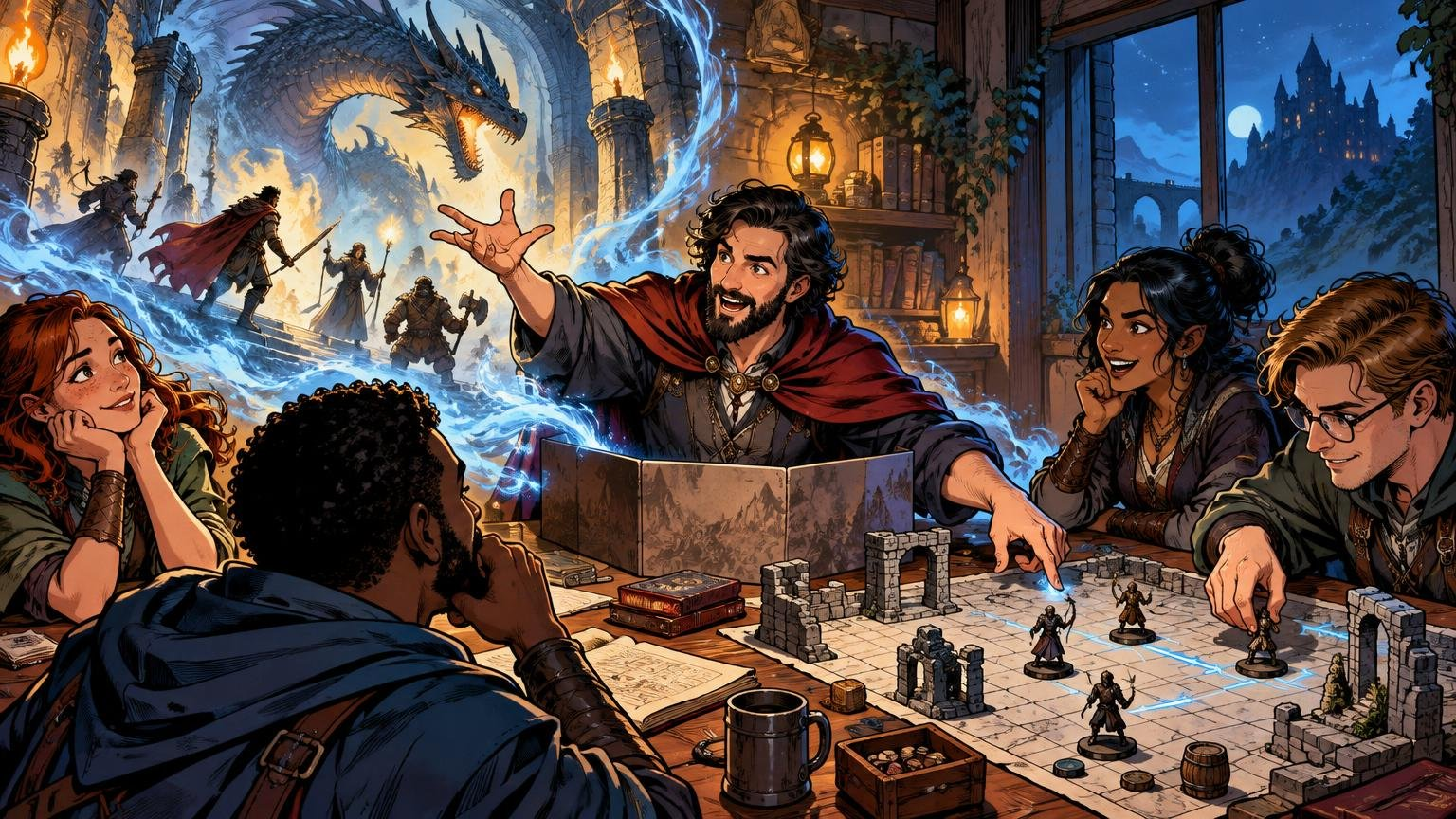
The best answer to D&D theater of the mind vs miniatures is usually not picking one forever. Narrate scenes when exact positions do not matter, add a rough sketch or tokens when everyone needs a shared picture, and use a measured grid when distance, terrain, cover, reach, or an effect’s footprint could change important decisions. Miniatures are optional even on a grid: coins, dice, paper counters, and other markers work.
A good default is hybrid play. Begin with description, introduce the lightest visual aid that resolves uncertainty, and reserve exact squares for encounters that benefit from them. This keeps a tavern scuffle from becoming a surveying project while giving a complicated bridge battle the clarity it deserves.
What theater of the mind and miniature play actually mean
Theater of the mind is a narration-first approach. The Dungeon Master describes the environment, characters explain their intentions, and the group maintains a shared mental picture. Positions can still matter, but they are expressed conversationally: the fighter is holding the doorway, two skeletons are near the altar, and the wizard is safely behind the overturned table.
Miniature play usually means representing persistent positions on a physical or digital surface. However, two separate choices often get bundled together: whether the table uses a visual aid and whether it measures exact distances. A few tokens on a sheet of paper provide a shared picture without committing the group to precise movement by square.
At the other end of the spectrum is a measured battle grid. Under the 2024 revised Free Rules procedure, a grid square represents 5 feet, movement is counted in 5-foot segments, diagonally adjacent squares cost the same as orthogonally adjacent squares, and a square of difficult terrain costs two squares of movement. The official rules for playing the game provide the relevant procedures and definitions.
| Presentation style | Best fit | Main tradeoff |
|---|---|---|
| Pure theater of the mind | Simple spaces, quick conflicts, conversational groups | The DM must restate positions and make consistent rulings |
| Rough sketch or loose tokens | Encounters where relative position matters more than exact distance | Borderline ranges still require a ruling |
| Measured grid with tokens | Terrain-heavy or tactically detailed encounters | More setup and attention to measurement |
| Measured grid with miniatures | Groups that enjoy tactical play and a strong visual spectacle | Models can add cost, storage, and preparation without changing the underlying rules |
When theater of the mind works well
Narration is a strong fit when the important question is what characters are trying to accomplish rather than exactly which 5-foot space they occupy. A chase through a kitchen, an ambush in a narrow alley, or a fight against one ogre in an otherwise empty room may be easy to understand through concise descriptions.
It also works better when the DM gives players decision-ready information. “There are enemies around you” is atmospheric but not useful. “Two guards are in melee reach, the captain is about 20 feet away, and the open door is behind you” tells the player what choices are plausible.
A reliable narration cycle is:
- Establish the important zones, obstacles, and obvious threats at the start of the scene.
- At the beginning of each turn, briefly update the active character’s situation.
- Let the player state an intention before requiring a mechanical commitment.
- Clarify uncertain distance, cover, or risk before the player spends an action or limited resource.
- After major movement or a change to the terrain, restate the scene.
That fourth step prevents many arguments. If a player says, “I want to reach the cultist without leaving the troll’s reach,” answer whether that appears possible before the character moves. Theater of the mind relies on shared trust; surprise should come from the monsters and story, not from information that would have been obvious to the character.
Official D&D Beyond advice identifies movement, range, melee tactics, areas of effect, and terrain as recurring adjudication challenges in theater-of-the-mind combat. It recommends communicating expectations and moving to a grid when spatial detail becomes important to the group.
When a grid earns its table space
A grid becomes useful when several spatial facts interact at once. Imagine a battle with a narrow bridge, difficult terrain, archers behind cover, an enemy with unusual reach, and characters trying to protect two different exits. The group can narrate all of that, but maintaining the same picture may take more effort than drawing it.
The 2024 revised rules make position relevant to mechanics including movement, range, reach, cover, creature spaces, difficult terrain, and opportunity attacks. A visible layout gives everyone a persistent reference for those facts. D&D Beyond’s tactical-combat guidance similarly describes the grid as a shared view of creature positions and terrain.
Consider switching to exact positions when:
- Several creatures have different movement speeds or reach.
- Cover and lines of approach are central to the encounter.
- The battlefield contains hazards, elevation, bottlenecks, or extensive difficult terrain.
- Forced movement could push creatures into hazards or out of protective positions.
- Several overlapping areas or persistent effects need to be tracked.
- Players repeatedly ask where everyone is or interpret the same description differently.
None of these conditions proves that a grid is mandatory. They indicate that the cost of ambiguity is rising. If the group enjoys negotiating approximate positions, narration can continue. If every turn begins with three minutes of geometric cross-examination, the map has probably won the argument.
You do not need miniatures to use a battle grid
Miniatures are display pieces and markers; the grid is the measurement tool. The current Free Rules describe battle grids and miniatures as tools some DMs use, while explicitly allowing substitutes such as coins, dice, paper counters, or candy.
A low-cost trial can therefore be extremely simple: draw one-inch squares on paper or use inexpensive graph paper, mark walls with a pen, and represent participants with objects that are easy to distinguish. Assigning colors or labels matters more than sculpt quality. “The red die is the captain” is enough information to make a tactical decision, even if the captain looks suspiciously like a six-sided cube.
Tokens may actually be easier than detailed miniatures when a scene contains many similar enemies. Number them so everyone can identify the wounded guard, the restrained guard, and the guard who has somehow survived every terrible decision the party has made.
Rules-sensitive moments need clear communication
Theater of the mind does not remove positional rules. It changes how the table establishes the facts those rules use. Before a consequential choice, the DM and player should agree on the relevant situation.
Range, reach, and opportunity attacks
State approximate distances in mechanically useful bands rather than relying only on words such as “nearby.” Normal melee reach is generally 5 feet unless another rule changes it, and an opportunity attack can be triggered when a creature a combatant can see leaves that combatant’s reach. If a player cannot tell whether movement will leave an enemy’s reach, clarify that before the move is finalized.
Cover and terrain
Describe not just what scenery exists, but what it does. Tell players whether the fallen pillar provides cover, whether the flooded floor is difficult terrain, and whether reaching the balcony requires climbing. On a map, mark these distinctions instead of assuming that the artwork communicates the rule.
Areas and forced movement
For an area of effect, explain which known targets can be included and whether allies would also be exposed before the player commits. Do not promise a universal shortcut: the correct outcome depends on the current text of the spell or feature and the established positions. Forced movement deserves the same care because a small positional difference can determine whether a creature reaches a hazard or remains within an effect.
A practical hybrid workflow
Hybrid play treats presentation methods as tools rather than team jerseys. The DM can move between them without ending the scene or changing the campaign’s identity.
- Start with narration and identify only the terrain and distances that affect immediate choices.
- If players form different mental pictures, draw a rough diagram with no scale or place a few loose tokens.
- If exact movement, reach, cover, or effect placement becomes consequential, declare that positions will now use a grid.
- Transfer the established relationships fairly. Do not use the new map to reveal that a character was mysteriously 15 feet farther away than the previous description implied.
- Return to narration when the battlefield becomes simple again, if that is what the group prefers.
Keep an emergency map kit nearby: blank paper, a marker, and a handful of distinct tokens. Online groups can use a shared whiteboard or basic virtual tabletop without preparing polished maps for every possible detour. The goal is common understanding, not winning an imaginary cartography award.
Agree on precision before it causes a dispute
A brief conversation at session zero can prevent different assumptions from colliding during an important fight. Add these questions to a broader D&D session zero checklist:
- Will distances be exact, approximate, or decided encounter by encounter?
- Will the DM declare range, cover, and opportunity-attack risks before a player commits to movement?
- How will the group resolve areas of effect when no grid is present?
- How precisely will forced movement and hazardous terrain be tracked?
- What level of retcon is allowed after a misunderstood description?
- What signal tells the group it is time to draw a map?
- Does anyone have accessibility needs that make spoken descriptions or visually dense maps difficult to follow?
The accessibility question is especially important. A map may reduce memory demands for one player while creating visual clutter for another. Clear verbal summaries help in either format, and labels, high-contrast tokens, larger maps, or digital zoom can make visual play easier to parse.
Which approach fits your group?
New DMs should usually begin with the simplest method they can adjudicate confidently. A rough map with tokens is a forgiving middle ground: it reduces confusion without requiring a library of terrain and miniatures.
Tactically focused groups are more likely to appreciate a measured grid, especially when characters and encounters regularly interact with reach, cover, terrain, and movement. Roleplay-first groups may prefer narration for routine confrontations while keeping a map available for major set pieces.
Low-budget in-person groups lose nothing mechanically by using coins, paper counters, spare dice, or other distinct markers. Online groups should choose tools according to preparation tolerance as well as tactical interest. A feature-rich virtual tabletop is not an automatic improvement if maintaining it consumes the DM’s limited preparation time.
Finally, ask what your players enjoy paying attention to. Some want to optimize every square. Others would rather describe a daring swing from the chandelier and trust the DM to translate it into a fair ruling. Both are legitimate ways to engage with the game, and many groups contain both kinds of player.
Choose clarity, not a camp
The useful choice in D&D theater of the mind vs miniatures is the one that gives your group enough shared information to make meaningful decisions without adding unwanted friction. Narrate simple spaces, sketch complicated relationships, and measure positions when precision changes the stakes.
For your next session, prepare a few labeled tokens and a blank sheet of paper even if you plan to run entirely through narration. If nobody needs them, excellent. If the third round produces five incompatible versions of where the owlbear is standing, you can solve the problem in thirty seconds and get back to the part where it tries to eat someone.
References
- Playing the Game – D&D Beyond Basic Rules – Dungeons & Dragons – Sources – D&D Beyond
- Adjudicating Edge Cases in Theater of the Mind | Dungeons & Dragons
- New Player’s Guide: How to Try Tactical Combat | Dungeons & Dragons
- The Basics – D&D Beyond Basic Rules – Dungeons & Dragons – Sources – D&D Beyond
