
TLDR
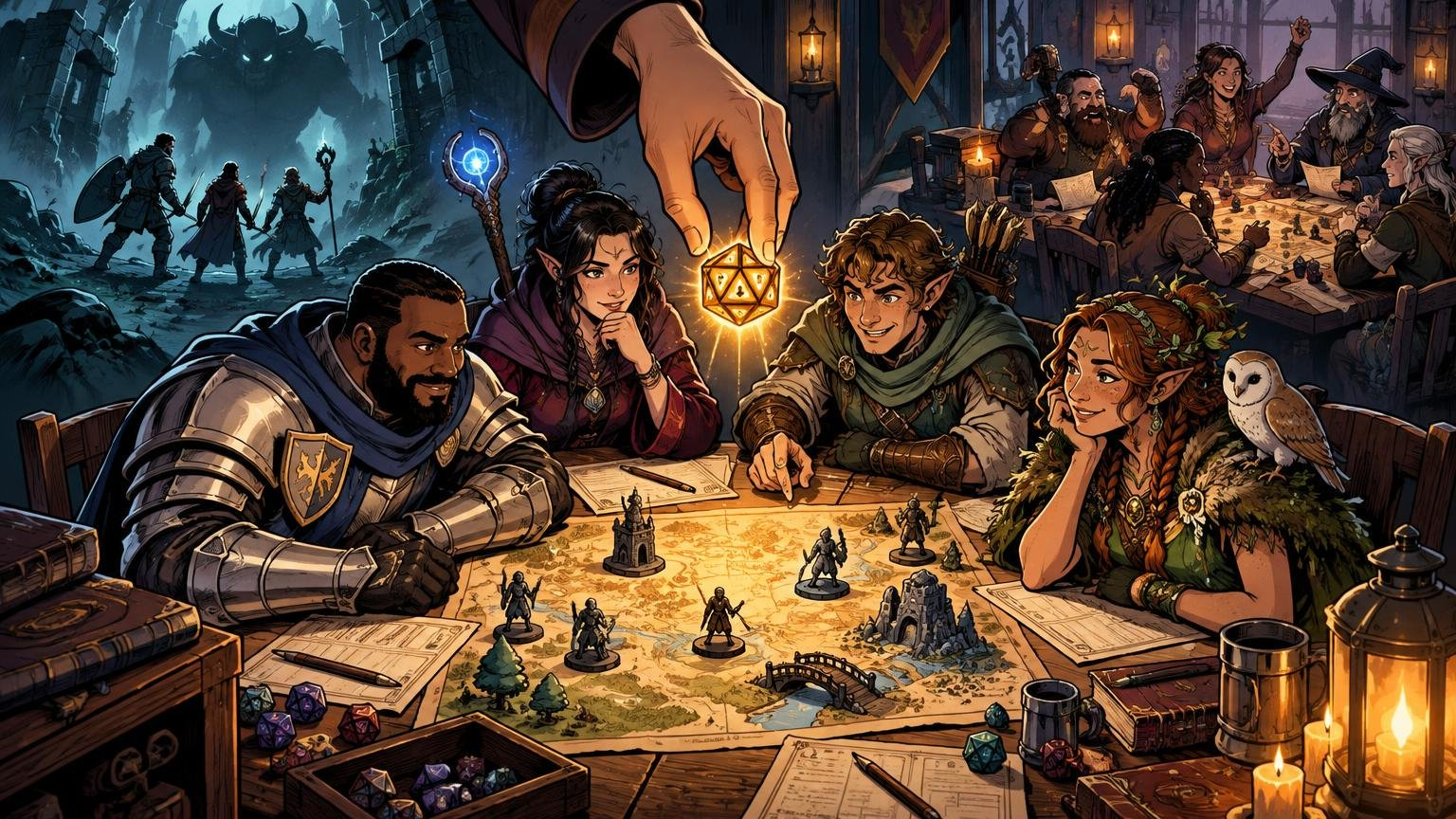
The 2024 D&D rules say the game plays best with four to six players in addition to the Dungeon Master. Within that range, four players is our practical default for a new campaign: it offers enough character variety without making spotlight management unnecessarily difficult. Three players creates a faster, more intimate game but leaves less room for absences. Five or six provides more ideas and scheduling resilience, at the cost of slower decisions and greater competition for attention. The best D&D party size is ultimately the smallest dependable group that supports the campaign everyone wants to play.
If you want the official baseline, the 2024 D&D Basic Rules recommend four to six players plus a Dungeon Master, while acknowledging that adventures with fewer or more characters are possible. The DM is not included in that player count. That range is guidance rather than a requirement, and choosing a number within it still changes how the campaign feels.
The best D&D party size at a glance
| Players | How it usually feels | Main advantage | Main challenge |
|---|---|---|---|
| 1–2 | Personal and character-focused | Plenty of individual agency and spotlight | Limited scheduling resilience and fewer answers to threats |
| 3 | Fast, intimate, and decisive | Every character matters frequently | One absence can disrupt the session |
| 4 | Balanced and manageable | Strong variety without excessive table traffic | Still vulnerable if several players are unreliable |
| 5 | Flexible and lively | More character ideas and attendance resilience | Decisions and combat require firmer facilitation |
| 6 | Busy, social, and varied | Broad party capabilities and energetic group play | Spotlight can become uneven |
| 7+ | Event-like and potentially chaotic | Supports a large friend group | Pacing, scheduling, and participation become difficult |
These are editorial judgments, not mechanical limits. A focused six-player group can move more smoothly than a distracted group of three. Experience, familiarity with the rules, online tools, adventure style, and willingness to make decisions all matter. Head count tells the DM what pressures to anticipate; it does not determine whether the group will have fun.
Three players: faster play with less room for absence
Three players can be an excellent party size for a character-driven campaign. Each player has more opportunities to speak, investigate, negotiate, and influence the direction of the story. Decisions also involve fewer competing plans, which can help the group move from discussion to action without convening a parliamentary subcommittee over every suspicious door.
The tradeoff is fragility. If one player misses a session, the party loses a third of its regular participants. Character abilities are also spread across fewer adventurers, so the group may lack an obvious answer to a particular obstacle. That is not automatically a problem: inventing an unusual answer is one of D&D’s pleasures. It does mean the DM should avoid building every important scene around one required spell, skill, or character.
For a three-player campaign, prepare problems with several plausible approaches. A guarded location might be entered through negotiation, stealth, bribery, magical assistance, or a dangerous climb. If the party has no specialist healer, make recovery resources and opportunities appropriate to the adventure rather than punishing players for declining to complete an imaginary job application form.
Three is especially attractive when all participants can attend consistently. Before starting, decide whether a missing player causes cancellation, whether someone else temporarily runs the character, or whether the character simply fades into the background. Settling that early prevents every absence from becoming a fresh constitutional crisis.
Four players: the strongest default for a new campaign
Four players is our most practical recommendation for a first-time DM or a group that has not played together before. It sits at the low end of the official four-to-six-player range, giving the party room for varied characters while keeping the number of individual preferences manageable. An official introductory adventure, Peril in Pinebrook, likewise recommends four players and one DM.
At four, players can develop distinct identities without needing rigid class roles. The party may have someone who excels in direct combat, someone comfortable with social scenes, and someone with useful exploration magic—but overlap is fine. Two characters can solve the same kind of problem in different ways, and nobody needs to spend an entire campaign performing a role they do not enjoy.
Four is not universally best. A group that loves elaborate tactical encounters may happily support five or six players, while a campaign centered on personal relationships may benefit from three. Treat four as a forgiving place to begin, not a sacred number engraved on the DM screen.
Five players: more flexibility, more table traffic
Five players gives a party considerable flexibility. More characters means more perspectives, more combinations of abilities, and a better chance that a session can proceed when one person is unavailable. It also creates more conversational traffic. A scene that invites everyone to contribute now has five player viewpoints for the DM to recognize rather than three or four.
Clear table habits begin to matter more at this size. During exploration, the DM can ask each player what their character is doing before resolving the scene. During open discussions, periodically invite quieter players to contribute rather than allowing the fastest voices to make every decision. In combat, announcing whose turn is next helps players prepare without imposing a stopwatch on people who need a moment to understand the situation.
A five-player table can also support different encounter styles. If exact positioning is becoming cumbersome, consider whether a particular scene needs a full tactical grid. Our guide to theater of the mind versus miniatures in D&D explains how to choose a presentation based on positional complexity instead of using one method for every encounter.
Six players: energetic, resilient, and demanding
Six players remains within the recommended range in the 2024 Basic Rules, but it asks more from the DM and the group. The potential upside is a lively campaign with broad character variety and enough attendance resilience that one absence need not cancel the evening. The downside is that every scene must distribute attention among six people.
Large parties benefit from visible procedures. Establish how the group chooses a direction when opinions split. Ask players to nominate a caller for a particular decision, take a quick vote, or let the character with the strongest stake make the choice. The goal is not to suppress discussion; it is to recognize when discussion has stopped producing new information.
The DM should also rotate narrative attention deliberately. One session might connect strongly to a character’s background, but other characters still need decisions to make within it. Across several sessions, vary whose relationships, goals, and complications move to the foreground. Spotlight does not have to be equal in every scene, but it should not permanently belong to the two loudest people.
Encounter preparation deserves similar care. Adding participants changes the party’s available actions, resources, and combinations, but simply filling every battle with more enemies can make resolution cumbersome. Mix group confrontations with hazards, negotiations, investigations, objectives, and encounters in which victory means something more interesting than removing every hostile creature from the map.
Can one- or two-player D&D work?
Yes, although it becomes a different kind of campaign. With one player and one DM, the game can focus closely on a protagonist’s decisions, relationships, and personal risks. Two players add cooperation while preserving that intimate scale. Official D&D material also recognizes the format: a July 1, 2025 D&D article notes that most adventures are built for parties of four to six characters but identifies Dragon Delves adventures suitable for one adventurer.
The safest approach is to use an adventure written for a small party or adapt threats around the characters actually present. Provide ways to gather information before committing to danger, allow retreat to remain meaningful, and avoid assuming that the party has access to every category of magic or skill. Supporting characters can help, but the players should continue making the important decisions. Otherwise, the DM risks playing both sides of the campaign while the human guest watches.
What changes with seven or more players?
Seven-player home campaigns are possible, but they require an honest conversation about the experience everyone wants. Each additional participant competes for speaking time and makes scheduling more complicated. New players may also find it harder to learn when several experienced participants answer simultaneously or advance scenes before they have processed their options.
If keeping the whole group together matters, use firm but friendly procedures: maintain a clear initiative order, discourage unrelated side conversations during another player’s scene, summarize the available choices when discussion stalls, and call on people who have not contributed recently. Ask players to learn the abilities they use most often, but leave room for questions. Efficiency should support participation, not turn the table into an exam.
Splitting the group into two campaigns may produce a better experience when several players regularly struggle to participate. That does create more DM work, so it is not a universal solution. Alternatives include rotating DMs, running connected one-shots, or scheduling occasional all-group events while keeping regular sessions smaller.
Home campaigns and Adventurers League use different guidance
Organized-play guidance solves a different problem from a continuing home campaign. The D&D Adventurers League Dungeon Master’s Guide version 14.0, effective March 4, 2024, said its adventures were designed for five players and could be adjusted for three to seven. It cautioned that play outside that range could be suboptimal.
That dated document should not be treated as a universal rule for home games—or assumed to be the latest organized-play policy without checking. Adventurers League sessions must accommodate standardized adventures and players who may not know one another. A home DM can tailor an entire campaign around three consistent friends, six relatives, or one heroic adventurer. If you are attending organized play, check the latest campaign documentation and event instructions rather than relying on home-table advice.
Does every party need a healer, tank, rogue, and spellcaster?
No supplied official guidance establishes a mandatory lineup of traditional party roles. More importantly, forcing players into unwanted jobs is a poor foundation for a long campaign. Party composition should influence how the DM presents problems, not act as a pass-or-fail test before play begins.
Discuss overlap and expectations during character creation. If three players want stealth-focused characters, ask whether everyone is excited about an infiltration-heavy campaign. If nobody wants healing abilities, make sure the group understands how recovery and consumable resources will work. If everyone chooses socially awkward adventurers, prepare for negotiations to become delightfully strange rather than quietly replacing someone’s character concept with “the responsible one.”
A useful party-composition conversation covers four questions:
- What kinds of scenes does each player want their character to shine in?
- Do any characters compete for exactly the same concept or narrative space?
- What obvious weaknesses does the party have, and does the group find those weaknesses interesting?
- Will the campaign provide several ways to approach its central problems?
Choose reliability before chasing a perfect number
Start with four players if you are assembling a conventional 2024 D&D campaign and want the most manageable default. Choose three when you value faster decisions and close character focus. Move to five or six when the group enjoys a busier social table and the DM is comfortable managing attention explicitly.
More important than any target number, however, is whether the participants share expectations and can attend consistently. Three engaged players who arrive ready to make decisions will usually create a stronger campaign than six nominal players whose schedules and preferred styles never align. Pick the dependable group first, then shape the adventure around the heroes who actually show up.
