
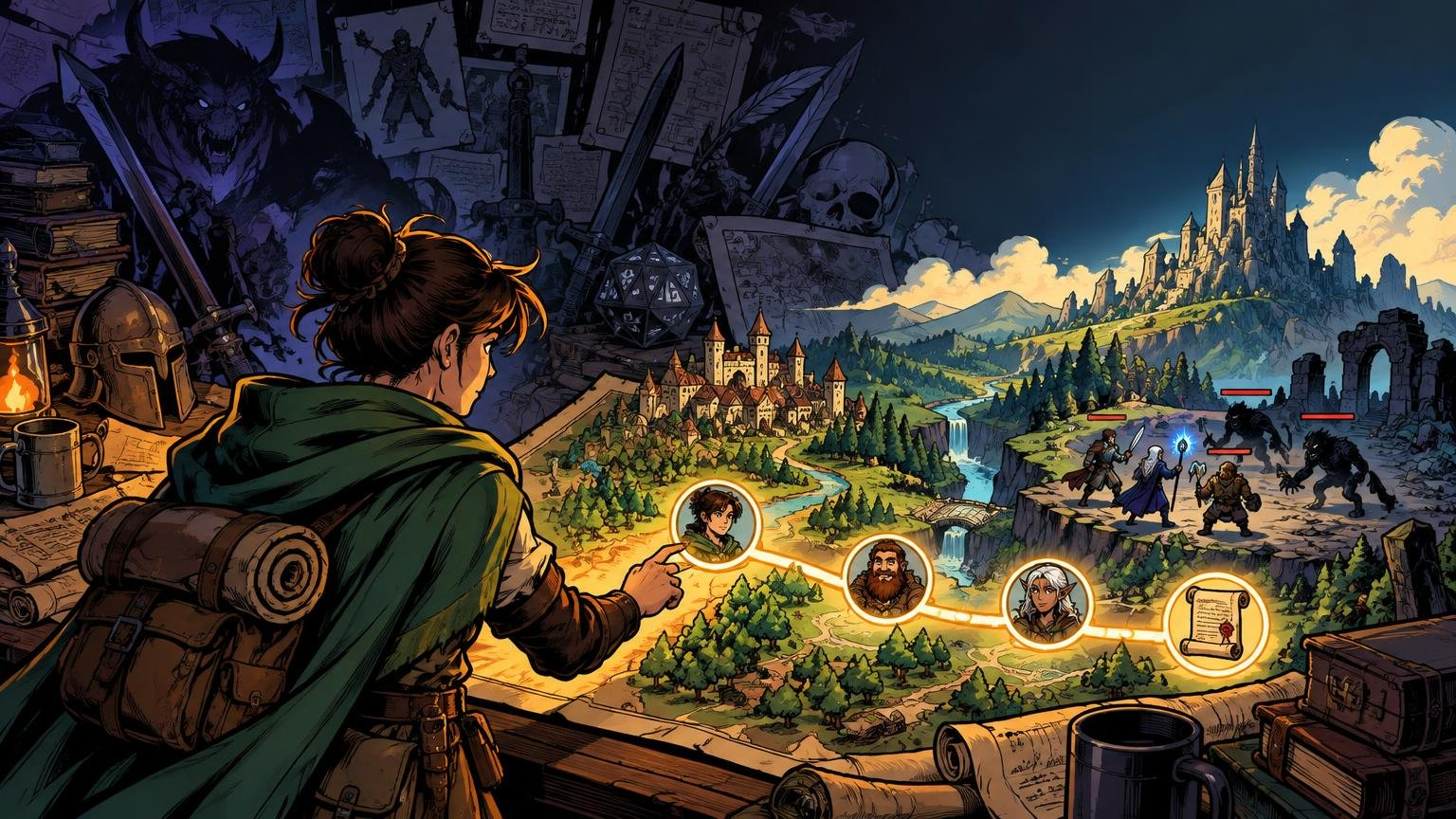
The easiest way to get into CRPGs is to stop treating them like exams. Pick an accessible game, choose a straightforward character, use a forgiving difficulty setting, and learn only the systems required by the next encounter. You do not need a perfect build, encyclopedic knowledge of the rules, or a spreadsheet documenting every villager you have mildly disappointed.
These games can look intimidating because they put character statistics, party management, tactical combat, exploration, and consequential dialogue on the screen at once. In practice, you can learn those layers separately. Your first objective is not system mastery. It is reaching the point where the rules begin supporting your decisions instead of obscuring them.
TLDR: Your manageable first approach
- Start with a modern, well-explained CRPG rather than the most complicated classic you can find.
- Choose a single-class character with an obvious role, such as a durable fighter, direct-damage spellcaster, or persuasive rogue.
- Use a lower or standard difficulty while learning. Difficulty is a tool, not an affidavit concerning your gaming credentials.
- Keep companions in their default classes until you understand what each one contributes.
- Choose turn-based combat if you want time to inspect abilities and plan every action.
- Treat failed dialogue checks as story developments unless the result seriously damages your enjoyment.
- Play one main quest and a few nearby side quests before worrying about optimal routes, secret endings, or build guides.
What is a CRPG, exactly?
CRPG stands for computer role-playing game, but the label is loose. It can broadly mean an RPG played on a computer, while modern usage often points to systems-heavy, choice-driven games influenced by tabletop role-playing. As discussed in research on CRPG design, these games typically combine a fictional world and its characters with formal rules that determine what happens when players act. The category does not require an isometric camera, a party, or turn-based combat.
The common thread is that your character sheet and decisions matter. A locked door might be opened with a key, picked by a skilled rogue, smashed by a strong character, bypassed through exploration, or left unopened. Combat is only one part of the game. Building a character, interpreting the environment, choosing allies, and accepting consequences are also part of play.
Choose your first game by complexity, not reputation
A celebrated CRPG can still be a miserable introduction if it presents six party members, an unfamiliar ruleset, and twenty years of interface conventions before you have found the pause button. For a first game, prioritize clear tutorials, readable ability descriptions, flexible difficulty settings, and the ability to correct character-building mistakes.
Baldur’s Gate 3 is a practical modern starting point for players interested in cinematic conversations, exploration, and turn-based battles. It uses a system based on Dungeons & Dragons Fifth Edition, but Larian says knowledge of the first two Baldur’s Gate games is not required. Its story introduces new characters, while player actions and dialogue can affect companion relationships. The official PlayStation introduction to Baldur’s Gate 3 also explains its difficulty options for newcomers, including Explorer and Balanced.
By contrast, Pathfinder: Wrath of the Righteous adds Mythic Paths, army recruitment, and a strategic Crusade layer to its party adventuring and tactical combat. Those systems can be rewarding, but they create more decisions for a new player to absorb. It may be a better second or third CRPG unless its setting and character options are exactly what have attracted you to the genre.
Make your first build boring on purpose
A build is the collection of choices that determines what a character can do. Depending on the game, it may include class, attributes or ability scores, skills, equipment, spells, special abilities, and advancement choices. A subclass or archetype is usually a specialization within a class. Multiclassing combines progression from multiple classes, which also creates more interactions to understand.
For your first character, pick one clear job and support it consistently. If you want to hit enemies with a large weapon, improve the attribute governing those attacks and choose abilities that make the plan more reliable. If you want to talk through problems, invest in the game’s persuasion-related skills. If you want to cast offensive spells, select a class designed around that rather than assembling a delicate three-class contraption copied from a late-game build video.
Single-class characters are usually easier to understand because each level extends an existing toolkit. That does not mean they are universally stronger. It means you can see the relationship between your choices and their results. Once you understand why your attacks connect, why enemies resist certain effects, and which resources return after resting, experimentation becomes much less mysterious.
Treat the party as a toolbox
Your party is the active group of characters traveling together. A companion is a recruitable character who may bring personal history, quests, motivations, and opinions about your conduct. Party management can include selecting companions, distributing equipment and consumables, positioning everyone, covering different skills, and deciding which character begins a conversation.
You do not need a rigid tank-healer-damage formation in every CRPG. Instead, ask whether the group can handle a few broad situations:
- Someone can survive attention at close range.
- Someone can threaten distant or hard-to-reach enemies.
- Someone can hinder groups through control, terrain, or area attacks.
- Someone can handle useful exploration or conversation skills.
- The party has a way to recover from damage or prevent it from becoming fatal.
One character may cover several jobs. A durable warrior might also intimidate people; a cleric might heal, defend, and control enemies; a rogue might scout, open locks, and deliver focused damage. Keep companions close to their default roles at first, and examine one character’s abilities before each battle rather than trying to memorize the entire party.
Pick the combat style that gives you room to think
Turn-based combat resolves actions in discrete turns. You can inspect the battlefield, read an ability, and decide who should move next without the fight continuing in the background. It is often the clearest format for learning positioning, ranges, status effects, and limited resources.
Real-time with pause, commonly shortened to RTwP, allows combat to proceed continuously until you pause it, issue commands, and resume. The pause is a central command tool, not an emergency button. Pause when enemies appear, when a character finishes an action, when reinforcements arrive, or whenever the battlefield stops making sense.
Some games support both systems. Pathfinder: Wrath of the Righteous allows switching between real-time-with-pause and turn-based play without reloading; Owlcat describes turn-based combat as providing more direct control over each character. Owlcat’s combat-mode explanation presents RTwP as the game’s original intended design, but that does not make it mandatory for a beginner.
Whichever style you choose, focus on action economy: how many useful things your party can accomplish before the enemy acts again. Removing or disabling one dangerous opponent is often more valuable than slightly damaging four. Positioning matters as well. Doorways can limit attackers, high ground may help in some systems, and clustered party members make extremely inviting targets for area effects.
Let dialogue choices belong to your character
CRPG dialogue becomes exhausting if you try to identify the objectively perfect response every time. Decide who your character is instead. Are they compassionate, practical, curious, greedy, or suspicious of anyone offering a quest beside an ominous cave? A simple role-playing principle narrows the options and gives the campaign a coherent shape.
An ability or skill check is a rules-based attempt to overcome a challenge, such as persuading a guard or detecting a lie. In D&D-derived games, an applicable ability modifier and proficiency may improve the roll. Advantage means rolling two twenty-sided dice and using the higher result; disadvantage uses the lower. These exact mechanics are not universal across CRPGs, so learn the vocabulary of the game you are actually playing.
Save before major conversations if irreversible outcomes would make you anxious, but consider allowing ordinary failures to stand. A failed persuasion attempt can reveal another route, create a fight, or alter a relationship. Reloading every imperfect roll turns role-playing into quality assurance work. Use saves to protect your enjoyment, not to erase every surprise.
A practical plan for your first five hours
- During character creation, choose a recommended class setup and one role-playing idea. Ignore multiclassing and highly optimized build plans.
- Complete the tutorial slowly. Read the combat log or event history whenever a result surprises you.
- Recruit a small party and identify one job for each member. Do not rebuild everyone immediately.
- Follow one obvious quest. Avoid collecting every side objective merely because an NPC has punctuation floating above their head.
- At the next level-up, choose abilities that reinforce what already works. New players benefit more from a reliable plan than from maximum theoretical flexibility.
- After several encounters, adjust the difficulty or combat mode if battles feel tedious, unreadable, or punishing. You are configuring the experience, not negotiating with a tiny judge inside the settings menu.
Essential CRPG jargon
| Term | Plain-English meaning |
|---|---|
| Party | The group of characters currently adventuring together. |
| Companion | A recruitable story character, often with personal quests and relationship systems. |
| Build | The combined class, statistics, skills, equipment, and advancement choices shaping a character. |
| Proficiency | Training that may add a bonus when the relevant rule applies. |
| Ability or skill check | A rules-based attempt to overcome a non-attack challenge. |
| Turn-based | Combat divided into distinct turns for characters or teams. |
| RTwP | Real-time-with-pause combat, where pausing lets you issue commands. |
| Respec | Rebuilding some or all character choices, if the game permits it. |
You are allowed to bounce off a famous CRPG
If one game does not click, identify the source of friction before deciding the genre is not for you. You may dislike real-time combat but enjoy turn-based tactics. You may enjoy character building but not managing six people. You may want a focused story rather than an enormous wilderness full of errands. CRPGs share traditions, not one mandatory design.
The right first CRPG is therefore not necessarily the deepest or most historically important. It is the one that makes you curious about your next decision. Start simply, lower the difficulty when needed, and let imperfect choices produce a story. System mastery can come later. The interesting part is discovering what your party does when the plan inevitably meets a locked door, a suspicious wizard, and one companion who absolutely warned you this would happen.
References
- Tool Support for Computer Role-Playing Game Programming
- Support – Larian Studios
- Support – Larian Studios
- Can you play Baldur’s Gate 3 if you’ve never played Dungeons & Dragons? | PlayStation (Saudi Arabia)
- Baldur's Gate 3 FAQ – Larian Studios forums
- Pathfinder: Wrath of the Righteous
- Playing the Game – D&D Beyond Basic Rules – Dungeons & Dragons – Sources – D&D Beyond
- Creating a Character – D&D Beyond Basic Rules – Dungeons & Dragons – Sources – D&D Beyond
- How to Start a Baldur's Gate 3 Co-op Campaign Your Group Will Finish – Culture of Gaming
- Pathfinder: Wrath of the Righteous
- Basic Rules for Dungeons and Dragons (D&D) Fifth Edition (5e) – D&D Beyond
