
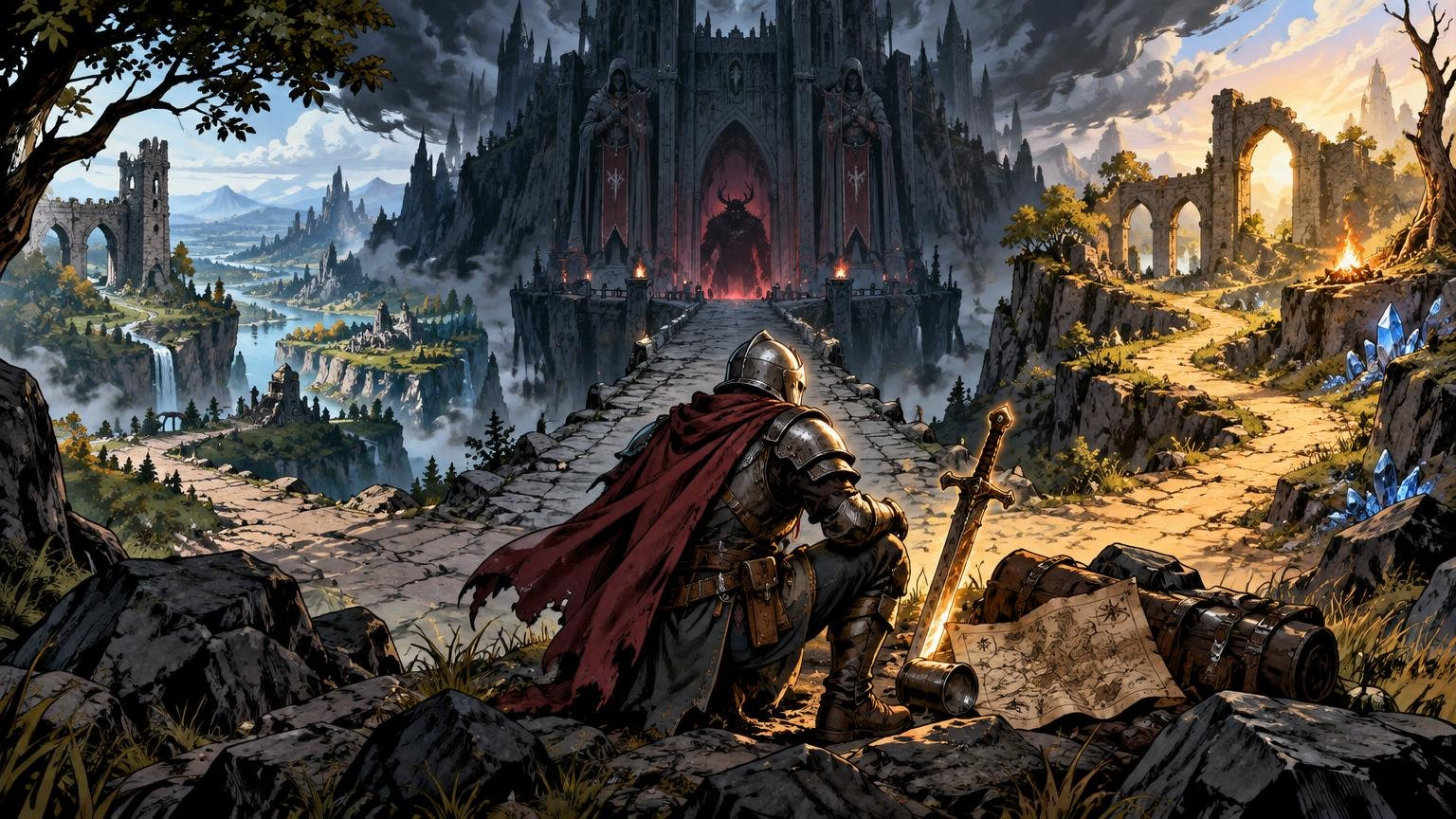
Elden Ring’s best answer to feeling stuck is usually not “try the identical plan another 20 times.” Leave, explore somewhere else, improve a weapon you enjoy using, add some survivability, and return with a clearer idea of what the encounter expects. The open world is not decorative scenery between bosses; it is one of the game’s main difficulty settings.
This spoiler-light beginner guide covers the base game and does not assume access to optional Tarnished Pack or Tarnished Edition additions. The mechanics discussed remain applicable under the official 1.17.2 update context, which introduced fixes rather than additional game content.
TLDR: Your unstuck checklist
- Leave the difficult encounter and explore in another direction.
- Find map fragments and mark caves, merchants, tough enemies, and places worth revisiting.
- Upgrade one or two weapons rather than spreading materials across everything you find.
- Check that you meet your weapon’s Strength and Dexterity requirements.
- Invest in Vigor if ordinary mistakes are deleting most of your health bar.
- Stay below 70% equipment load to avoid the heavy roll.
- Use Spirit Ashes, shields, weapon skills, ranged attacks, mounted combat, or co-op when appropriate.
- Spend a few attempts studying one attack or opening instead of trying to win immediately.
- Recover dropped runes only when doing so is worth the risk. Sometimes letting them go is cheaper than losing another half-hour.
Explore somewhere else before forcing progress
A difficult enemy is not automatically a mandatory gate. Bandai Namco’s own official early-game guidance uses a powerful mounted opponent as an example of something players can avoid, then revisit after adventuring and becoming stronger. If a fight feels wildly beyond your current damage and durability, believe the evidence. The game is inviting you to wander, not questioning your honor.
Look for map fragments to reveal terrain detail, then use custom markers aggressively. Mark caves you have not cleared, merchants you may want to revisit, inaccessible items, and enemies that deserve a future rematch. This turns random wandering into a useful circuit of smaller objectives.
Sites of Grace restore health, Focus Points, status conditions, and Sacred Flask uses, although resting generally revives defeated enemies. Discovered Sites of Grace also become fast-travel points outside restricted situations. Activating them as you explore gives you a network of safe staging areas rather than one increasingly miserable commute.
Upgrade your weapon before chasing perfect stats
Early character levels matter, but weapon enhancement is often the more direct way to improve damage. A smithing table at the Church of Elleh provides early enhancement access, while Smithing Master Hewg handles further upgrades later. Smithing stones can be found in mines and caves, including locations in Limgrave. The darker mine-like marks visible on the map are therefore worth investigating.
Choose a weapon whose moveset feels manageable and upgrade it rather than waiting indefinitely for a mythical perfect drop. Before spending materials, confirm that you meet its attribute requirements. Strength and Dexterity commonly determine whether an armament can be used effectively; missing those requirements substantially reduces its damage. For a fuller explanation of materials and upgrade paths, see GameSpot’s weapon-upgrade guide.
Do not confuse scaling with base damage. Scaling adds damage according to relevant attributes, improves as a weapon is upgraded, and can be changed on many weapons through Ashes of War. Early on, meeting requirements and improving the weapon can be more useful than pouring every level into its preferred damage stat.
Build enough survivability to learn
Vigor raises maximum health, making it an especially useful early investment because it increases how many hits you can survive. More health does not replace learning, but it gives you time to learn. A failed dodge becomes information rather than an immediate loading screen.
Also check the equipment-load indicator. Endurance affects stamina and maximum equipment load. At 30% to 69.9% load you retain a medium roll, but 70% begins the heavy-load range; at 100% or more, dodging and jumping are disabled. Remove or swap equipment until you reach medium load or lighter unless you have a deliberate reason to accept slower evasion.
Improve your Sacred Flasks as opportunities arise. Their number of charges and healing amount can both be increased, while the balance between health and Focus Point flasks can be adjusted at Sites of Grace. A melee-focused character carrying more blue flasks than they can sensibly use is effectively bringing empty bottles to a sword fight.
Turn failed attempts into controlled practice
When you return to a difficult encounter, stop treating every attempt as a final exam. Spend one run watching the enemy’s opening sequence. On another, focus on dodging a troublesome attack. Test whether you can block it, jump it, interrupt it, or simply move out of range.
Combat offers more than light attacks and panic rolls. Lock-on, blocking, jumping, charged attacks, parries, guard counters, weapon skills, and critical hits all create different answers to pressure. Jump attacks and guard counters can be particularly useful for breaking an opponent’s stance, although parry effectiveness varies by enemy.
Watch for the delay between an enemy raising a weapon and actually swinging it. Dodge the attack, not the dramatic pose before it. Then make one or two safe attacks and reset. Greed is responsible for an impressive number of deaths that initially get blamed on difficulty.
Change tools instead of repeating a bad matchup
Elden Ring supports melee weapons, sorcery, incantations, shields, bows, stealth, mounted combat, Spirit Ashes, weapon skills, paired weapons, and co-op allies. You do not have to adopt all of them, but refusing every tool except the first one you tried can turn a flexible encounter into a self-imposed challenge run.
Spirit Ashes can be summoned in designated difficult areas when you have the Spirit Calling Bell and an appropriate ash. Only one spirit type can be active, and spirits are unavailable during multiplayer. Outdoors, Torrent can help with exploration and some encounters, although the mount is unavailable in certain areas and dungeons.
For co-op, using a Furlcalling Finger Remedy reveals eligible gold summon signs, and the map can show multiplayer activity. Asking for help is not bypassing the game. It is using a system the game deliberately provides.
Treat runes as a resource, not a hostage
When you die, carried runes remain at the death location. You can retrieve them, but dying again first removes them permanently. Stakes of Marika may offer a closer respawn point where available. Before entering a suspicious arena or pushing deeper into unknown territory, spend enough runes that a death will not dominate your next decision.
If a small pile is trapped behind an enemy that repeatedly defeats you, consider abandoning it. Losing runes stings, but repeatedly sprinting into a bad situation can cost more time than earning them again through ordinary exploration.
The best next move is usually a different move
When stuck, change one variable at a time: explore another path, upgrade your weapon, raise Vigor, reduce equipment load, improve your flasks, summon help, or practice a single defensive response. If you forget how a mechanic works, tutorial messages can be reread from the inventory’s Info menu.
Elden Ring becomes far more approachable once every obstacle stops looking like an immediate order. The world gives you room to retreat, experiment, and return better prepared. Use that freedom. Persistence matters, but adaptable persistence is what actually gets the door open.
References
- ELDEN RING – Patch Notes Version 1.17.2 | Bandai Namco Europe
- Elden Ring – Patch Notes Version 1.17 | Bandai Namco Europe
- Elden Ring early game tips | Bandai Namco Europe
- ELDEN RING Starter Guide : Tips to know before playing the game | Bandai Namco Europe
- ELDEN RING How-To Guide Part 1 – Stats | Bandai Namco Entertainment America Inc.
- www.gamespot.com
- ELDEN RING How-To Guide Part 2 – Advanced Stats | Bandai Namco Entertainment America Inc.
- What Is Elden Ring About? | Bandai Namco Europe
