
TL;DR: This Far Cry 6 review finds a colorful, accessible shooter with a gleefully destructive arsenal and a frustrating shortage of reasons to master it. Yara invites stealth, improvisation, vehicles, animal companions, and improvised superweapons, but weak strategic pressure makes most of that freedom cosmetic. The explosions are lively; the revolution rarely feels revolutionary.
Our verdict Far Cry 6 supplies a colorful setting and an entertaining arsenal, but its shallow challenge and crowded progression systems turn guerrilla freedom into repetitive open-world housekeeping. The explosions are lively; the revolution rarely feels revolutionary.
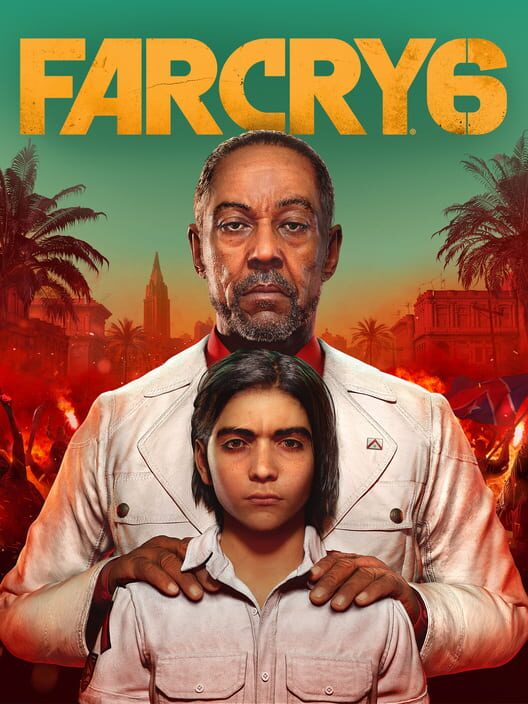
Far Cry 6 (2021)
Far Cry 6 is built around an appealing fantasy: become a guerrilla, study an occupying force, and use whatever scraps, weapons, allies, and bad ideas are available to dismantle it. The trouble is that Ubisoft gives the player an enormous toolbox without constructing enough problems that require particular tools. Choice is everywhere, but consequence is in short supply.
Released in 2021, the base game follows Dani Rojas through the fictional Caribbean nation of Yara, where a guerrilla movement is fighting dictator Antón Castillo, portrayed by Giancarlo Esposito. Ubisoft presents the campaign as a solo or two-player cooperative open-world experience, although this review concentrates on the base game’s broader design rather than co-op or platform-specific performance. It also avoids major story spoilers.
Yara gives familiar work a stronger sense of place
Yara is Far Cry 6 at its most persuasive. Its cities, jungles, coastlines, military installations, farms, and guerrilla camps give the campaign a colorful environmental identity. Traveling across the island can sell the scale of a country under occupation even when the objectives waiting at the destination are instantly recognizable as another checkpoint, cache, base, or resource run.
That contrast matters. The series has long relied on turning attractive wilderness into a playground of hostile outposts and combustible opportunities. Far Cry 6 does not escape that formula, but Yara gives it texture. The landscape creates the anticipation that something surprising might be over the next hill, even when the underlying structure is already preparing another icon for the map.
Ubisoft Toronto led development, with the studio stating that 11 Ubisoft teams contributed to the project. The scale is visible, sometimes impressively so, but it also explains the game’s central excess. Far Cry 6 feels packed rather than focused. There are many landscapes, activities, resources, weapons, perks, and progression hooks, yet the campaign rarely turns that abundance into a coherent rhythm.
For me, the atmosphere is more effective than the occupation simulation. Yara looks like a place worth liberating, but its repeated activities gradually reduce it to territory worth clearing. The distinction is crucial: exploration begins with curiosity and ends as administration.
The arsenal is entertaining before it becomes unnecessary
Far Cry 6 understands the immediate pleasure of causing trouble. Players can approach military targets with conventional firearms, stealth, vehicles, Amigos, Resolver weapons assembled from unlikely materials, and Supremo backpacks capable of spectacular destruction. Ubisoft explicitly positioned stealth and direct combat as parallel approaches rather than forcing one prescribed style.
At its best, this produces wonderfully undignified action. A careful infiltration can collapse into gunfire, fire, alarms, and a vehicle arriving at precisely the wrong moment. Resolver weapons and Supremos amplify that action-movie tone. They are not interesting because they resemble plausible guerrilla equipment; they are interesting because Far Cry knows that improvised mayhem is often funnier and more memorable than military authenticity.
The problem is not a lack of options. It is the lack of resistance needed to distinguish those options. A satisfying sandbox makes the player read a situation: perhaps armored enemies require one answer, an alarm network makes another route valuable, or limited resources force an uncomfortable compromise. Far Cry 6 gestures toward those decisions through ammunition, gear, modifications, companions, and special equipment, but encounters too rarely demand that the player engage deeply with all of them.
Once a dependable approach emerges, much of the arsenal begins to feel like entertainment selected for novelty rather than a response to tactical pressure. That can still be enjoyable. There is nothing wrong with choosing a ridiculous weapon because it makes the next explosion more theatrical. But the game presents its loadout systems with the visual and mechanical ceremony of meaningful buildcraft, then provides too few situations in which optimization carries real weight.
A contemporary GameSpot review of Far Cry 6 similarly observed that its encounters did not consistently require planning or optimization. I think the consequence runs deeper than an overly easy firefight: it undermines the game’s central promise of freedom. Freedom in a sandbox becomes meaningful when different choices produce different risks. When nearly every route works with limited friction, selecting a tactic can feel less like improvisation and more like choosing the color of the fireworks.
Progression turns guerrilla warfare into inventory management
The shallow challenge would matter less if Far Cry 6 treated its arsenal as a loose toy box. Instead, the game surrounds the shooting with layers of equipment, upgrades, resources, and activity rewards. The result is a peculiar mismatch: the menus keep suggesting that preparation is important while the encounters keep demonstrating that it usually is not.
This is where abundance becomes friction. A new weapon or piece of gear should open a possibility, sharpen a preferred style, or solve a problem the player has learned to fear. Too often it is simply another object to inspect before returning to a strategy that was already working. Progression continues numerically and materially, but the player’s tactical vocabulary does not need to evolve at the same rate.
The campaign’s pacing suffers accordingly. Its strongest moments are immediate: locate a target, improvise an approach, recover when the plan inevitably catches fire, and enjoy the destructive aftermath. Resource collection and incremental loadout management interrupt that loop without adding equivalent depth. A revolution becomes a checklist, complete with the nagging sense that liberation apparently requires a surprising amount of wardrobe maintenance.
This also exposes the difference between having systems and being systems-driven. In a strong systemic game, mechanics collide and force the player to reconsider priorities. Our Factorio review examines a very different kind of sandbox in which pressure gives planning its meaning. Far Cry 6 has plenty of mechanics, but they often sit beside one another rather than forming a demanding network. Its tools expand horizontally while its problems remain comparatively flat.
Ubisoft later added New Game+ and regional completion tracking in Title Update 6, released on November 29, 2022. Those additions can make completion and repeat play more convenient, but they do not alter the underlying critical issue. More opportunities to carry an arsenal through Yara cannot create strategic depth if the campaign rarely requires the player to explore that arsenal in the first place.
The spectacle weakens the revolution
Far Cry 6 wants the language of revolution and the pleasure of a blockbuster shooter at the same time. That tension is not automatically a flaw. Games can use exaggeration, satire, and mechanical excess to examine serious subjects. Here, however, the spectacle often overwhelms the politics rather than complicating them.
Dani’s role in the guerrilla movement gives the campaign a clear personal route through the conflict, while Castillo provides the recognizable face of authoritarian power. Yet the open-world structure repeatedly pulls attention away from urgency. A story about resisting a dictatorship has to coexist with scavenging, optional diversions, collectible rewards, and the leisurely clearing of map icons. The narrative says the country is in crisis; the progression loop says there is always time to check one more container.
Giancarlo Esposito’s presence gives Castillo immediate authority, but no performance can completely reconcile that tonal split. The issue is structural rather than theatrical. The villain belongs to a focused political thriller, while much of the player’s time belongs to a sprawling amusement park where the occupation supplies targets and permission for chaos.
I like Far Cry 6 most when it stops insisting that every system is essential and embraces uncomplicated action. Its unusual weapons, volatile encounters, and scenic travel can produce an entertaining rhythm. The game is less convincing when it asks those pleasures to support a grander idea about resistance. There is little sense that the player must become a more perceptive guerrilla because the world so readily accommodates brute efficiency.
Who will enjoy Far Cry 6?
Far Cry 6 is easiest to recommend to newcomers who want an accessible open-world shooter and to returning fans who mainly want another large landscape filled with bases, vehicles, suppressed firearms, and avoidable explosions. The low strategic pressure can be a feature for players who prefer experimentation without harsh punishment. It is easy to swap approaches, recover from a failed stealth attempt, and keep the spectacle moving.
It is a much weaker fit for players seeking demanding stealth, consequential character builds, tightly controlled pacing, or a genuine reinvention of Ubisoft’s established structure. Its systems imply complexity without consistently delivering the decisions that make complexity worthwhile. Completionists may find plenty to clear, but quantity should not be mistaken for momentum.
- Play it if you want a forgiving, colorful shooter with vehicles, companions, improvised weapons, and frequent spectacle.
- Approach it cautiously if repetitive map clearing and layered inventories quickly drain your interest.
- Look elsewhere if you want stealth that demands reconnaissance, builds that substantially change combat, or an open world that resists familiar solutions.
Far Cry 6 review verdict: freedom needs friction
Far Cry 6 is not short of fun things. Yara is inviting, the arsenal has personality, and the combat can generate energetic bursts of chaos. What it lacks is the resistance that would make its many options feel necessary. The game hands the player stealth tools, companions, vehicles, ammunition choices, gear, Resolver weapons, and Supremos, then too often asks only that something—almost anything—be used to finish the next objective.
That is the central irony. Far Cry 6 looks like a celebration of improvisational freedom, but meaningful improvisation depends on pressure. Without enough danger, scarcity, or tactical distinction, freedom collapses into convenience. The toolbox remains enormous; the reasons to reach beyond its most dependable corner remain scarce.
There is still an audience for its generous chaos. If the prospect of roaming a vivid island and turning military targets into noisy action scenes is enough, Far Cry 6 delivers that fantasy with confidence. For anyone hoping its revolution would also transform the Far Cry formula, however, this is familiar open-world housekeeping wearing brighter colors and carrying a homemade rocket launcher.
