
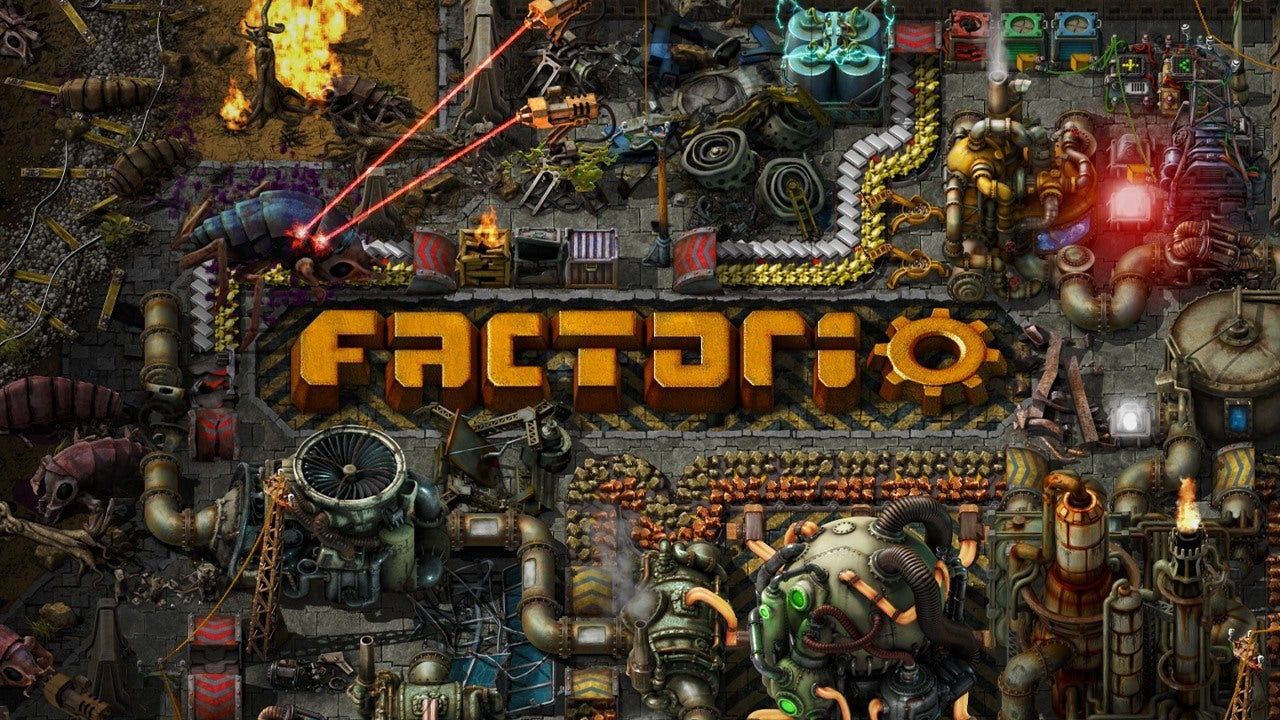
TLDR: This Factorio review finds an exceptional automation sandbox in which every improvement creates a fresh problem worth solving. Its belts, power networks, research, pollution, transport, and defenses form a machine that reflects the player’s priorities. Factorio can be mentally exhausting, visually difficult to parse, and emotionally remote, but those costs buy an unusual degree of creative freedom. If optimization is your idea of play rather than office work with more conveyor belts, the base game is an emphatic recommendation.
Factorio (2020)
- Developer
- Wube Software
- Genres
- Simulation · Strategy · Indie
- Platforms
- PC · Mac · Linux · Switch · Switch 2
- Release date
- Aug 14, 2020
Our verdict
Factorio is an exceptional automation sandbox whose interlocking production, logistics, pollution, and defense systems turn every bottleneck into a compelling problem of your own making. Its steep mental demands are the price of unusually expressive design.
Factorio begins with a simple escape premise: you are stranded on an alien planet and must build the industrial capacity needed to leave. Developed and published by Wube Software, the game reached version 1.0 on August 14, 2020 after years of development and early access. That premise points the player toward progress, but it is not the reason Factorio matters. The real story is the factory spreading across the map—and the increasingly revealing mess you make while trying to improve it.
Factorio review: every bottleneck becomes a self-portrait
The factory is simultaneously Factorio’s central puzzle and your answer to it. Raw materials travel along belts, mechanical inserters move them between machines, assemblers manufacture components, and power keeps the whole arrangement alive. Pipes, trains, drones, research, and defensive infrastructure eventually extend that logic across much larger distances. Gathering resources, researching technologies, automating production, and constructing infrastructure form the official core of the game. Wube’s Factorio overview The magic lies in how completely those activities depend on one another.
An iron shortage is rarely just an iron shortage. Perhaps the miners need more power. Perhaps the power plant needs more fuel. Perhaps the belts leaving the mine are saturated, the smelting array is too small, or one inserter is facing the wrong direction with the serene confidence of a worker who knows it cannot be fired. Fixing the obvious blockage can expose a less obvious one several stages downstream. Production increases, stored resources disappear into new construction, and yesterday’s generous power reserve becomes today’s rolling blackout.
That chain reaction could have felt like administrative punishment. Instead, it gives Factorio an extraordinarily strong rhythm: observe, diagnose, redesign, expand, and then discover what the expansion has broken. The game does not merely reward finding an efficient answer. It gives players enough interconnected tools to develop a personal way of thinking about efficiency.
For me, that is Factorio’s defining triumph. Efficiency becomes a creative language rather than a prescribed solution. A compact factory says something different from a sprawling one built with generous room for future lines. One player may tolerate improvised belts weaving around old infrastructure; another will demolish half a production district because two rows are not quite symmetrical. Both factories can work. Both reveal their creators.
Growth turns success into a fresh logistical problem
Factorio’s progression keeps changing the scale at which the player must think. Early automation removes the drudgery of gathering and crafting basic materials by hand, but relief never lasts for long. New research unlocks more elaborate production chains, fluids, oil processing, long-distance transportation, drones, and increasingly capable defenses. Each technology solves an immediate limitation while increasing the number of systems competing for space, energy, and materials.
This is a superb mastery loop because learning does not make the game run out of ideas. Learning gives you the confidence to attempt larger, stranger, and more ambitious projects. A belt arrangement that once looked intimidating becomes a reusable building block. Soon the interesting question is no longer whether you can manufacture an item, but whether you can manufacture enough of it, deliver it consistently, and keep doing so while the rest of the factory expands.
Factorio also understands that convenience is most satisfying when it has been earned. Automation does not arrive as an abstract upgrade that makes numbers rise in the background. You design the line, route its materials, provide its energy, and watch physical objects move through the system. When it works, the pleasure comes partly from increased output and partly from seeing an idea become a functioning place.
That physical clarity is why the factory can feel expressive despite Factorio’s understated top-down presentation. It is not a decorative base surrounding a menu-driven economy. Its shape matters. Distance matters. Access matters. A badly chosen route can linger as an industrial scar, repeatedly forcing later systems to bend around an old decision.
Pollution makes industrial ambition consequential
Pollution is the connective tissue that prevents expansion from becoming a purely inward-looking numbers exercise. Industrial growth spreads contamination across the surrounding territory, and that pollution contributes to aggression from the planet’s hostile creatures. Production and danger therefore belong to the same system: expanding the factory helps create the pressure that threatens it.
I like this relationship far more than Factorio’s direct shooting. Manual combat is functional, but it lacks the expressive depth of constructing the factory. The more satisfying challenge is preparing for violence before it reaches the walls: manufacturing ammunition, transporting it to defensive positions, supplying repairs, expanding radar coverage, and making sure the power network can withstand an attack.
Defense becomes another production chain, complete with bottlenecks and uncomfortable tradeoffs. Ammunition allocated to a vulnerable frontier is material not being spent elsewhere. Additional turrets increase security but require resources and distribution. An ambitious expansion can improve extraction while creating a longer perimeter that is harder to protect. Combat is at its best when Factorio translates it back into logistics.
Pollution also gives the landscape a moral texture without pretending to deliver a grand environmental parable. The player is trying to escape, but the solution is ruthless industrial growth. Forests, open ground, and hostile territory become variables in a production plan. Factorio does not spend much time telling you how to feel about that transformation. It simply lets the consequences gather at the edge of the factory and start chewing through the walls.
The plain presentation can hide expensive mistakes
Factorio’s density is also its most serious barrier. As production chains multiply, reading the factory becomes demanding work. A tiny misplaced component can interrupt an otherwise sensible design, and the muted palette does not always help the important detail announce itself. From the top-down view, the difference between a profound logistical failure and one machine facing the wrong way can be a few easily overlooked pixels.
That is more than a cosmetic complaint. Factorio asks players to reason about flow, ratios, power, space, supply, and future expansion at the same time. When the visual feedback does not immediately reveal what has failed, diagnosis can tip from satisfying investigation into squinting at machinery. A missing item, reversed inserter, or insufficient input may sabotage a line whose broader design is perfectly sound.
The mental burden grows alongside the factory. Players who enjoy keeping several connected problems in their heads will find the escalation thrilling. Those hoping to dabble for a relaxed half-hour may discover that reopening a complicated save feels like returning to a desk covered in someone else’s notes—even when the someone else was you last Tuesday.
This difficulty is not evidence that Factorio is badly designed. Much of the pleasure depends on the systems being consequential enough to require attention. But admiration should not be confused with universal accessibility. The game rewards patience, curiosity, and a willingness to rebuild. It can be unfriendly to players who need frequent narrative direction, immediate action, or a clearly marked correct solution.
The factory supplies the story Factorio chooses not to write
Players seeking a character-driven campaign should approach cautiously. Factorio’s escape objective supplies motivation, but not much emotional drama. There is no rich cast waiting to turn the factory into a traditional adventure, and the industrial progression does far more narrative work than the stranded-engineer premise.
For systems-minded players, that absence is liberating. The memorable events emerge from the factory: the first dependable automated line, the blackout caused by overconfident expansion, the remote mining operation finally connected by rail, or the defensive position that fails because ammunition production could not keep pace. These are not scripted twists, but they acquire meaning because they expose your earlier priorities.
For everyone else, Factorio may remain emotionally remote. The machines are compelling because of what they do and how they interact, not because the game gives them personality. Its atmosphere comes from industrial momentum—the flicker of movement across belts, the hum of infrastructure, and the uneasy knowledge that the entire system is consuming something somewhere. That atmosphere is powerful, but deliberately impersonal.
Co-op rewards groups that can share ownership
Beyond freeplay, Wube lists scenarios, cooperative multiplayer, a map editor, generated maps, and Lua modding among Factorio’s features. Those options give an already flexible sandbox substantial potential longevity, although the base automation loop does not need added content to justify itself.
Co-op is especially appealing in principle for a group that likes collaborative planning. Factorio presents enough simultaneous problems for players to divide responsibility between energy, resource extraction, defenses, transportation, and manufacturing. The factory offers a shared project rather than a sequence of disconnected multiplayer chores.
The social risk is equally obvious: one experienced engineer can quietly become everyone’s unpaid supervisor. If every belt placement receives a correction and every beginner’s imperfect design is replaced rather than understood, cooperation turns into watching somebody else optimize. A better group treats inefficiency as part of learning, assigns areas of responsibility, and agrees before demolishing another player’s lovingly chaotic spaghetti. The most efficient factory is not necessarily the one that produces the best evening.
Space Age is optional, not a missing final chapter
Factorio: Space Age is a separately sold expansion released on October 21, 2024 alongside the free 2.0 update. Wube’s Space Age release announcement It should not be confused with the base game or treated as content required to complete it.
That distinction matters because the original Factorio already stands as a complete, richly interconnected work. Its production, logistics, research, pollution, transportation, and defense systems create more than enough room for experimentation. Space Age may be an attractive later step for a player who has learned what kind of engineer they enjoy being, but newcomers do not need to buy additional complexity before discovering whether the foundational loop suits them.
Verdict: buy the base game if problems are your playground
Factorio is an emphatic recommendation for players who enjoy optimization, open-ended problem-solving, and learning systems that keep revealing new relationships. Its finest achievement is not simply that it contains a daunting number of moving parts. It makes those parts feel personal. Every power shortage, tangled belt, polluted frontier, and hungry ammunition line exists because of choices you made—and can be improved through choices you make next.
The reservations are real. Direct combat is thin beside defensive logistics, the plain presentation can conceal small but costly mistakes, and the escalating cognitive load will exhaust players who want immediate relaxation. Its authored story is little more than scaffolding around the machine. Factorio asks for attention and does not pretend otherwise.
Yet few games make thought itself feel this creative. The factory is never merely a puzzle someone else designed for you to solve. It is your puzzle, your answer, and often your next problem. Buy the base game confidently if that sentence sounds inviting. Consider Space Age later, once the original factory has taught you just how much trouble you enjoy making for yourself.
