
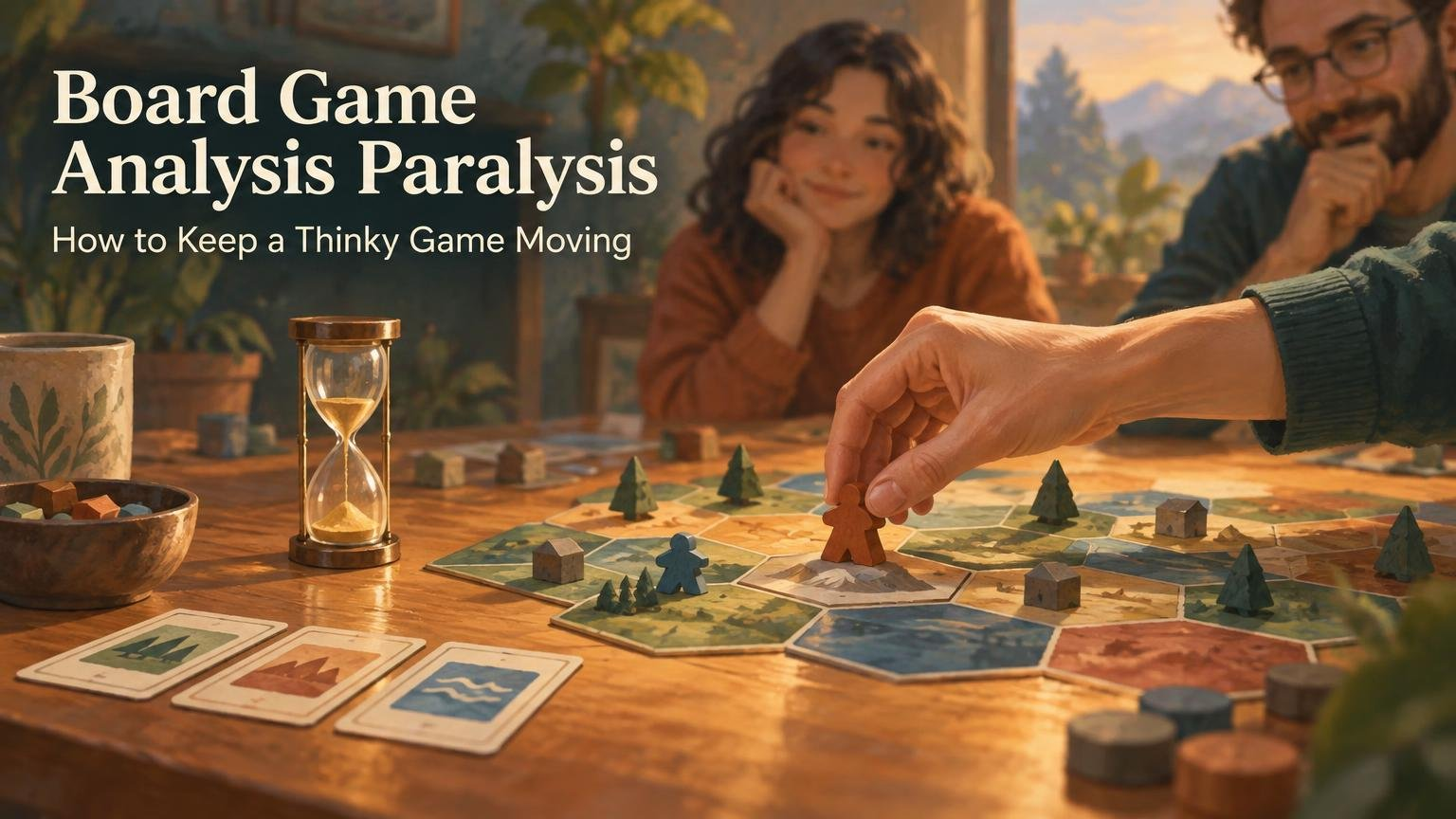
TLDR: Board game analysis paralysis becomes a problem when repeated deliberation pushes the session beyond the pace the group expected. Do not treat the slowest player as defective. Reduce the decision burden through clearer teaching, agree on table expectations before play, and use timers only when everyone understands and accepts them. The goal is not instant turns; it is keeping every player meaningfully involved.
A thoughtful move can be one of the pleasures of a strategy game. The trouble starts when one person studies every possible branch while everyone else checks their phone, reorganizes the snack table, and quietly ages. Board game analysis paralysis is best understood as a mismatch between the time a decision takes and the pace the group wants—not as a diagnosis or character flaw.
There is no universal number of seconds that separates careful play from slow play. A three-minute turn may feel perfectly reasonable near the end of a close game and painfully long during an introductory round. What matters is frequency, context, and effect: Are long turns recurring? Are other players disengaging? Is the game likely to miss the agreed finish time? If so, the table has a pacing problem it can solve together.
What causes board game analysis paralysis?
Analysis paralysis, often shortened to AP, usually appears when the decision feels larger or more consequential than the player can comfortably process. That can happen to a beginner learning a light game, an experienced player confronting a dense strategy game, or an entire table facing an unfamiliar system.
Common contributors include:
- A large decision space with many legal actions and no obvious way to compare them.
- An unclear objective, especially when the player understands the rules but not what a productive turn looks like.
- Unfamiliar iconography, card effects, or exceptions that repeatedly send the player back to the reference sheet.
- A changing board state that makes planning during other players’ turns difficult.
- Moves that appear irreversible or unusually costly, making every option feel like a potential disaster.
- Unsolicited advice from several people, which turns one decision into a committee meeting.
- Different expectations about whether the session is exploratory, social, or competitively optimized.
Research into strategic decisions provides useful background but not a stopwatch for game night. A study covering more than 1,000 participants and 121 unfamiliar two-player strategy games examined how people use relatively shallow simulations to reason through new games. Its setting is narrower than a casual multiplayer evening, but it reinforces a practical point: players learning a system cannot realistically calculate every possible future. Read the published research on reasoning in new games.
Likewise, an analysis of more than 215,000 moves from professional over-the-board chess reported a negative relationship between decision time and move quality after the researchers’ controls. That does not prove that faster turns are always better in hobby games. It does challenge the assumption that another minute of thought necessarily produces a stronger decision.
Prevent slow turns before the first move
The best AP fix often happens during the teach. A complete rules explanation is not automatically a useful one. If players remember twelve exceptions but cannot identify the objective or basic turn loop, their first decision will still feel like opening a restaurant from scratch.
Teach in this order: the objective, how the game ends, what happens on a normal turn, and what an initially useful decision looks like. Add exceptions when they become relevant. For a fuller teaching sequence, see how to teach a board game without dumping the entire rulebook on new players.
Demonstrate one plausible opening decision without presenting it as the only correct move. For example: “You could collect those resources because they contribute to this public objective.” That gives the learner a way to evaluate options while preserving ownership of the choice.
The host should also name the session’s constraints. “We have about two hours, and this is a learning game” communicates something very different from “We are playing competitively and have the whole afternoon.” Neither is the right way to play every time. The useful expectation is the one everyone understands.
A pre-game agreement that takes one minute
You do not need a treaty, ceremonial pens, or tense negotiations. A short conversation can settle the issues most likely to interrupt play.
| Question | Useful agreement |
|---|---|
| When do we need to finish? | Choose a realistic stopping time and leave room for setup, teaching, and scoring. |
| What kind of session is this? | Decide whether this is a learning game, relaxed social play, or a more competitive match. |
| When is advice welcome? | Ask before offering help, and let the active player make the final decision. |
| Are take-backs allowed? | Set a simple boundary, such as allowing them until new information is revealed. |
| How will rules questions work? | Choose one person to check the reference while play continues when possible. |
| Are we using a timer? | Agree on the limit, when it starts, and what happens when it expires. |
This agreement makes later reminders less personal. “We said we wanted to finish by ten” is easier to hear than “You always take forever.” One refers to a shared plan; the other puts a player on trial.
How to make a good-enough decision
Players can reduce their own turn time without treating every move as disposable. The key is to replace exhaustive calculation with a repeatable decision process.
- Restate the immediate objective. Ask what advances your position this round rather than trying to solve the entire game.
- Identify two or three plausible moves. Do not keep every legal action in active consideration.
- Compare the options using the information that actually changes the choice: points, resources, position, risk, or progress toward an objective.
- Check for one obvious consequence, especially if the move reveals information or blocks another player.
- Choose a solid move when further calculation is unlikely to change the ranking of your options.
This is not an instruction to play badly. It is a way to spend attention where it has value. A player choosing between two close options may gain little from repeatedly recounting the same possibilities. Meanwhile, the social cost of the delay continues to rise.
Planning during other turns helps, but only when the board state is stable enough. If every action changes your available options, prepare priorities instead of a fixed move: “I want income first, then mobility, then points.” When your turn arrives, you can select the legal action that best matches that order.
How the group should address slow play
Use neutral, group-level language before singling anyone out. Try: “Can we all make the best move we see and keep this round moving?” That request applies to the table, including the person making it.
If the pattern continues, talk privately and describe the practical effect rather than guessing at the cause. “Our last two sessions ran much later than planned, and several people checked out during the long turns” gives the player something concrete to discuss. Avoid labels about intelligence, anxiety, perfectionism, or personality. You rarely need a theory about someone’s inner life to negotiate a workable pace.
The group also needs to examine its own behavior. A player may take longer because three spectators keep suggesting contradictory moves. Unsolicited coaching expands the decision rather than simplifying it, and it can make the active player feel responsible for evaluating everybody’s plan.
In cooperative games, this can become quarterbacking: one confident player effectively directs everyone else’s turns. Ask whether help is wanted, offer a limited summary of options, and return the choice to the active player. “You can defend this area or pursue the objective; which sounds better?” is usually more useful than delivering a five-minute sequence of mandatory instructions.
When should you use a turn timer?
A sand timer, phone timer, or chess clock can help a willing group externalize its pace. It can also make a relaxed evening feel like an oral examination. Use timing as an agreed format, not as a surprise punishment for one player.
Before starting, settle four details:
- Whether the clock covers thinking only or also physical actions and rules checks.
- Whether every player receives the same time or learners receive more.
- Whether unused time carries over between turns.
- What happens at expiry: an automatic default action, a small penalty, or simply a prompt to decide.
Apply the rule consistently unless the group explicitly agrees to an accommodation. Run a short trial round first when possible. If the timer makes players rush component handling, miss rules, or enjoy the game less, it has failed at its actual job.
Chess clocks demonstrate that timing can be integrated into a formal rules environment, but casual board games are not automatically improved by importing tournament chess procedures. FIDE publishes detailed technical requirements for electronic clocks and preset time controls because its events rely on standardized enforcement. FIDE’s official chess-equipment rules are a useful example of how much structure formal timing requires, not a default etiquette code for every table.
If a game has official timing rules, follow those rules. Otherwise, the group’s agreement should take priority over an improvised penalty. A timer with no agreed consequence merely replaces one awkward conversation with a beeping noise.
Choose the game for the evening you actually have
Some game structures are easier for pace-sensitive groups, but that does not make particular titles universally safe or AP-heavy. The same game may move briskly with an experienced group and crawl during a first play.
When time is limited, look for structures that reduce inactive waiting:
- Simultaneous choices, so several players decide at once.
- A bounded action menu rather than dozens of individually distinct options.
- Short rounds that provide regular stopping points.
- Clear objectives and visible progress.
- Useful downtime in which players can plan without the board changing completely.
- A player count that does not multiply downtime beyond the group’s tolerance.
Do not rely only on the playtime printed on a box. Teaching, setup, player count, familiarity, and the group’s conversational pace can all change the evening. If you have a strict weeknight window, choose a game comfortably shorter than the available time rather than one that fits only if every decision is flawless.
Sometimes the answer is not another pacing rule. If attention is fading, take a short break or switch to something lighter. A dense economic game at the end of a long day may be an excellent game in the wrong time slot. Table fit includes mental energy, not just taste.
Keep strategy, lose the waiting
The practical response to analysis paralysis is not “play faster” shouted from across the table. Start by clarifying the objective, teaching a useful decision framework, and agreeing on the kind of session everyone wants. During play, narrow choices, limit unsolicited coaching, and refer back to the shared finish time.
For your next game night, make one change before opening the box: agree on the expected finish time and what kind of help players want. That small conversation prevents more downtime than a timer introduced after patience has already run out.
References
- People use fast and flat simulation to reason about new games.
- Speed and quality of complex strategic decisions | PNAS
- C. GENERAL RULES AND TECHNICAL RECOMMENDATIONS FOR TOURNAMENTS / C.02. Chess Equipment Technical Specifications, Rules, and Regulations / 03. Chess Equipment with Electronic Components (effective from 1 March 2026) / FIDE Handbook
