
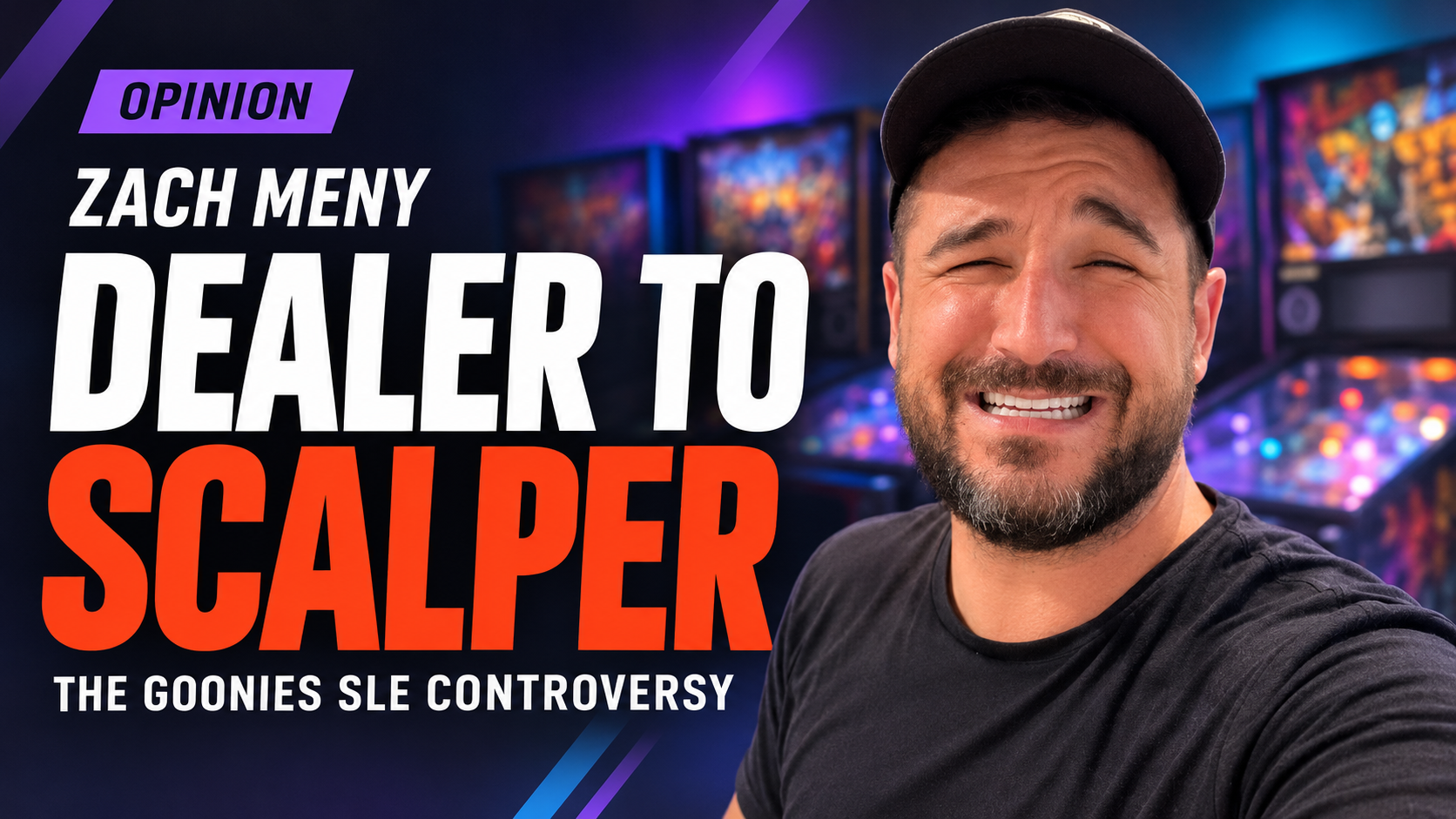
Opinion
TL;DR: Zach Meny’s Goonies SLE sale has given collectors good reason to question Flip N Out’s priorities. A near-$50,000 opening offer, followed by a reported $44,999 offer, puts a huge premium on scarce dealer access. In our view, the scalper label fits the conduct, and the community-minded sales pitch makes it worse.
Zach Meny has given pinball collectors a very good reason to find another dealer. Flip N Out’s November 18 opening Goonies SLE offer was $49,999 before shipping and tax, as documented in the email reproduced by This Week in Pinball. That is an astonishing amount to ask for a machine being offered to selected buyers through Spooky’s drawing for $14,999. twip.kineticist.com
Then came the explanation about fairness and supporting the hobby. Apparently, collectors were supposed to admire the process while the dealer tested whether somebody would swallow a thirty-five-thousand-dollar premium.
On Pinside, one poster put the objection plainly: “a dealer is not there to become a scalper.” Other posters defended Flip N Out and described positive dealings with the business. Those good experiences do not oblige anyone to applaud this particular sale. Meny has chosen a role collectors have every reason to resent: the person charging a fortune because he controls a scarce allocation. Pinside Forum
He Chose to Start at the Top
Meny’s own announcement described an estimated range of $20,000 to $50,000. It acknowledged the difficulty of assessing a price without established comparable sales. Flip N Out would begin near the top and lower its ask every 24 hours if allocations remained available. Pinside Forum
He set an ambitious opening number and invited buyers to prove he could get it. The arrangement gave him a chance to collect the highest premium before accepting anything less.
The factory drawing provides an uncomfortable comparison. Thirty of the 85 SLEs are allocated to eligible CE buyers through that process at $14,999. Those buyers need to qualify and be selected; it is a restricted opportunity. But the same factory edition sits behind both offers.
That makes the premium unusually easy to see. The dealer’s access is doing an enormous amount of work in the price. Collectors are being asked to pay heavily for the privilege of getting past the shortage.
As far as I am concerned, that is scalping with an authorized dealer’s logo attached.
The Reported Drop to $44,999 Deserves No Applause
Later Pinside posts reported another Flip N Out email offering the SLE for $44,999. That still leaves a $30,000 gap above Spooky’s drawing price. Pinside Forum
A seller coming down from fifty grand has not performed an act of generosity. He has reduced his demand. Collectors should keep that distinction in mind before the size of the opening number makes everything below it feel like a bargain.
The daily reductions also put buyers in an unpleasant position. Wait and the price may improve. Wait too long and someone with a much larger budget may take the allocation. You get to spend the day wondering whether patience will save money or leave you regretting the decision.
A whale can end that suspense by paying. Everybody else gets to watch the seller work down toward the next person’s limit.
It is a cynical way to sell a dream theme. The excitement gets mixed with anxiety, the inbox becomes something to monitor, and the dealer benefits from the possibility that a buyer will pay more just to stop worrying. Meny can explain the procedure clearly and still deserve criticism for choosing it.
Dealer Access Has Become the Product
A specialist dealer should have useful things to offer: knowledge, communication, help with delivery, and support when an expensive machine needs attention. A good relationship can make a difficult purchase easier.
The Goonies SLE pitch puts the allocation itself at the center of the transaction. The seller has a scarce spot. The buyer wants it. The opening ask tests how much that imbalance can produce.
That is exactly the kind of conduct collectors complain about when a private flipper does it. An established business should expect the same scrutiny. Its name recognition gives customers more reasons to form expectations about how it will behave.
The phrase “market price” offers no moral shelter. A wealthy buyer agreeing to a number would establish that the seller found someone willing to pay. It would leave the greed, the priorities, and the effect on customer trust open to judgment.
And the customer is entitled to judge harshly. Trying to squeeze the largest possible premium from a scarce allocation is a lousy way to demonstrate affection for the people buying your products.
Your Bad Inventory Is Not the Customer’s Debt
One defense deserves particular attention. This Week in Pinball quoted another dealer, Jason Grindle of Classic Game Rooms, arguing that profitable opportunities can help balance losses on less successful machines. twip.kineticist.com
That argument asks customers to become very sentimental about somebody else’s balance sheet.
Retail involves risk. A dealer chooses inventory, commits money, sets prices, and hopes demand follows. Customers did not sign a promise to make those decisions profitable. Their excitement about a new title does not create a debt for the games a business struggled to sell.
If a dealer needs a bigger margin to make a sale worthwhile, he can state the price and accept the reaction. The performance becomes obnoxious when the hobby is asked to celebrate the seller’s attempt to extract as much as possible.
Collectors have their own bills, bad purchases, and financial disappointments. They still have to decide whether the machine in front of them is worth the asking price. Sympathy for the industry should never require switching off that judgment.
Spooky Gave Him the Opportunity. Zach Meny Chose the Approach.
Spooky belongs in this discussion. Meny said the manufacturer encouraged market pricing. Spooky Luke publicly defended allowing collectors with the means to make high offers through dealers and described the SLE as a celebration.
That explains why the opportunity exists. Meny remains responsible for how Flip N Out uses it.
A dealer could announce a fixed price and draw names among interested customers. It could accept a smaller premium. It could decide that a launch this anticipated was an opportunity to strengthen customer loyalty.
Those choices might leave money on the table. The willingness to leave some money there is precisely what gives a claim about supporting the hobby substance.
Meny chose the high opening ask and the descending-price process. He then described the arrangement as “fair, balanced, and cleanest” while invoking support for the community. That combination deserves every bit of the irritation it has attracted. Pinside Forum
The behavior looks greedy as hell. The self-congratulation makes it harder to stomach.
Remember This When the Next Game Drops
A dealer does not get to define loyalty entirely around the customer’s willingness to keep buying. The business has to give people reasons to return when another seller can supply the next machine.
This sale gives collectors something specific to remember. Faced with a scarce, highly desirable allocation, Flip N Out chose to test how close to fifty thousand dollars someone would go. Buyers can weigh that choice alongside whatever other experiences they have had with the company.
I would shop elsewhere. A dealer who puts this kind of squeeze on a launch has told me enough about what happens when the opportunity for a large premium appears.
That is how Meny earns the scalper comparison. The label follows a public sales strategy that turns privileged access and collector anxiety into an opportunity for a huge payout.
He can pursue the whale. He can find the buyer. He can explain every step in advance. Collectors can still decide that his approach is exactly what they hate about scalping, and take their next order to someone else.
References
- This Week in Pinball: “Whale Hunt,” including Flip N Out’s opening email and the dealer-margin defense
- Zach Meny’s explanation of Flip N Out’s sales process
- Pinside reports of the subsequent $44,999 offer
- Pinside criticism and defenses of the sale
- Spooky Luke’s explanation of the SLE allocation approach
