
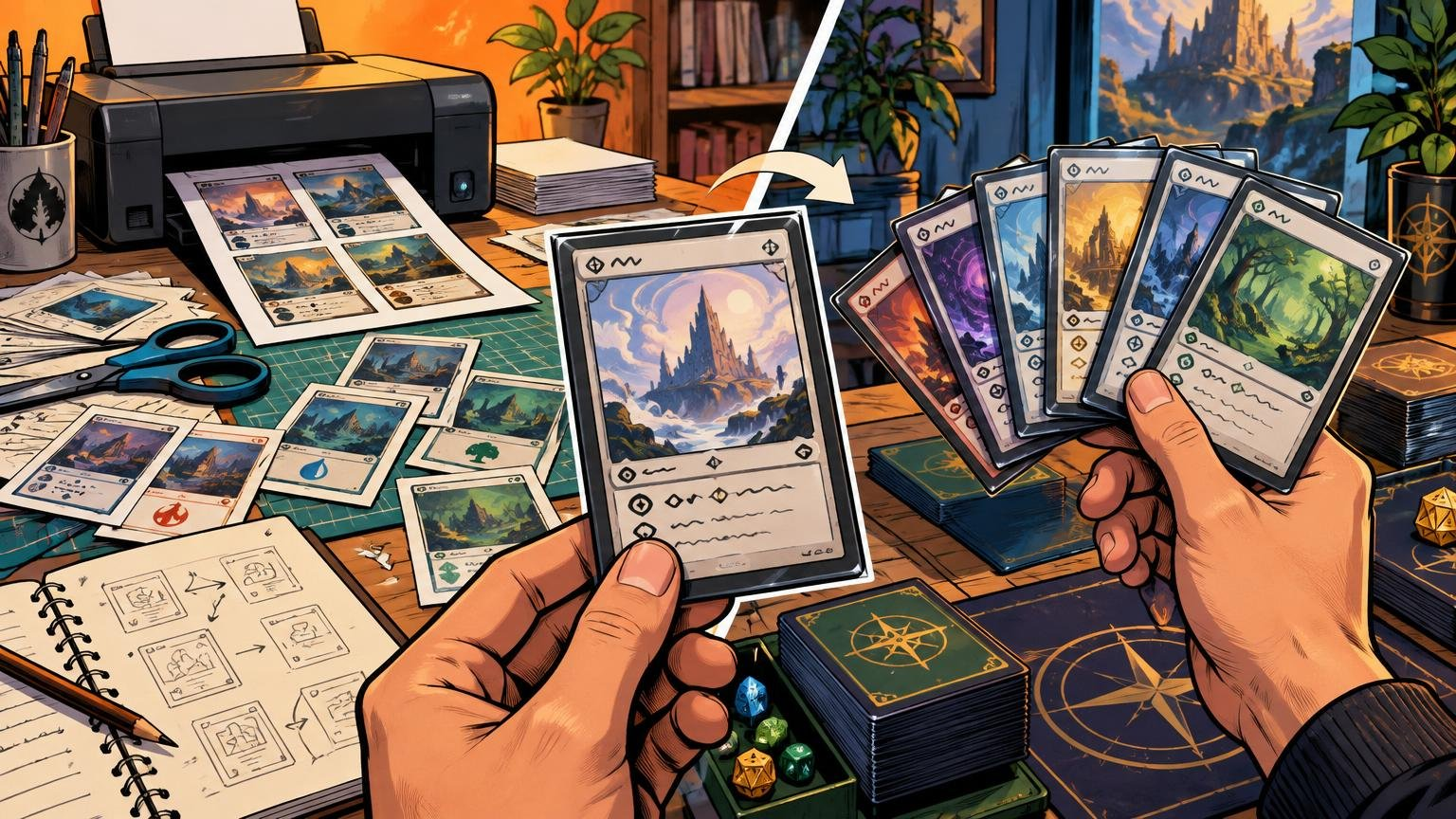
Home-printed MTG proxies are usually the better choice for quick experiments, frequent deck changes, and the lowest possible commitment. Professionally printed playtest cards make more sense when a list is stable, the cards will see repeated use, or consistent cutting and readability matter to your group. Neither option becomes an authentic Magic card simply because it looks tidy.
The useful question is not which method is universally “best.” It is whether you are testing tomorrow’s draft of a deck or building a casual cube that will be shuffled for years. One needs speed and flexibility; the other benefits from consistency and durability.
TLDR: Choose for the stage of the project
- Print at home when you are testing a few cards, changing lists frequently, teaching with temporary examples, or trying an idea before spending more time and money on it.
- Use a professional printing service when the list is settled, you need a large batch, or the cards will be handled and shuffled repeatedly in a proxy-friendly group.
- Use opaque sleeves and consistent backing cards so every card in the deck feels similar and cannot be identified from the back or by thickness.
- Keep either kind clearly distinguishable from authentic cards, and confirm that everyone at the table is comfortable using playtest cards.
- Do not bring player-made home or professionally printed substitutes to a sanctioned event. Current tournament rules require authorized genuine Magic cards, apart from narrow judge-issued replacements.
First, understand what these cards are
In casual conversation, “proxy” covers everything from a card name written on a basic land to a commercially printed reproduction. For responsible play, “playtest card” is often the clearer term: it describes a stand-in used to test gameplay rather than something represented as authentic.
Wizards gives examples of personal playtest cards such as a basic land with another card’s name written on it or a printed paper slip placed in front of a land inside a sleeve. It distinguishes those clearly non-authentic aids from counterfeits intended to pass as genuine cards. Wizards’ explanation of its proxy and playtest-card policy also says it does not seek to police personal, non-commercial playtest cards used outside sanctioned events when they are not attempts to reproduce genuine cards.
Sanctioned play is a different environment. The February 27, 2026 Magic Tournament Rules define authorized cards as regulation-sized genuine Magic cards publicly released by Wizards. Player-made substitutes are prohibited, whether produced on a home inkjet or ordered from a professional printer. A Head Judge may issue a temporary proxy in limited circumstances, such as when a qualifying card becomes damaged during the event, but players cannot make those tournament proxies themselves.
For a fuller breakdown of that boundary, see our guide to MTG proxy legality in tournaments and casual play.
Home printing and professional printing at a glance
| Factor | Home-printed playtest cards | Professionally printed playtest cards |
|---|---|---|
| Best use | Rapid testing and frequently changing lists | Stable decks, cubes, teaching sets, and repeated casual play |
| Turnaround | Potentially immediate if equipment and supplies are ready | Requires production and delivery time |
| Up-front commitment | Low for a few paper inserts | Usually more sensible when ordering a planned batch |
| Consistency | Depends heavily on printer settings, paper, cutting, and assembly | Typically offers more consistent cutting and stock within one order |
| Revision cost | Easy to replace individual cards | Changing a finished batch means ordering replacements |
| Table feel | Functional when sleeved with uniform backing cards | Usually more cohesive for repeated shuffling and handling |
| Sanctioned events | Not permitted as a player-created substitute | Not permitted as a player-created substitute |
Home printing wins when the deck is still changing
Home printing is wonderfully disposable. If a new Commander list contains 20 uncertain cards, you can test them, discover that half the mana curve was wishful thinking, and replace the failures without mourning an elaborate order.
Simple paper inserts are often enough. Print the card information at a readable size, trim the insert, and place it in an opaque sleeve in front of a basic land or another consistent backing card. The backing card supplies stiffness while the sleeve keeps the components together. Our home MTG proxy printing guide goes deeper into paper, cardstock, inkjet, and laser-printer choices.
The tradeoff is labor. Scaling errors, low-resolution images, white cutting borders, inconsistent trimming, and variable printer output can make a batch harder to read or shuffle. None of those problems is catastrophic for a four-card test. They become considerably less charming around card 312 of a cube.
Professional printing wins when consistency matters
Professional printing is better suited to projects that have moved beyond rough experimentation. A settled casual deck, shared battle box, teaching set, or frequently drafted cube benefits from cards that are cut consistently and remain readable after repeated handling.
This route also removes much of the assembly work. Services offering professionally printed MTG playtest cards can be a practical next step when you already know which existing printings you want and do not want to trim a large stack by hand. The benefit is convenience and consistency, not authenticity or tournament legality.
Check the actual service rather than assuming “professional” describes one universal specification. Stock, coating, image requirements, cutting methods, available printings, minimum quantities, pricing, and production times vary. A vendor’s published specifications describe its own workflow; they are not independent measurements or an industry-wide standard.
Cost depends on more than ink versus order price
For a handful of temporary cards, home printing is difficult to beat if you already own a printer, sleeves, and spare backing cards. But the apparent bargain becomes less obvious when a project consumes ink, paper, replacement blades, failed sheets, and an evening of trimming. Your time is part of the cost, even if no invoice politely points it out.
Professional printing adds an order cost and a wait, but it can reduce manual work substantially. Compare the delivered total for the quantity you need, not a prominently advertised per-card figure tied to a much larger batch. Also consider how many cards are likely to change. Professionally printing a deck that will be rebuilt next week is an impressive way to create premium recycling.
Use a two-stage approach for bigger projects
The strongest workflow often uses both methods rather than declaring loyalty to one.
- Build the initial list with clearly marked paper inserts or handwritten stand-ins.
- Play enough games to identify dead cards, awkward curves, unclear interactions, and cards that create the wrong experience for the group.
- Revise aggressively while replacements remain quick and cheap.
- Once the list is stable, decide whether its expected use justifies a professionally printed batch.
- Keep a few home-printed inserts available for later experiments instead of replacing finished cards immediately.
This approach is especially useful for cubes. A cube can require hundreds of cards, but its first draft is rarely sacred scripture. Cheap prototypes let the group discover whether archetypes work before committing to a more polished version.
Table clarity matters whichever method you choose
Tell the group that the deck contains playtest cards before play begins. Make those cards clearly non-authentic, keep their text legible, and avoid backs or finishes that could cause confusion. If a double-faced card is involved, establish how its reverse side will be represented; our guide to double-sided MTG proxies and helper cards covers practical sleeve options.
Consistency also affects fair play. A noticeably thicker card, transparent sleeve, curled insert, or distinctive edge can reveal information from the library. Uniform opaque sleeves and matching backing cards solve many of these problems without turning game night into a print-production seminar.
The verdict
Choose home-printed playtest cards for discovery: early deck drafts, rapid substitutions, small tests, and ideas that may not survive the evening. Choose professional printing for established casual projects that deserve consistent handling, cleaner presentation, and less cutting-room labor.
For many players, the best answer is home first and professional later. Test cheaply, listen to the people playing with you, and polish only the version that has proved it deserves to stay.
