
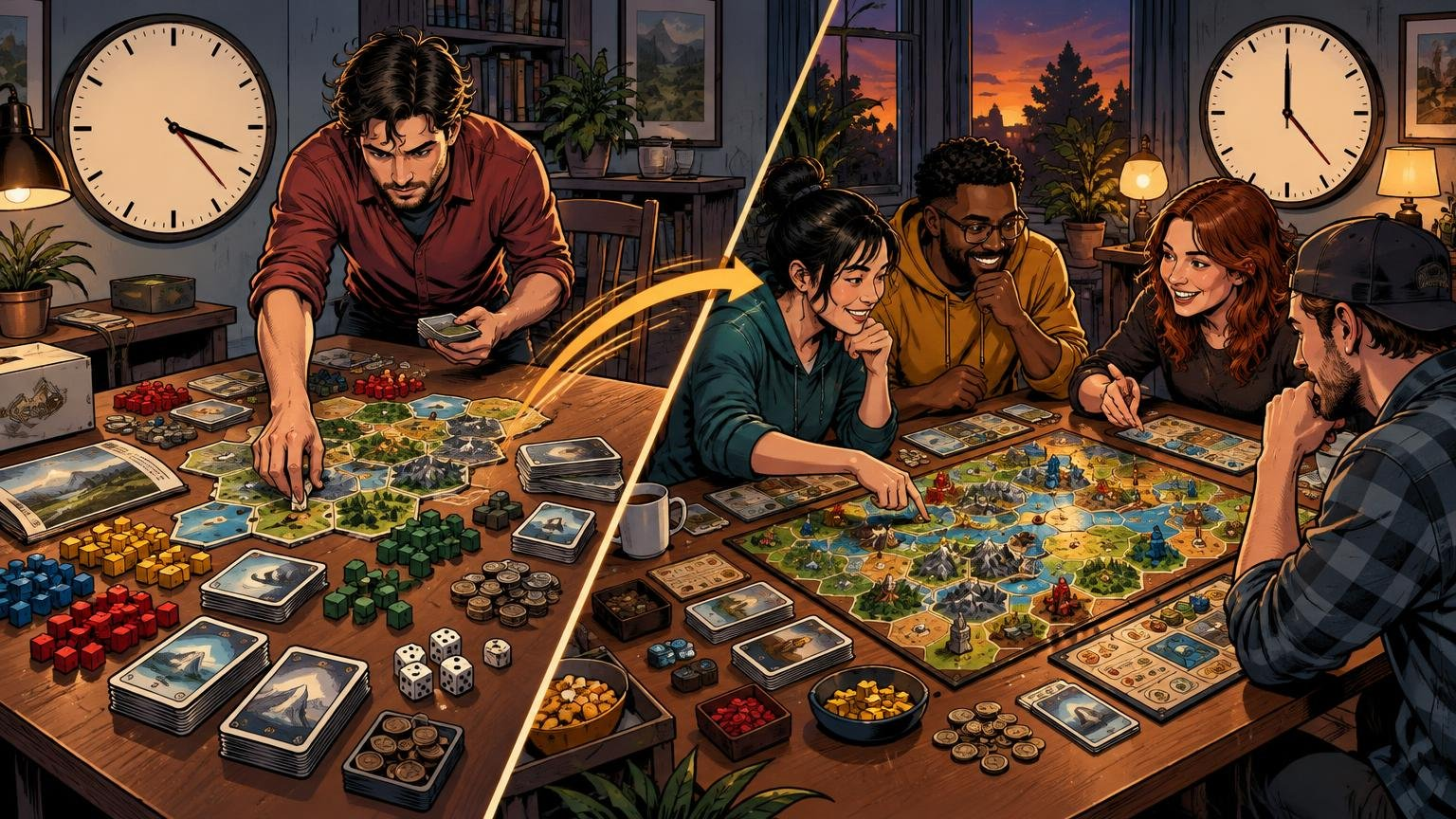
TLDR
Board game setup time vs play time is only the beginning of a useful game-night estimate. Budget separately for getting components ready, teaching or refreshing the rules, playing, final scoring, and cleanup. Add breathing room for a first play, an unfamiliar group, or a hard stopping time. Choose the game that fits the whole window—not merely the number printed beside “playing time.”
A 60-minute game does not necessarily occupy only 60 minutes of your evening. Someone has to open the box, sort the pieces, explain why everyone suddenly owns sheep, answer questions, calculate the winner, and persuade all the wooden tokens to return to the correct bags.
That is why board game setup time vs play time matters most as a group-planning question. If four people have two hours together, the useful number is not simply the estimated duration of active play. It is the total time between claiming the table and leaving it usable for breakfast.
Board game setup time vs play time: what the numbers mean
Setup time is the period spent preparing the game for its opening turn. Depending on the title, that can include unfolding boards, sorting cards, building decks, distributing player pieces, preparing shared supplies, choosing a scenario, and placing starting components.
Play time is an estimate of how long the game itself takes. Do not assume every publisher calculates or presents that estimate in exactly the same way. Check the individual product listing or rulebook when timing is important, because the label may not tell you whether teaching, final scoring, or cleanup is included.
Some publishers explicitly separate setup and play estimates. The official Wingspan product listing gives a five-minute setup time and a 40–70-minute game length. AEG’s Atelier product page similarly lists a three-minute setup time and a 30–45-minute playing time. These are useful examples of separate labels, not proof that every group will reproduce those times or that the whole industry measures them consistently.
For planning purposes, treat all advertised times as inputs rather than guarantees. Your actual evening has more moving parts.
Use a full-session time budget
A practical editorial framework is: total table time equals setup, plus teaching or a rules refresh, plus active play, plus scoring, plus teardown. Breaks, food, late arrivals, and social interruptions sit outside that basic formula but still consume the available window.
| Part of the session | What it includes | What commonly changes it |
|---|---|---|
| Setup | Boards, decks, tokens, player areas, scenarios, and starting resources | Storage quality, component count, expansions, and whether the host prepared ahead |
| Teach or refresh | Explaining the goal, turn structure, important actions, and unusual rules | Player experience, game complexity, and how recently the group played |
| Active play | Turns, rounds, negotiation, simultaneous choices, and rules checks | Player count, decision load, familiarity, downtime, and group pace |
| Scoring | End-game calculations, tie breakers, and checking objectives | Scoring complexity and whether progress was tracked during play |
| Teardown | Sorting, bagging, boxing, and clearing the table | Insert design, component organization, and how many people help |
This framework is deliberately not a universal timing formula. There is no responsible fixed multiplier that turns a box estimate into an accurate result for every game and group. Instead, estimate each stage based on the people attending and what they already know.
For a familiar game with organized components, setup and teaching might be minor. For a first play of a scenario-heavy title, preparation and explanation may become a substantial part of the event. Neither situation means the publisher’s estimate is dishonest; it means the estimate and your scheduling question are not necessarily measuring the same thing.
Why the same game takes different groups different amounts of time
Familiarity changes almost everything
Experienced players recognize the flow of a turn, understand common iconography, and spend less time checking basic procedures. New players must build that mental model while also making decisions. A group returning after six months may fall somewhere between those extremes: it remembers the broad objective but not the fiddly exception involving the purple token. There is always a purple token.
Teaching deserves its own budget rather than being quietly absorbed into play time. A structured explanation can also prevent repeated interruptions later. If your group is learning something new, our guide to teaching a board game without dumping the rulebook offers a practical sequence centered on meaningful early decisions.
Player count affects more than the number of turns
Adding players can increase active turns, rules questions, conversation, and the time needed to reach shared decisions. It can also create more downtime in games where actions happen sequentially. However, the effect is game-specific: simultaneous selection or shared phases may keep a larger group moving more efficiently than a strictly turn-by-turn system.
Use the title’s supported player count as an eligibility check, not a promise that every count produces the same pace or experience. When possible, think about whether each additional player adds only another set of actions or also creates negotiation, competition over shared spaces, and more information to evaluate.
Decision load can stretch a short ruleset
Simple rules do not always produce quick decisions. Players may face many plausible options, worry about making the wrong move, or keep recalculating after the board changes. This is especially noticeable when newer players sit with someone who already sees several turns ahead.
The answer is not to rush everyone with a stopwatch. Set expectations about pace, narrate useful decision criteria during the teach, and choose a game whose complexity matches the mood. If long turns regularly swallow the evening, these approaches to board game analysis paralysis can help the table move without turning thoughtful play into speed chess.
Expansions and scenarios create different workloads
An expansion might add components to sort, modules to select, or additional rules to explain. A scenario may require a specific map or deck configuration. Even if the extra material barely changes active play, it can alter preparation and teardown.
Do not automatically include every module because it lives in the same box. Before game night, decide which version the group is playing and organize only what that version needs. The deluxe “everything everywhere all at once” setup can wait for a night that actually has room for it.
How to choose a game when you have a hard stop
Start with the real window. If the venue closes, the last train leaves, or someone must relieve a babysitter, that deadline is part of the game selection—not an inconvenience to discover in the final round.
- Write down the time when everyone can realistically begin, not merely the invitation time.
- Subtract time for setup, teaching or refreshing rules, scoring, and cleanup.
- Leave a buffer rather than scheduling every remaining minute. The buffer is protection against ordinary variation, not a precise formula.
- Compare the remaining play window with the game’s listed estimate and your group’s prior experience.
- If the fit is tight, choose a familiar title, a shorter scenario, or a game with a clean stopping structure.
A new game is a higher-risk scheduling choice because the group has no shared baseline. The host may know the rules, but that does not remove teaching time or guarantee quick decisions from everyone else. When the deadline truly matters, save the ambitious first play for a less constrained session.
It is also worth deciding what happens if the game runs long. Can the state be saved? Is there a round boundary that produces a tolerable early ending? Would everyone rather choose something shorter than abandon a two-hour investment without a conclusion? Agreeing before setup is considerably less painful than negotiating while somebody is already putting on a coat.
Reduce setup time without changing the game
Faster setup usually comes from reducing searching and repeated decisions. You do not need to alter the rules or buy an elaborate storage system. A few low-cost habits can make the box much easier to bring back to the table.
- Label bags or containers by component type, player color, or setup step.
- Store frequently used components together when doing so does not damage them.
- Keep a short setup checklist in the box, especially for games with variable maps or decks.
- Assign parallel jobs: one person prepares the board while others sort player pieces or shuffle decks.
- Set out permitted public components before guests arrive, but avoid making hidden selections or random choices that players are supposed to perform.
- Use player aids so the teach does not have to cover every reminder in exhaustive detail.
- During teardown, sort components in the way they will be needed next time rather than simply fitting everything into the box.
Delegation works best when the host gives specific jobs. “Can you build the supply using this card?” is easier to act on than “Everybody help somehow.” For a complicated title, the setup checklist also protects the host from discovering halfway through round one that a critical deck remains under the insert.
When a longer setup is worth it
Low setup is useful, but it is not automatically the most important feature. A feature game planned weeks in advance may justify a substantial opening ritual if the group wants a deep campaign chapter, sprawling map, or special scenario. A casual weeknight after work usually has a different tolerance for sorting several hundred tiny ambitions.
Judge setup cost against the experience it enables and how often the group expects to play. Longer preparation can make sense when the game is the evening’s main event, everyone understands the commitment, and the resulting experience fits the group. The same preparation may feel excessive when the group wants conversation, flexibility, or time for several shorter games.
Frequency matters too. A game with modestly complicated setup may become easy after several sessions if components stay organized and everyone knows a task. Conversely, a game with a short physical setup can still occupy a large window if every session requires a full rules explanation or produces lengthy turns.
A quick pre-game checklist for the host
- How much time exists between the realistic start and the hard stop?
- Has anyone played before, and who needs a full teach?
- Which player count and game version are you using?
- Are expansions or scenarios adding preparation or explanation?
- Are the components organized for setup rather than merely stored?
- Who can help prepare and clear the table?
- What is the backup choice if the preferred game does not fit the window?
The backup is not an admission of defeat. It is how you avoid spending 25 minutes debating what to play and then discovering that the surviving window fits none of the original options.
Frequently asked questions
Does setup count as play time?
For planning your evening, count setup as part of total table time. Whether a particular publisher includes any preparation in its displayed estimate is a separate question, so consult that game’s listing or rules rather than assuming a universal convention.
Why can a 60-minute board game occupy two hours?
The listed estimate may not account for teaching, setup, scoring, cleanup, breaks, or your group’s decision pace. New players, higher player counts, rules checks, and unfamiliar expansions can also extend the session. That does not mean every 60-minute game will take two hours; it means active play is only one part of the schedule.
Should publisher time estimates be treated as guarantees?
No. Treat them as useful estimates associated with a particular game, then adjust your plan for familiarity, player count, selected modules, and the full session around active play. If your group has played before, its own recorded times will usually be more relevant to future scheduling.
What is the easiest way to make setup faster?
Organize components according to how they enter play. Labeled bags, a setup checklist, and clearly delegated tasks reduce searching and confusion without changing the rules. Preparing permitted public components before guests arrive can help too.
Choose for the whole evening
The most useful game-night metric is total table time: setup, teaching, active play, scoring, and teardown, with enough flexibility for real people to ask questions and refill a drink. A printed duration remains helpful, but it should not carry the entire planning job.
Before choosing the box, choose the window. Then account for your group’s experience, pace, player count, and appetite for learning. The right game is not always the one with the shortest setup or play estimate. It is the one your group can start, understand, enjoy, and finish without the final round becoming a hostage situation.
