
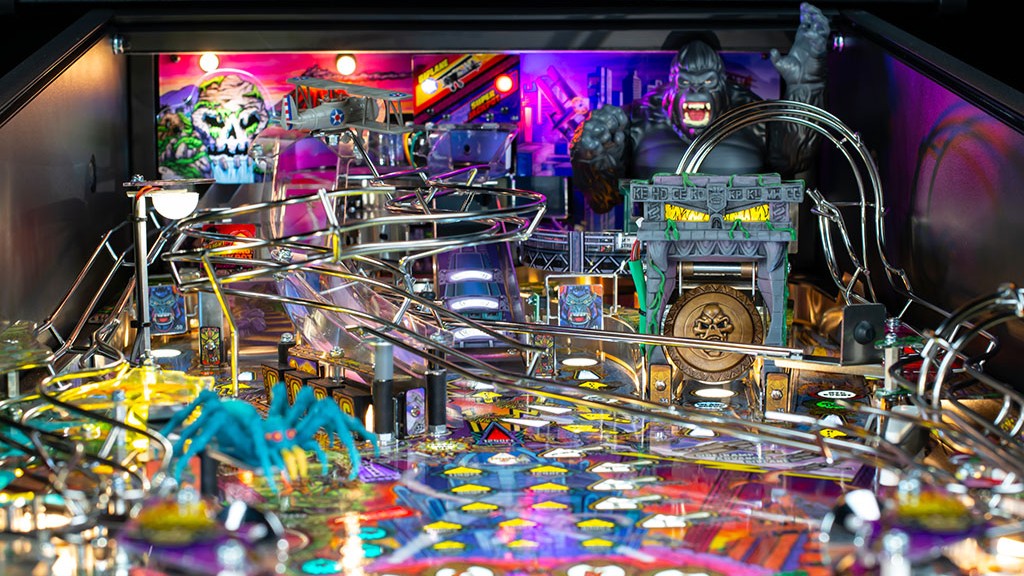
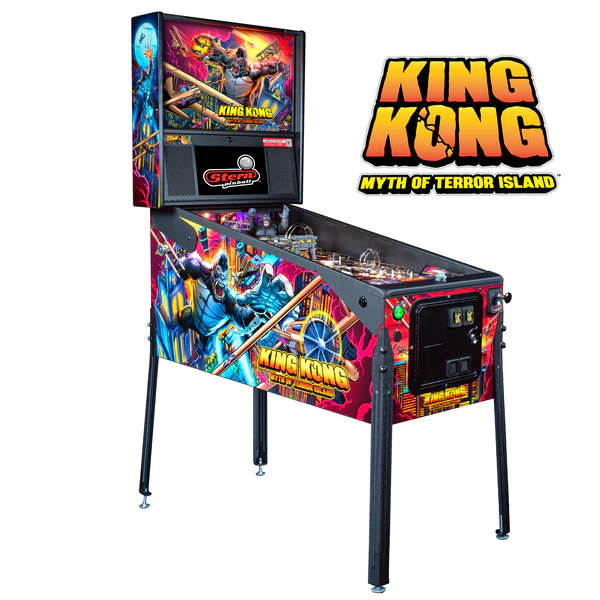
King Kong: Myth of Terror Island is one of Stern’s more interesting modern releases because it is not really leaning on a film adaptation the way people might expect. Stern built it as an original pinball-specific King Kong story, running from Terror Island to New York City, and shipped it in Pro, Premium, and LE trims at $6,999, $9,699, and $12,999. The machine also uses an animatronic Kong, a spider-controlled pit that grabs the ball magnetically, a biplane ramp, a train-car multiball moment, and Insider Connected achievements and treasure-hunt progression.
The nice thing about writing about King Kong now instead of right at reveal is that the machine has had time to cool off, settle in, and collect actual reception. That matters. Hype can make anything look amazing for a week. King Kong now has a strong Kineticist review, a sizable pool of Pinside ratings, and a clearer reputation: it is a very well-liked shooter with a few presentation caveats, not just another “cool reveal” that evaporates once people touch it.
TLDR
- King Kong looks like a layout-first hit. The strongest praise keeps going back to the shot flow, the ball paths, and the sheer fun of shooting it.
- It also seems easier to recommend now than it was at reveal, because the code appears to have matured well and player ratings have stayed strong instead of falling off a cliff.
- The main hesitation is presentation polish. Even fans still note that the art, animations, and sound package are more uneven than the actual playfield design.
The Layout Is the Real Headliner
The biggest compliment King Kong gets is also the one that matters most in the long run: it sounds great to shoot. Kineticist called it another great Keith Elwin game and spent most of its review talking about space usage, combo paths, upper-playfield complexity, novel ball returns, and how many satisfying shots and feeds the table produces. That is usually a good sign. When reviewers cannot stop talking about shot geometry, the machine is probably doing something right.
Kineticist was especially positive about the upper-left section, the punch-back target under Kong, the feed to the upper-right flipper, and the biplane ramp. That review also made an important distinction: with Keith Elwin tables, the real question is often not whether the game is good, but how good it is relative to his own absurd standards. That is a very annoying compliment if you are any other designer, but it is a compliment all the same.
The Toys and Theme Actually Do Their Job
Stern’s official feature set sounds like the right kind of over-the-top. Kong swings his arms and torso through an animatronic system, the New York train car flips over to start multiball, and “The Pit” uses a giant spider and a magnetic grab to attack the ball. That is not exactly subtle, but subtle is not really the point of King Kong.
The more interesting part is that Stern had to do this without leaning on a normal movie-license content dump. Kineticist notes that the machine is effectively a non-licensed interpretation built around the 1932 novel’s public-domain status, which forced Stern’s team to make more of the world and presentation from scratch. That helps explain why the theme feels a little different from the studio’s more directly licensed games. It also makes some of the visual weirdness easier to understand, even if it does not magically make every artistic choice land.
Why It Is Easier to Recommend Now
This machine’s reputation has held up well. On Pinside, the Premium currently sits at 8.651 with 234 approved ratings, and the comments are full of players praising the smoothness, shot variety, toys, and overall flow. Even when people disagree on where it belongs in the Stern hierarchy, they still tend to talk about it like a serious table rather than a novelty theme with one good mech.
Kineticist also makes a useful point here. Their review says King Kong felt feature-complete at launch, had fleshed-out code even in early form, and probably belongs in the upper tier of Keith Elwin releases. That is strong language, and it matters more now because the player ratings have broadly backed it up instead of contradicting it.
The Caveat Is Not Gameplay
The biggest caveat with King Kong is not that it plays badly. It is that the presentation seems a little less unanimously loved than the layout. Kineticist said the sound and animation package felt roughly in line with recent Stern releases, and on Pinside you can find players saying the playfield is gorgeous while also calling the cabinet art, animation style, or overall visual mix a little uneven.
There are also a couple of gameplay-specific notes worth flagging. Kineticist found the gong entrance tricky on the Pro and suggested the Premium’s King Kong multiball path might be too elaborate for many casual players to reach consistently. That does not sound fatal, but it does sound like a machine with some bite, not a pure walk-up crowd pleaser.
My Verdict
I think King Kong looks like one of those machines that becomes easier to like the more you care about pinball design and a little harder to like the more you obsess over audiovisual polish. That is not a backhanded compliment. It is actually pretty high praise. Layout matters longer than reveal-week spectacle does, and every sign here suggests Stern and Keith Elwin got the important part right.
So my verdict is pretty simple: King Kong seems very easy to recommend to people who prioritize shot flow, satisfying geometry, and a table that keeps giving you more to chew on. If your favorite thing about a machine is perfect presentation symmetry and pristine theme packaging, you may have a few complaints. But if your favorite thing is how the ball moves, this one looks like the real deal.
