

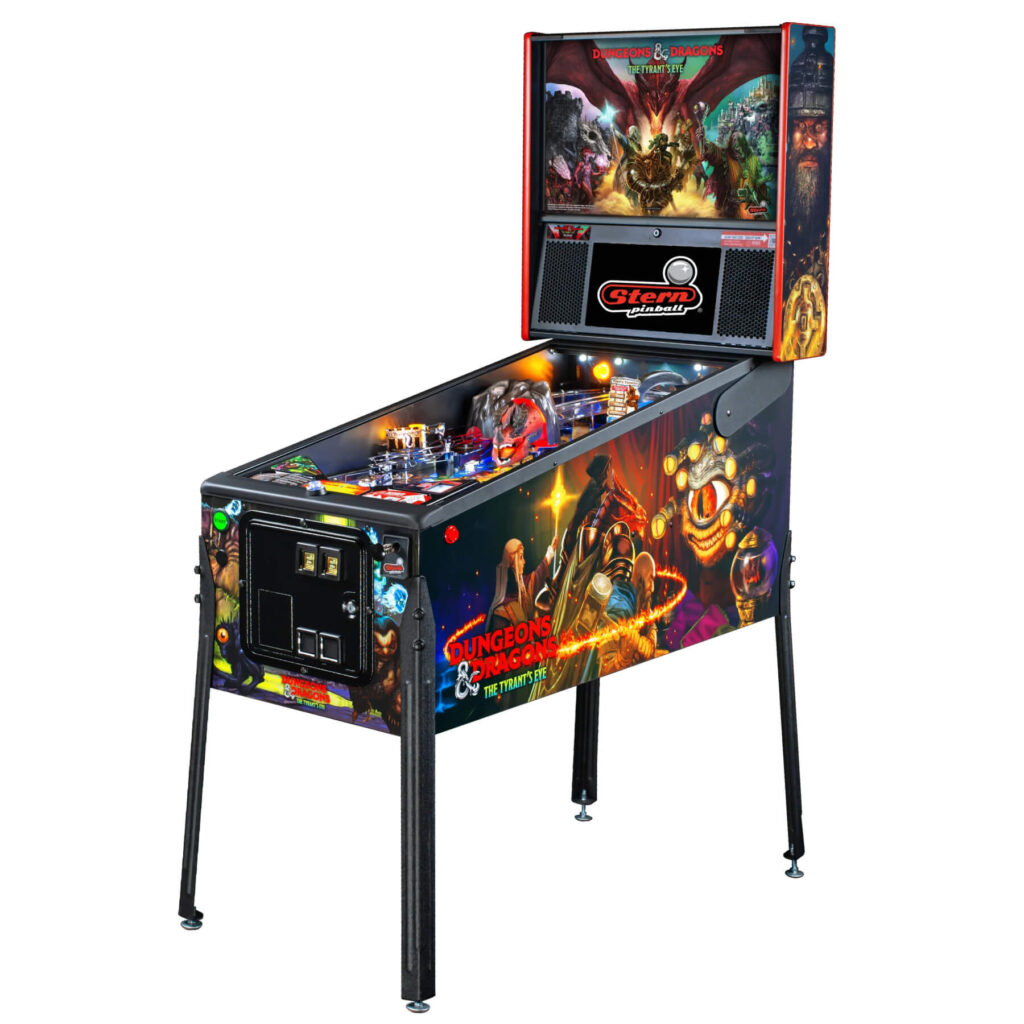
Stern’s Dungeons & Dragons: The Tyrant’s Eye launched in January 2025 in Pro, Premium, and Limited Edition trims at $6,999, $9,699, and $12,999, and it was clearly designed to be more than a cabinet with a big dragon on it. Stern built it around the Forgotten Realms, a Dragonshield Guild campaign, multiple endings, character progression, and a feature set that includes an animatronic red dragon, a gelatinous cube magnet, a trap-door dungeon, and Insider Connected progression systems.
And at this point, this is not really a launch-day guessing game anymore. There is enough official detail, enough post-launch code support, and enough community feedback to say the machine has settled into a pretty clear identity. This is a rule-heavy, progression-driven pinball machine that a lot of players genuinely love, but it is not built for people who want everything explained in one ball and a half.
TLDR
- This is one of Stern’s most ambitious recent theme integrations, and it seems best suited to players who want campaign structure, character choices, inventory flavor, and long-term progression instead of simple “shoot flashing thing” pinball.
- The layout sounds unusually approachable for a game this deep. Early hands-on coverage praised the flow, the 3-flipper design, and the way the game helps players line up important upper-flipper shots.
- The tradeoff is that even some happy owners still describe the rules as hard to parse at first, and at least part of the player base thinks it can be a bit of a drain monster.
The Best Part Is That It Actually Feels Like D&D
This machine sounds like somebody at Stern asked the correct question for once: “What would make this feel like D&D under glass?” not “How many monsters can we stick on a translite?” The answer, apparently, was character selection, branching progression, location-based modes, dungeon travel, multiple endings, scaling encounters, and persistent progress through PinSave. That is a much more interesting answer than the usual branded pinball shortcut.
Officially, Stern frames the game around the Dragonshield Guild trying to stop Tiamat while dealing with enemies like Rath the Relentless, Xanathar, mimics, an owlbear, and Sammaster. The game also uses randomness and choice in its campaign structure, which is exactly the sort of thing that could have been a mess in lesser hands but makes sense here. It sounds less like a themed scoreboard and more like a pinball machine trying very hard to behave like a fantasy adventure.
The Layout Sounds Better Than the Marketing Pitch
The feature list is loaded, but the more important part is that the game seems to shoot well. Kineticist’s hands-on coverage was unusually positive, calling out Brian Eddy’s flow-centric design, the return to a 3-flipper layout, and the way the machine makes upper-flipper progression shots easier to line up instead of turning them into punishment for existing. That matters, because a deep game with a fussy layout just becomes homework with lights.
The toys also sound like they were chosen to do something rather than just sit there being expensive. Stern’s official feature set includes Rath the Relentless as a multi-axis animatronic mech, a metal shield between the flippers, an electromagnet-powered gelatinous cube, hidden passages, a disappearing trap door, and Fizmo’s store. That is a lot. But unlike some overly stuffed machines, the early coverage suggests the layout still feels coherent and playable.
Why Players Have Stayed Positive
The broad reception is strong. On Pinside, the Pro currently sits at 8.320, the Premium at 8.413, and the LE at 8.558, which is not just “people were excited on reveal day.” That is real sustained approval. And the more interesting comments tend to focus on the same things: the quest structure, the character system, and the way saved progress changes how people think about pinball progression in a home setting.
One reason that positivity has held is probably that Stern is still actively supporting the game. The official site built Insider Connected and ongoing code updates into the pitch from the start, and Stern posted a 1.00.0 game-code update just a few days ago. For a machine like this, continued support is not a side perk. It is part of the product. A progression-heavy table without follow-through would feel half-baked pretty quickly.
The Catch
There is one very obvious catch, and it is not subtle. This machine asks a lot from the player. Kineticist liked that depth, but even their early hands-on admitted there was a lot to take in from the first plunge. And on Pinside, you can already find owners praising the game while also saying the rules can be hard to understand at first or that the layout can become frustrating when the machine turns mean.
So this is probably not the right fit for someone who wants a breezy, low-explanation location game where the fun is obvious in fifteen seconds. It looks better suited to people who enjoy learning a ruleset over time, improving a character, and getting more out of a machine the longer they live with it. Basically, it is a little nerdy. Which, in fairness, is exactly what you would want from a Dungeons & Dragons pinball machine.
My Verdict
I think The Tyrant’s Eye looks like one of Stern’s strongest recent theme-first machines, and maybe one of its clearest examples of a table that actually commits to the logic of its license instead of decorating around it. The layout sounds smart, the feature list sounds purposeful, and the reception has been strong enough to treat it as a real success instead of a curiosity.
But I would not call it universal. If you want immediate readability and zero friction, there are easier pinball machines to love. If you want depth, campaign flavor, progression, and something that feels a bit different from the standard Stern formula, this one seems very easy to recommend. Not effortless. Just easy. There is a difference.
