
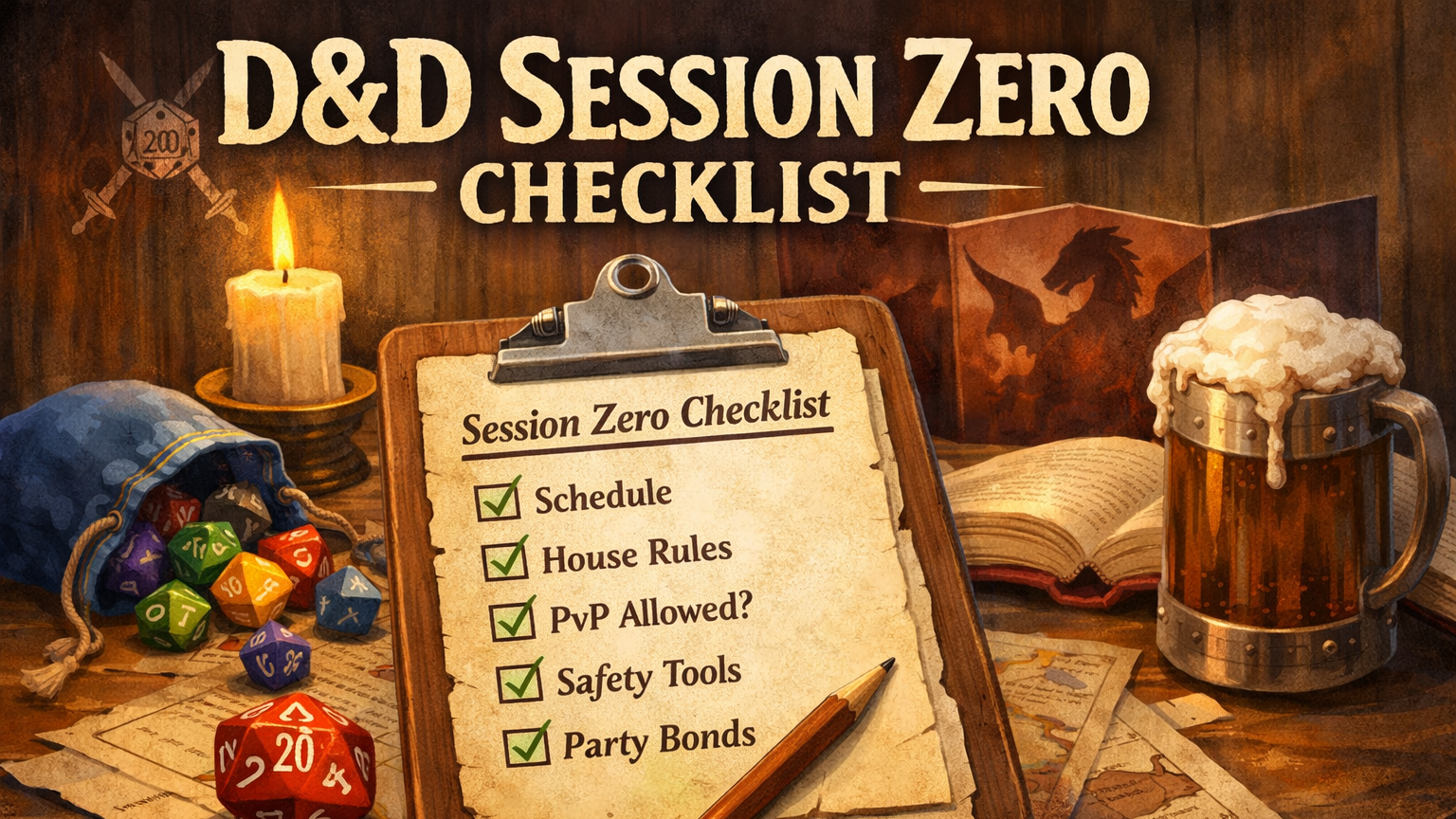
A D&D Session Zero checklist is the least exciting thing you will do for your campaign, and also the thing most likely to keep it alive past week three. It is not bureaucracy. It’s how you avoid the campaign dying to scheduling, mismatched vibes, and the classic surprise reveal that two players thought they were signing up for cozy tavern roleplay while the DM prepared grimdark horror and emotional damage.
If you only take one idea from this post: you are not trying to agree on everything. You are trying to eliminate the avoidable misunderstandings that make people quietly stop showing up.
What Session Zero is (and what it is not)
Session Zero is a short, intentional conversation where everyone gets on the same page about:
- when you play
- what kind of game you are playing
- what rules you are using
- how you treat each other at the table
- what content is off-limits or should be handled carefully
Session Zero is not:
- a two-hour lecture where the DM reads their setting bible aloud
- a hostage negotiation over every optional rule in the book
- “we’ll figure it out later” (that is just procrastination with dice)
You can do this in 30 minutes. The trick is having a structure. That’s what this D&D Session Zero checklist is for.
D&D Session Zero checklist: Logistics (the part that actually kills campaigns)
Campaigns do not die because the villain was too strong. They die because nobody can agree on Tuesday.
1) Schedule and time boundaries
Pick the default slot and guard it like it’s the last healing potion.
- Day/time: “Every other Thursday at 7pm”
- Session length: 2.5 hours, 3 hours, whatever you can actually sustain
- Hard stop: decide when you end so people can plan their lives
If you want a simple rule: consistent, shorter sessions beat “someday we’ll do a 6-hour marathon” almost every time.
2) Frequency and campaign horizon
Be honest about what you are building.
- One-shot that might become a mini-arc
- 6 to 10 sessions
- “We play until we get bored” (fine, but say it out loud)
3) Quorum rule (aka “what happens when people miss”)
This saves friendships.
- Minimum players to run: 2? 3? “We play if we have at least X”
- What happens to absent characters: fade into the background, DM pilots them, or they are “back at camp”
- How much recap happens: who does it, and for how long
4) Cancellation rules (stop the slow bleed)
Set a norm:
- how much notice is expected
- when it’s okay to cancel last-minute
- whether you “skip this week” or “run a side quest”
5) Communication channel
Pick one place for logistics so nobody has to hunt through three group chats.
- text thread, Discord, whatever
- decide if reminders go out automatically or one person pings the group
If you want to connect this to broader tabletop culture, your group expectations are a big part of why modern gaming feels like its own ecosystem. It’s not just games, it’s social contracts with snacks. See: Board Game Culture: How the Hobby Became a Whole Social Ecosystem.
D&D Session Zero checklist: Tone and table expectations
This is the “vibes” section, but we are going to do it without being vague.
1) Genre, tone, and content rating
Agree on the tone using plain language:
- heroic fantasy, dark fantasy, horror-lite, comedy, political intrigue
- “PG-13” vs “R” energy
- how graphic violence gets
- how silly you want the table to be
You are not judging anyone’s taste. You are preventing surprise misery.
2) Player style mix
Ask what people actually want to do:
- roleplay-heavy vs combat-heavy
- puzzles and mysteries vs straightforward quests
- tactical combat vs “theater of the mind and vibes”
- how much character backstory matters
3) Difficulty and lethality
Decide how dangerous the world is.
- Are character deaths on the table?
- Is resurrection common, rare, or basically a myth?
- Are you running “fail forward” or “fail and now you live in a ditch”?
4) Table etiquette (yes, this counts)
Set norms so nobody has to passive-aggressively sigh.
- phones at the table
- side conversations
- rules lookups: who does it, and how long you pause
- snacks, allergies, alcohol, breaks
A lot of “table salt” is just expectation mismatch. Commander players have known this forever. If you want a quick parallel example of expectations going sideways, the whole “everyone is a 7” problem is basically Session Zero failing in a trench coat: MTG Commander Power Levels Explained (and why everyone is a ‘7’).
D&D Session Zero checklist: House rules and allowed content
This is where you prevent the mid-campaign argument that starts with “Well technically…” and ends with someone doomscrolling at the table.
1) Allowed books and character options
Be specific:
- which sourcebooks are allowed
- whether Unearthed Arcana is allowed
- how you handle third-party content and homebrew
A good default: official content is fine, homebrew is case-by-case, and anything complicated needs DM review before it hits the table.
2) Character creation rules
Decide:
- starting level
- stat method (standard array, point buy, rolled stats)
- any restrictions on races/classes
- how you handle party balance (or if you don’t care)
3) Variant rules
Pick now, not in the middle of a fight:
- flanking
- feats
- encumbrance
- inspiration rules
- critical hit rules
- any custom stuff you love
4) Rules disputes
This is the underrated one.
A simple policy saves time:
- DM makes a quick call in-session
- you look it up after the game
- if it matters, you adjust going forward
Nobody wants a 12-minute argument about a spell interaction while pizza gets cold.
D&D Session Zero checklist: PvP, spotlight sharing, and party cohesion
This section prevents the “my character would do this” excuse from becoming a weapon.
1) PvP and party conflict
You need a clear rule here because D&D is cooperative by default.
Options:
- No PvP at all (cleanest)
- PvP only with mutual consent, and either player can veto
- “soft PvP” allowed (arguments, rivalry), but no stealing, sabotage, or lethal nonsense
If you allow betrayal, say it out loud. If you do not allow betrayal, say it even louder.
2) Spotlight sharing
Set the expectation:
- everyone gets moments
- nobody is the main character
- if someone is quiet, the group helps pull them in, not bulldoze them
A practical trick: rotate who gets “the next scene” attention when things slow down.
3) Party cohesion and character hooks
Make characters that actually want to adventure together.
- shared goal, shared patron, shared backstory thread
- at least one bond per character with another character
- agree on what “party loyalty” means
You do not need a novel-length backstory. You need reasons to cooperate when it matters.
D&D Session Zero checklist: Safety tools in plain language
“Safety tools” sound dramatic until you realize they are mostly just communication shortcuts. You are giving the table a way to say “nope” without having to justify it in the moment.
1) Lines and veils
- Lines: content that does not appear in the game at all
- Veils: content that might exist, but stays off-screen or handled gently
This is the cleanest, least awkward starting point for most tables.
2) A pause button during play
Pick one:
- X-Card style “tap the card, we redirect”
- a simple phrase like “pause” or “rewind”
- Script Change style controls (pause, fast-forward, rewind, etc.)
The point is not to interrogate someone. The point is to move on and keep the game safe and fun.
3) Consent checklist (optional, but useful)
If you are running horror, trauma themes, or anything intense, a checklist helps people flag topics privately or semi-privately.
4) Debrief: roses and thorns
Take two minutes at the end:
- one thing you liked
- one thing that didn’t land (or one thing you want more of)
This prevents tiny annoyances from fermenting into “i guess I’m just not feeling it anymore.”
One-page Session Zero checklist (copy and use)
Copy this into your notes app, a Discord pinned message, or a shared doc. This is the D&D Session Zero checklist condensed to one page.
Logistics
- Default day/time:
- Frequency:
- Session length:
- Hard stop time:
- Quorum rule (minimum players to run):
- Cancellation notice expectation:
- Absent character handling:
- Communication channel:
- Platform/tools (in-person, VTT, audio):
- Breaks, snacks, food rules:
Tone and expectations
- Genre and tone:
- Content rating (PG, PG-13, R vibe):
- Roleplay vs combat balance:
- Difficulty and lethality:
- Humor level (serious, mixed, chaos goblin):
- Table etiquette (phones, side talk, rules lookup limits):
House rules and allowed content
- Allowed books/sources:
- Homebrew policy:
- Character creation (start level, stats method):
- Variant rules (flanking, feats, encumbrance, etc):
- Rules disputes policy (DM call now, research later):
PvP and party cohesion
- PvP allowed? (no / consent-only / other):
- Stealing from party allowed? (usually no):
- Secrets and betrayal rules:
- Spotlight sharing expectation:
- Party bonds or shared hook:
Safety tools
- Lines (hard no topics):
- Veils (off-screen topics):
- In-session pause tool (X-Card / pause word / script change):
- Consent checklist used? (yes/no):
- End-of-session debrief (roses and thorns):
- How to raise concerns between sessions (private message, group chat, etc):
If you do nothing else, do the logistics section and the PvP section. Those are the two that most reliably prevent a campaign from quietly collapsing while everyone pretends they’re “just busy lately.”
