
This TCG Card Condition Guide exists because card condition is the easiest way to accidentally overpay for cardboard. And because the phrase “Near Mint for its age” has launched more arguments than any planeswalker ever printed.
Condition labels are not magic. They’re a shorthand for wear, damage, and how picky the seller is feeling that day. The goal here is simple: help you grade cards quickly, translate the most common condition systems, and buy online without getting condition-catfished.
Why card condition is weirdly hard
Two reasons:
- Grading is subjective. Even marketplaces that publish standards admit it’s not an exact science. People see different things, care about different flaws, and sometimes “LP” means “LP if you squint.”
- Different stores use different scales. One shop’s “Excellent” is another shop’s “Lightly Played,” and your local binder gremlin may call everything “NM” as long as it still fits in a sleeve.
So rather than chasing perfection, aim for consistency: a fast inspection method and a working translation between common grading systems.
The big three condition systems you’ll actually run into
TCGplayer style (NM, LP, MP, HP, Damaged)
This is the most common marketplace language in the US for MTG, Pokémon, and plenty of other TCGs. It’s five buckets:
- Near Mint (NM): minimal wear
- Lightly Played (LP): small, noticeable wear
- Moderately Played (MP): clear wear, may include bends a crease can be visible
- Heavily Played (HP): a lot of wear, but usually still “playable”
- Damaged: structural issues or flaws beyond the other tiers
Important detail: many marketplaces don’t even offer “Mint” as a normal listing option. If you see “Mint” thrown around casually, treat it like “rare” on Facebook Marketplace.
Card Kingdom style (NM, EX, VG, G)
Some retailers use a tighter, store-specific scale. For example, you’ll see:
- Near Mint (NM)
- Excellent (EX)
- Very Good (VG)
- Good (G)
This can feel stricter because the store is trying to avoid customer complaints and returns. The upside is consistency. The downside is you will sometimes pay “consistency tax.”
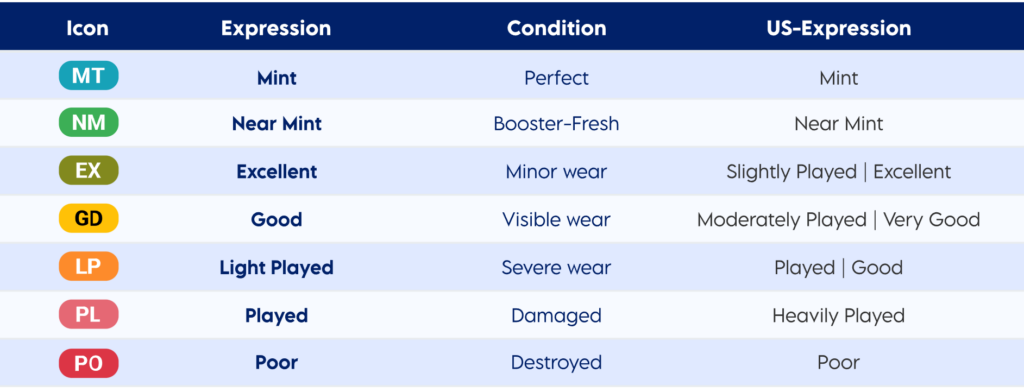
Cardmarket style (Mint, NM, EX, GD, LP, PL, PO)
Europe often uses a broader ladder that includes Mint and Poor, plus slightly different naming. It’s not better or worse, just different. The useful takeaway is that condition language changes by platform, and you should not assume “LP” means the same thing everywhere.
TCG Card Condition Guide: the 30-second inspection
Here’s the method that saves you time and money. You’re checking five zones, in order, because your eyes have limited patience.
1) Corners
Corners are the first thing to go and the easiest thing to spot.
- tiny whitening: fine for NM or LP depending on severity
- rounded corners, soft edges: you’re drifting into MP or worse
- corner bends or creases: start thinking MP, HP, or Damaged
2) Edges and border wear
Look for whitening along the edges, especially on black-bordered cards.
- a couple small spots: NM or LP
- consistent whitening around most edges: MP
- heavy whitening everywhere: HP
3) Surface (front and back)
Tilt the card under light.
- light scuffs: LP
- obvious scratches, clouding, or widespread wear: MP/HP
- sticky residue, ink, stains, or anything that makes you say “what is that”: Damaged, and also maybe wash your hands
Foils deserve special attention because they show surface flaws like they’re trying to win an award.
4) Bends and creases
This is the difference between “played” and “yikes.”
- a mild bend with no crease: can land in MP depending on severity
- a crease you can see: usually HP or Damaged
- a crease you can feel through a sleeve: you’re not arguing your way back to LP
5) Alterations and “helpful” fixes
Sharpie on the border. Inked edges. Painted corners. Signatures. Stamps. Anything added that was not printed by the manufacturer.
- For play pieces, it might be fine
- For value and resale, it’s almost always a downgrade
- For honesty, it should always be disclosed
Quick translation: NM, EX, LP, and the rest
This is not perfect, because no translation is. But it’s good enough to keep you from making expensive assumptions.
- TCGplayer NM roughly lines up with Retailer NM, but some stores will bump borderline NM down to EX for safety.
- TCGplayer LP often overlaps with Retailer EX (and sometimes low NM).
- TCGplayer MP often overlaps with Retailer VG.
- TCGplayer HP often overlaps with Retailer G (or “below G” if the damage is too real).
- Damaged is its own world. Once a card is torn, split, soaked, or structurally compromised, the nice labels stop helping.
If you’re buying expensive singles, the safest move is boring: trust sellers that grade conservatively, and pay a little more for fewer surprises.
What “Damaged” usually means in practice
People hear “Damaged” and imagine a card that looks like it survived a house fire. Sometimes yes. Often it’s subtler and still matters.
Damaged usually includes things like:
- tears, splitting, punctures
- water or liquid exposure
- major creases
- foreign substances (yes, this is a real category because humans are like this)
- missing or illegible information
- alterations that affect authenticity or usability
And yet, Damaged cards can be a good buy if:
- you only need a playable copy
- the card is going straight into an opaque sleeve
- the discount is large enough to be worth it
- you are not secretly hoping it will “grade as a 10” later (it will not)
Buying online without regret
This is where most condition pain comes from, because photos lie and expectations lie harder.
Ask for the right photos
If you care about condition, ask for:
- front and back, straight-on
- close-ups of corners
- a light-tilt shot for surface wear
- foils: a video clip or multiple angles helps
If the seller refuses, that’s information. Not good information, but still.
Learn the warning phrases
Some classics:
- “NM for its age”
- “See photos, no returns” paired with blurry photos
- “Only played once” (in the same way a precon is “only upgraded a little”)
Choose marketplaces based on your tolerance
If you want a higher chance of consistent grading, stick to established retailers and read how they handle condition and support. If you want deals, marketplaces can be great, but you’re trading money for time and risk.
If you want more context on where to shop and what tradeoffs you’re actually making, these are worth a read:
- Where to Buy Magic: The Gathering Cards Online (2026 Buyer’s Guide)
- Card Kingdom Review: Why People Pay More (and When It’s Worth It)
Selling cards without starting a small war
If you sell singles, the best long-term strategy is simple: undergrade slightly and disclose clearly.
- If a card is borderline NM/LP, list it as LP unless you want messages.
- If a card has a crease, do not call it MP because you feel optimistic today.
- If a card is altered, say so. Some buyers love altered cards. Some buyers will treat it like a crime scene. Both deserve the truth.
Your future self will enjoy fewer disputes and more repeat buyers.
One-page checklist you can copy
Use this as your quick grading sheet. It’s basically the TCG Card Condition Guide boiled down to what you check and what it usually means.
Step 1: Corners
- Clean corners: NM
- Small whitening: NM/LP
- Rounded or bent corners: MP/HP
- Creased corner: HP/Damaged
Step 2: Edges
- Tiny edge wear: NM
- Noticeable edge whitening: LP
- Widespread edge whitening: MP
- Heavy edge whitening everywhere: HP
Step 3: Surface
- Clean surface: NM
- Light scuffs or minor scratches: LP
- Obvious scratches, clouding, or surface wear: MP/HP
- Stains, residue, ink, deep gouges: Damaged
Step 4: Bends and creases
- Bend without crease: MP (sometimes LP if very minor)
- Visible crease: HP/Damaged
- Crease you can feel through a sleeve: Damaged
Step 5: Alterations
- Signed, stamped, inked, painted, sharpied: treat as Damaged for most marketplaces unless explicitly listed as altered with photos
If you do those five checks consistently, you’ll be more accurate than 90 percent of listings on the internet. Which is not a high bar, but it’s the bar we have.
