
TLDR
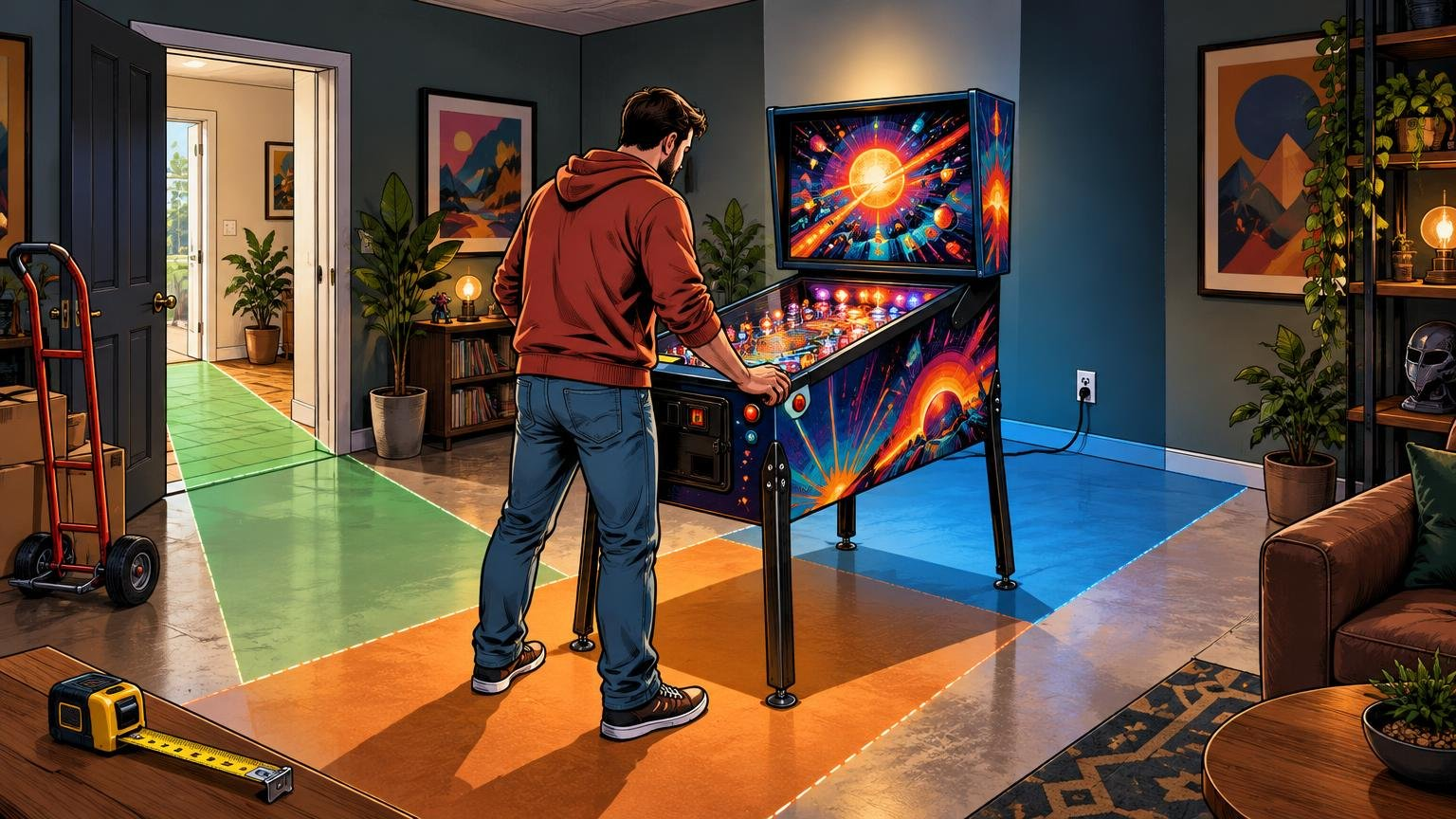
Do not plan a home pinball space from cabinet width alone. Check the exact machine’s assembled dimensions, then account for the player standing at the front, backbox or topper height, glass removal, maintenance access and the complete delivery route. A nominally suitable corner is useless if a boxed 300-pound machine cannot pass the stairway turn needed to reach it.
How much room does a pinball machine need?
A conventional modern machine commonly occupies roughly 2.5 feet of room width and about 7 feet of floor length once practical clearance is included, but that is a planning estimate rather than a universal specification. Manufacturers measure models differently, and toppers, backboxes and unusual cabinet designs can change the answer.
For example, Stern’s Pokémon Pro and Premium flyer lists the unboxed machine at 75.5 inches high, 27 inches wide and 55 inches deep. The machine weighs 250 pounds before packaging. Jersey Jack Pinball lists its conventional games at 76 inches high without a topper, with a 29-inch-wide backbox, 52-inch cabinet depth and 325-pound weight.
Jersey Jack’s Harry Potter documentation gives a similarly useful minimum room size: 79 inches high, 30 inches wide and 84 inches long without a topper. With a topper, the required height rises to 90 inches. The lesson is pleasantly simple: measure the whole game, not merely the box-shaped part beneath the glass.
Plan the playable area, not just the cabinet
The front clearance is where the player stands, shifts weight and works the flipper buttons. A tight wall directly behind the player can make every game feel like pinball performed in an airplane aisle. Leave enough room for a comfortable stance and for another person to pass if the machine shares a family room or busy game room.
Width also affects play. The machine must fit without buttons, trim or cabinet sides rubbing against furniture. If multiple machines sit in a row, a small gap makes leveling, cleaning and moving them far easier. It also helps prevent decorative side art from being scraped when one cabinet is adjusted.
Measure ceiling height at the machine’s actual position, especially in basements with beams, ducts or sloped ceilings. Include the backbox and any topper you intend to install. A topper can turn an otherwise comfortable location into one where the game technically fits but cannot be assembled correctly.
Measure the complete delivery route
Final floor space is only half the problem. Before ordering or collecting a machine, trace its route from the vehicle to its destination. The 360 Pinball room-fit guide recommends checking doors, hallways, stairs, corners, elevators and fixed obstructions. Measure the narrowest point and consider whether the load can turn through it, not just whether its width fits through a single open doorway.
Packaging makes a machine larger and heavier. Stern lists the packaged Pokémon Pro and Premium at 56 by 31 by 31 inches and 280 pounds. Jersey Jack’s Harry Potter documentation lists a 57-by-31-by-32-inch box on a pallet with a weight of 370 pounds. Decide in advance where packaging or the pallet will be removed and how the machine will be handled after that point.
- Measure door openings with the door installed, including handles and closers.
- Check stair width, ceiling height over the stairs and the landing at every turn.
- Measure elevator doors and the interior, including the diagonal turning space.
- Identify railings, radiators, shelving and other fixed obstacles.
- Confirm that the floor and route are suitable for the machine’s documented weight.
- Arrange enough capable help and appropriate moving equipment before delivery day.
If access is already your biggest constraint, compare compact home-oriented designs as part of the buying decision. Our guide to beginner-friendly pinball machines for home use covers the broader question of choosing a machine that suits the household, not merely the highest-rated table that will fit through the door.
Leave room for maintenance
Pinball ownership involves more than wiping fingerprints off the glass. Routine work can include removing playfield dust, cleaning the glass, leveling the cabinet and replacing worn rubbers. Jersey Jack identifies all of these as normal maintenance tasks.
You therefore need enough front and overhead space to remove the lockbar and slide out the glass safely. Check the machine’s manual before lifting or supporting the playfield because access procedures vary. Nearby furniture that blocks the glass path will become irritating remarkably quickly.
Rear access matters too. Connections, power hardware and backbox components should remain reachable without treating every small task as a full relocation project. A machine does not need to float in the middle of the room, but wedging it permanently between immovable furniture creates unnecessary work. Leave cable slack and avoid crushing cords against the wall.
Leveling also affects how the game plays. Reserve enough side access to reach the leg levelers, particularly during initial setup. If lighting is part of the room plan, consider glare on the playfield glass before adding more fixtures; our guide to pinball lighting changes that improve play explains why brighter is not automatically better.
Check power and room conditions
Use the electrical requirements for the exact model. Jersey Jack states a domestic requirement of 120 VAC and 8 amps, while its Harry Potter manual specifies a nominal 120 VAC input and nominal line current of 2 amps, with 8 amps as the maximum input current. Avoid building a room plan around assumptions borrowed from another machine.
The location should also stay within the manufacturer’s environmental limits. Stern specifies an operating and storage range of 32–104°F and 5–95% relative humidity, non-condensing, for Star Wars Home Edition Plus. Its manual also says the appliance must be placed horizontally. A dry, temperature-controlled room with a level, stable floor is a much better home than a damp garage or an uneven corner.
A simple pre-purchase space check
- Download the current manual or dimensional flyer for the exact title and edition.
- Mark the documented machine footprint on the floor with removable tape.
- Add the manufacturer’s recommended playing-area length and topper height.
- Stand at the taped front edge and test whether play and foot traffic feel comfortable.
- Simulate glass removal and confirm that nearby furniture will not block it.
- Measure every stage of the delivery route, including turns and vertical clearance.
- Confirm power availability, floor condition and room temperature control.
- Plan how the machine can be moved for rear access and future maintenance.
Give the game room to breathe
The best pinball location is not the smallest rectangle into which the cabinet can be persuaded. It is a space where the machine can arrive safely, players can stand comfortably, and routine cleaning or leveling does not require dismantling the room. Start with the exact model’s documentation, tape out the full playable footprint, and walk the delivery route before money or machinery starts moving.
