
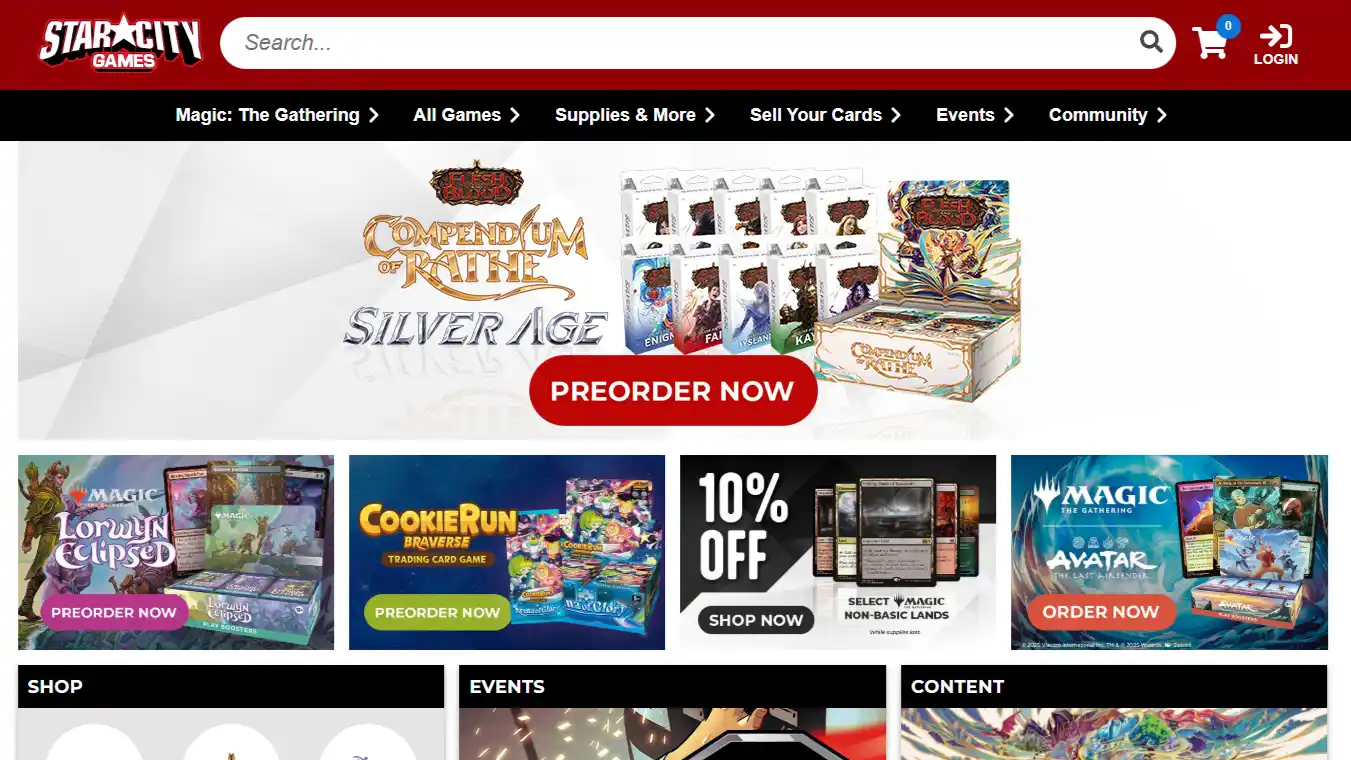
TLDR
- This Star City Games review comes down to a simple trade: you often pay a bit more to avoid marketplace chaos.
- SCG is usually worth it when you want one retailer, clear grading, and predictable shipping options.
- The big “read this first” gotcha is returns: SCG’s policy is basically “inspect fast and contact us fast,” especially for singles.
- If you want the full context on choosing between marketplaces and retailers, start here: Where to Buy Magic: The Gathering Cards Online (2026 Buyer’s Guide)
What Star City Games is actually good at
Star City Games (SCG) is a long-running MTG retailer with a reputation for being very “constructed player coded.” In plain English, that usually means:
- Big inventory of staples (especially the stuff that shows up in decklists repeatedly)
- A pricing model that is not always the cheapest, but is often more predictable than marketplace shopping
- Policies and processes that read like they’ve handled a lot of orders (because they have)
If TCG marketplaces are “let me optimize this cart for 45 minutes,” SCG is closer to “let me buy the cards and move on with my life.” If you enjoy the cart optimization mini-game, you might feel bored here. That’s not a joke, it’s a real buying preference.
Star City Games review: pricing and why it can feel higher than marketplaces
You’re rarely going to beat a big marketplace on raw price, because marketplaces are a knife fight where dozens (or hundreds) of sellers undercut each other.
SCG sits in a different lane. You’re paying for:
- One checkout
- One grading system
- One support pipeline
- One shipment more often than not

That premium is easiest to justify when the alternative is split-shipping a deck across five sellers and then discovering two of the “Near Mint” cards are what i’d describe as “Near Mint… emotionally.”
One thing SCG does fairly well is keep order management structured. Orders can sometimes be combined (more on that later), and they’ve historically run promotions that pay back some store credit during specific windows. Those promos change, so treat them as “nice when it happens,” not the core reason to shop.
Grading and condition: clear system, but fewer micro-grades
SCG uses a four-tier scale for MTG singles: Near Mint (NM), Played (PL), Heavily Played (HP), and Damaged (DMG).
A few details that matter in practice:
1) The website is basically HP and up
SCG notes that Damaged (DMG) is sold in person, while the website offers HP and better. That’s useful if you’re hunting the cheapest playable copy online and don’t want the “surprise DMG” experience.
2) Their grading is more defined than people assume
SCG says they grade primarily by evaluating the back side of the card (with specific exceptions like double-faced cards and foils), and they publish a surprisingly detailed breakdown of what counts as subtle wear vs obvious wear vs major wear. They even call out that cards printed after 2020 may have more manufacturing variance than other cards, which is a quietly important note if you’ve ever opened a pack and thought “this was printed on a Tuesday.”
3) “Played” is a wide bucket
If you’re used to retailers that split the middle into SP/LP/MP style granularity, SCG’s Played (PL) category can feel broad. The upside is simplicity. The downside is you have fewer “dial settings” when you’re trying to save money while still buying something that looks clean in a sleeve.
My take: SCG grading is a net positive if you want predictable categories, but you’ll get the best results if you’re intentional about condition. If you are picky, pay for NM. If you want cheapest-playable, HP is often the honest “this will be fine in sleeves” lane.
Shipping: lots of options, a couple of rules that matter
SCG’s shipping policy is refreshingly specific.
What to expect
- Orders ship Monday through Friday, excluding U.S. federal holidays.
- You get tracking once it ships.
- They support both UPS and USPS domestic services, with different delivery estimates and (importantly) different value limits on certain USPS services.
High-value orders: signature requirements
SCG requires signatures for domestic orders at or above a specific subtotal threshold. That’s good for security, but it also means you should not ship a $500+ order to an address where nobody can sign and then act surprised when it becomes a side quest.
The “PO box” detail
UPS does not deliver to PO boxes, so if your shipping address is a PO box, you’re realistically in USPS territory.
If you’re ordering for an event, shipping choice matters. Paying more for faster shipping hurts less than paying for overnight shipping and then realizing the issue was processing timing or signature delivery.
Order management: combining orders and the “no, we can’t edit that” reality
SCG is pretty blunt about order changes.
Modifying orders is limited
They note that items can’t be added or removed once an order is released for fulfillment, and that their goal is to fulfill and ship orders quickly (which is why they can’t always accommodate edits). Translation: double-check your cart before you hit purchase.
Combining orders can help
SCG may automatically combine eligible orders under one tracking number if certain criteria match (same email, shipping date, shipping address, and domestic UPS/USPS method). They also mention that if combining orders lowers shipping cost, the difference can be issued as store credit to your account. That last part matters: guest checkout can limit what they can credit back.
This is one of those policies that doesn’t sound exciting, but it can save you money if you place multiple orders close together.
Returns and refunds: inspect fast, because the clock is real
This is where people get annoyed, so it’s worth being direct.
SCG’s policy is essentially:
- If you want to make a return, contact them within 48 hours of receiving your order.
- Unauthorized returns may not be refunded.
- Returns on singles are generally not accepted unless the singles are defective, damaged, or incorrect, because singles prices are volatile.
That means you should do two things every time:
- Open the package promptly.
- Verify condition and contents promptly.
If you want a “i’ll deal with it next week” buying experience, this is not that.
The Ban and Reprint Return Policy is a real perk
SCG also has a Ban and Reprint Return Policy: if a publisher issues a ban and/or reprint announcement, they allow returns of singles included in that announcement that were purchased online up to 14 days prior to the announcement, for a full refund in store credit, with specific timing requirements for contacting them and shipping the return.
That policy isn’t something you’ll use every month, but if you buy competitive staples and you’ve ever been on the wrong end of a ban announcement, you can probably see why people like having it.
Selling to SCG: itemized Sell List vs Ship + Sell
Even if you’re here for buying, selling is part of why SCG stays in people’s rotation.
Sell List (itemized)
SCG’s Sell List process is for people who want itemized pricing locked in, with the normal reality that final pricing depends on grading once they see the cards. They also have process rules like needing approval before shipping and shipping within a short window to lock prices.
Ship + Sell (convenience)
Ship + Sell is the “i don’t want to sort this perfectly” option. SCG publishes expected processing timelines based on collection size, and they disclose a processing fee for Ship + Sell requests, with a reduced fee for very large totals.
The trade is simple: you save time, you pay for convenience.
If you’re trying to squeeze maximum value from your collection, itemized selling tends to be the more controlled route. If you’re trying to convert cardboard into “less cardboard” with minimal effort, Ship + Sell exists for a reason.
When SCG is worth it
In my opinion, SCG is usually a good buy when:
- You want a single retailer experience instead of marketplace split shipping
- You care about grading clarity and want predictable condition categories
- You’re buying staples and want the process to be straightforward
- You value a defined policy environment (shipping options, signatures, dispute process)
It’s also a solid option if you’re comparing “retailer order” vs “marketplace cart gymnastics.” If you want the marketplace angle, we covered that experience here: TCGPlayer.com review: our experience, what is good, and what is bad
When you might skip SCG
SCG is not always the right move if:
- Your top goal is absolute lowest price, no exceptions
- You want lots of middle-grades (LP/MP nuance) rather than broader buckets
- You tend to delay opening packages and dealing with issues (SCG is not built for procrastination-based customer service)
Verdict
This Star City Games review is basically: SCG is a strong “buy singles like an adult with a calendar” retailer. Not always the cheapest, usually more predictable than marketplaces, and clear enough about shipping, grading, and returns that you can plan around it.
If you’re price-first and love optimizing carts, marketplaces will win plenty of battles. If you’re consistency-first and want fewer packages and fewer arguments with your own eyeballs about condition, SCG earns its place in the rotation.
