
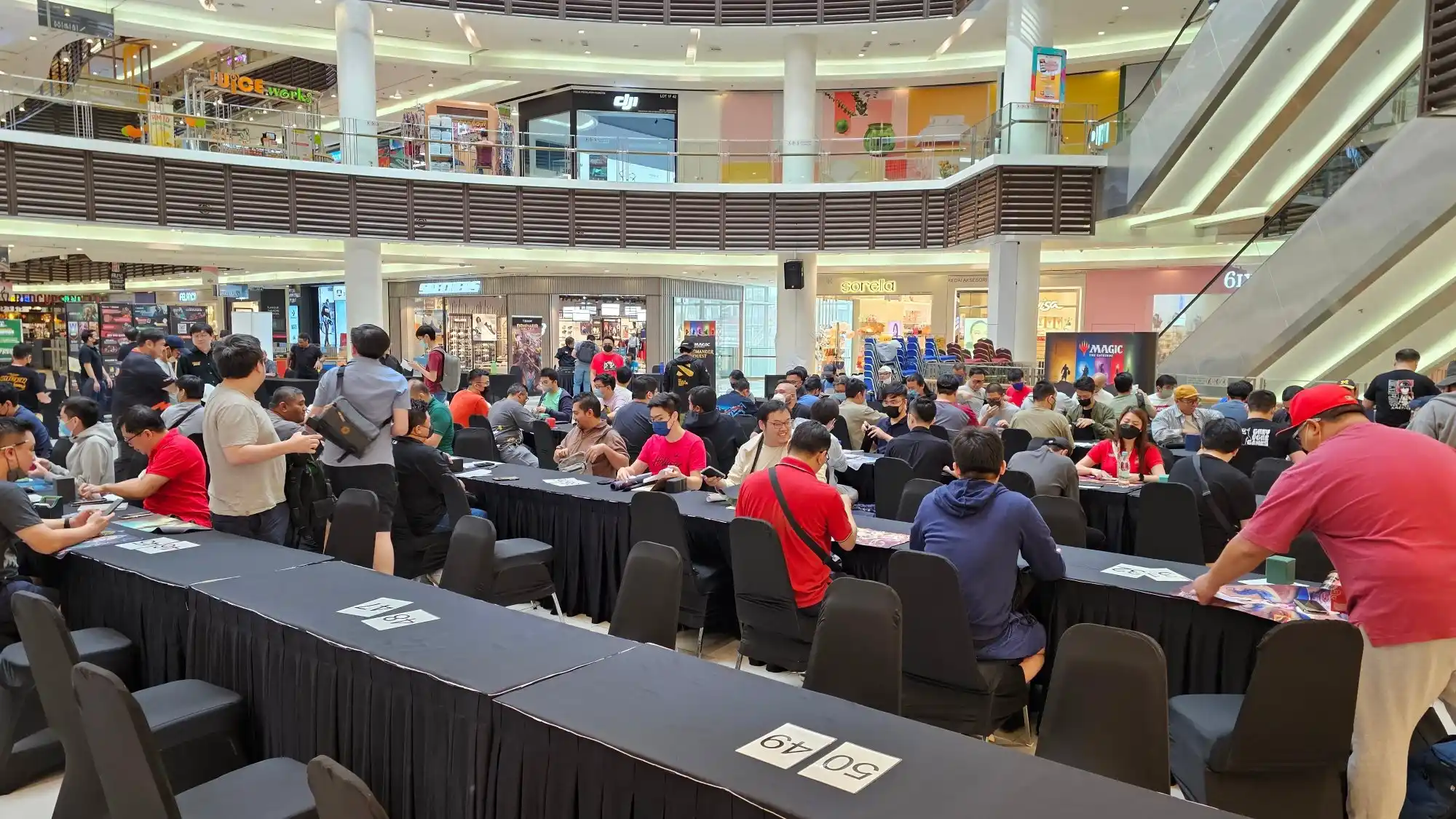
If you’ve ever played a clean, friendly kitchen table game and then walked into a sanctioned event thinking it would be the same thing with worse lighting, this is your warning label. MTG tournament shortcuts exist because nobody wants to verbally pass priority 47 times per turn, but they also change what “I meant to” means. In tournaments, your intent does not get a loyalty counter.
Before we get into the practical stuff, here’s your homework:
Now let’s talk about the stuff that actually causes friction: takebacks, missed triggers, and the “we all know what I meant” shortcuts that stop being cute the second prizes exist.
Why MTG tournament shortcuts exist (and why they feel harsher)
At a casual table, you can often narrate your way through a turn like a podcast host and everyone’s happy.
At events, the goal is closer to: “play fast, play clearly, and don’t create ambiguity.”
That’s where MTG tournament shortcuts come in. Officially, they are actions players take to skip parts of the technical sequence without announcing every micro-step. Most of them involve skipping one or more priority passes, as long as both players understand where the game is landing. Players can interrupt a shortcut by saying where they want to act, and you are not allowed to use shortcuts to create ambiguity on purpose. That last part is doing a lot of work.
The vibe is simple: tournaments want speed, but not at the cost of clarity.
Kitchen table vs tournaments: the invisible setting is REL
Organized play uses Rules Enforcement Levels (REL). You don’t need to memorize the whole scale, but you do need to know the difference in expectations:
- Regular REL (think Prerelease, most FNMs): education-first, fix mistakes, keep the game moving.
- Competitive REL (RCQs, larger constructed events): tighter policy, less leniency, judge procedures matter.
If you’ve ever heard “at Regular, derived info is basically free,” that’s not a myth. Policy explicitly treats derived information as free at Regular REL.
Translation: casual tables and Regular REL are closer cousins. Competitive REL is the stricter sibling who labels their spice rack.
The big three sources of confusion
These are the three topics that create 90% of “wait, can you do that?” arguments:
- Shortcuts (especially combat and end step)
- Takebacks (what can be undone and when)
- Missed triggers (who is responsible and what happens when you forget)
Let’s hit them in that order.
MTG tournament shortcuts you need to know before you embarrass yourself
You can live a full life without learning every shortcut. But there are a few that show up constantly and will absolutely bite you if you don’t recognize them.
Shortcut #1: “Go to combat” is not one thing
If the active player passes priority with an empty stack in main phase 1, the default assumption is that the non-active player is acting in the beginning of combat. After those actions resolve (or if nobody does anything), the active player gets priority at the beginning of combat and beginning of combat triggers can be announced then.
Practical meaning:
- If your opponent says “combat?” you typically get a chance to do “beginning of combat” actions.
- If you want to act earlier (still in main phase), you have to say so.
Shortcut #2: “Go” or “your turn” points to end step
If the active player passes priority with an empty stack in main phase 2, or uses “Go” or “Your turn,” the default assumption is the opponent is acting in the end step (unless they’re affecting whether end step abilities trigger). Also, certain non-targeting end step triggers may resolve after the non-active player passes.
Practical meaning:
- “End of turn” talk usually belongs in the end step, not some imaginary pause after everything.
- If you wanted to do something during second main, say it.
Shortcut #3: Casting a spell usually means you passed priority
Whenever a player adds an object to the stack, the default assumption is they pass priority unless they explicitly say they are retaining it.
That is why “hold priority” is an actual phrase people say out loud. If you do not say it, the table is allowed to treat your play as “spell on stack, your turn to respond.”
Shortcut #4: If you stack multiple things without saying “hold priority,” the game assumes you didn’t
If you add a group of objects to the stack without explicitly retaining priority, the assumption is you added them one at a time and let each resolve before adding the next. If someone wants to act in the middle, the sequence may get rewound to that point.
Practical meaning:
- If you’re trying to cast A, then immediately cast B before anyone can answer, you need to be explicit.
- Otherwise, you are basically offering your opponent a response window between A and B.
Shortcut #5: You can’t request priority just to be dramatic
Policy is blunt about this: you can’t request priority and then do nothing with it. If you decide you don’t want to act, the request is nullified and priority goes back to whoever had it.
Translation: “I want priority” is not a vibe check. It’s permission to do a thing.
Takebacks: the social contract nobody wrote down
Takebacks are not a rules mechanic. They are a table culture mechanic. And they change dramatically depending on whether you are playing for fun, playing for prizes, or playing with that one guy who treats every Commander night like Day 2 of a Pro Tour.
Here’s a clean way to think about it.
Kitchen table takebacks (recommended)
A reasonable casual rule is:
You can take something back if:
- No hidden information has been revealed since the action (no draws, no new cards seen, no shuffle)
- The game state is still simple enough that nobody made meaningful decisions based on the mistake
- It’s immediate, not two turns later with a full recap and a PowerPoint
Examples that are usually fine:
- “I meant to play that land before casting the spell” (and nothing else happened)
- “I tapped the wrong two lands” (and it doesn’t change what you could cast)
- “I forgot my attack trigger and we’re still in combat and nothing else happened”
Examples that usually should not be fine:
- “Actually I wouldn’t have attacked” after blockers were declared
- “Actually I wouldn’t have kept this hand” after you’ve seen two draw steps
- Anything involving a shuffle, a scry, or looking at cards that were not known
This is where kitchen table Magic stays friendly: you fix honest mistakes early, and you don’t weaponize confusion.
Tournament takebacks (what actually happens)
At events, “takebacks” are not a player-negotiated thing. If something illegal happened, call a judge.
At Regular REL, guidance is still education-first. Judges can back up if the error was caught quickly and backing up is relatively easy, but they are also warned not to go wild with it when hidden info or lots of decisions are involved.
At Competitive REL, the Infraction Procedure Guide treats backups as a last resort. It highlights how quickly information leaks in Magic, and says backups should only happen when leaving the game as-is would be substantially worse. It also emphasizes minimizing backups and being extremely cautious when unknown or random elements are involved.
If you want the one-sentence tournament take:
- Don’t assume you get takebacks. Assume you get rulings.
Out-of-order sequencing: “close enough” with guardrails
Out-of-order sequencing is the tournament version of “we all know what I meant,” but with limits.
Policy allows players to take actions in a technically incorrect order if the result is a legal and clearly understood game state once the sequence is complete. Your opponent can ask you to do it in the correct order so they can respond at the appropriate time. You also can’t use out-of-order sequencing to gain information early, or to retroactively take an action you missed.
This is important because it explains why judges let some sloppy sequencing slide, but do not let you rewind after you see how your opponent reacts.
A good mental line:
- Out-of-order sequencing is allowed to keep the game moving, not to create a free “try it and see” simulator.
Missed triggers: the fastest way to start an argument in three formats
Missed triggers are where casual norms and tournament norms diverge the hardest, because everyone thinks they know the “real rule,” and at least two of them are wrong.
At Regular REL (and many casual tables)
Regular REL guidance is straightforward:
- A triggered ability is missed if you don’t acknowledge it at the point it needs choices or has a visible in-game effect.
- If it includes “may,” assume the player chose not to do it.
- Otherwise, the judge may put it on the stack unless that would be too disruptive, especially if significant decisions were made based on it not happening.
- Opponents can choose whether or not to point out missed triggers.
That’s basically the “keep it fun and fair” model.
At Competitive REL (and why it feels colder)
The IPG defines a missed trigger as a trigger that happened but the controller didn’t demonstrate awareness by the first point it would visibly matter. It then gives specific deadlines for acknowledging different types of triggers.
The remedy is also very specific:
- Some missed triggers resolve immediately in narrow cases.
- Some delayed triggers that undo a zone change give the opponent a choice about when they resolve.
- For many other triggers, if it was missed too far back, you just continue playing.
- Otherwise, the opponent may choose whether the trigger is added to the stack. If it is, it’s inserted appropriately if possible, or placed on the bottom of the stack. And players can’t make choices that wouldn’t have been legal when the trigger should have happened.
This is the key Competitive REL reality:
- You are responsible for your triggers.
- Your opponent is not required to help you remember them.
- And a lot of the time, your opponent gets agency in whether a missed trigger comes back.
Also worth knowing: policy explicitly says that not reminding an opponent about their triggers is not Failure to Maintain Game State. It is allowed.
The social glue rule that prevents salt
If you play a lot of Commander or casual Modern, you should probably decide this as a group:
Do you want a “help each other” environment, or a “you miss it, you miss it” environment?
Both are valid. Mixing them without saying so is how you get a 45-minute argument about a Rhystic Study trigger.
If you want a default that keeps games pleasant:
- Remind people of triggers that are mandatory and visible.
- Treat “may” triggers as optional and on the controller.
- If a turn has moved on and decisions have been made, let it go.
What to say at the table (phrases that save games)
Here are DraftSim-friendly phrases that reduce drama immediately:
- “Still in main phase, I want to do something before combat.”
- “Beginning of combat, I have an action.”
- “I’m casting this and holding priority.”
- “I missed a trigger. We’re still in the same step. Can we back it up?”
- “Judge, please.” (At events, this is always correct. Even when it’s awkward.)
If you take nothing else from this article, take this:
- If you want a specific window, name the step. Vague “end of turn” language is a trap.
If you’re playing kitchen table Magic, proxies are basically the ultimate “we’re here to play the game, not your bank account” tool. As long as everyone’s on the same page, a proxy lets you test decks, try new archetypes, and keep up with your group’s power level without treating staples like a second mortgage. The social glue part matters: mention proxies up front, match the table’s expectations (sharpie-on-a-basic is fine if everyone agrees, but clean readable prints make games smoother), and don’t use proxies as a stealth upgrade to pubstomp a casual pod. Proxies won’t fly in sanctioned tournaments, but in casual games they’re often the simplest way to keep Magic accessible, keep decks interesting, and keep the focus where it belongs—on the decisions, not the price tags.
Wrap-up: tournaments are not mean, they are just explicit
Kitchen table Magic runs on trust, shared intent, and the understanding that everyone is here to have a good time.
Tournament Magic runs on policy, clarity, and the understanding that prize support makes people’s brains do weird math.
MTG tournament shortcuts are not there to trick you. They’re there to keep games moving. But they also mean you should be more explicit about timing, less dependent on takebacks, and more responsible for your own triggers.
And if you want the timing foundation that makes all of this make sense, link back to the pillar again:
MTG Timing Rules Explained: Priority, Triggers, and the Stuff That Actually Matters
