
What do you picture when you hear “Magic: The Gathering player”? If your brain immediately supplies a hoodie, a basement, and the posture of someone who has not seen the sun since Khans of Tarkir, congrats: you’ve met the greatest hits album of MTG player stereotypes.
And look, i get it. Every hobby has a stock photo version of itself. Yoga has perfect hair. Golf has pastel pants. MTG has… whatever that mental image is where someone is arguing about a triggered ability like it’s a Supreme Court case. But “stock photo” isn’t “typical.” It’s just what people who don’t play imagine, then repeat until it feels true.
The weird part is that trading card games are everywhere now. MTG, Pokémon, Lorcana, Flesh and Blood, Netrunner in the corner like an indie band that refuses to break up. Digital clients. Commander nights. Kitchen table piles. People buying packs because they love the art, because they like cracking packs, because their friend group needed a shared excuse to hang out that wasn’t “let’s stare at our phones in the same room.”
So why are the stereotypes still so sticky? Mostly because they’re convenient. Stereotypes are mental shortcuts. They’re also wrong a lot, which is kind of their thing.
The mental picture problem with MTG player stereotypes
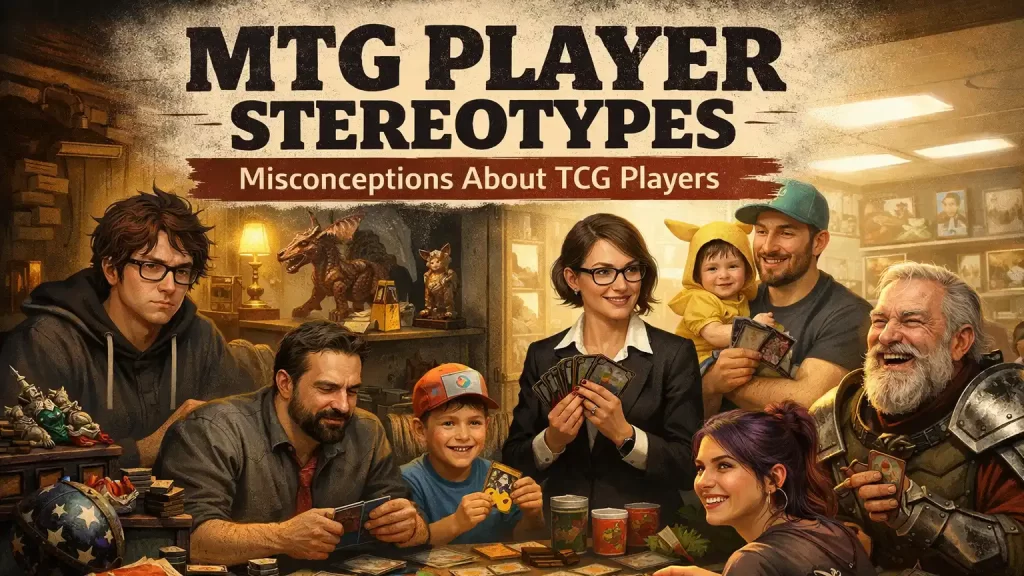
The first misconception isn’t even about behavior. It’s about identity. People assume you can spot a “TCG person” the way you can spot a delivery truck. But you can’t, because the hobby isn’t a single type of person.
Some players are teenagers. Some are parents who only get to shuffle up after the kids are asleep. Some are professionals who can calculate stack interactions faster than they can answer an email. Some people are loud. Some people are shy. Some people show up to Commander night with a backpack that looks like it’s carrying a small fridge. Some people show up with one precon and a dream.
And a lot of players don’t even look like “players” because they’re also collectors, artists, casual drafters, Arena grinders, or the friend who mostly came for vibes and snacks. The hobby has grown up, sprawled out, and gotten messy. Which is what hobbies do when they become normal.
Misconception #1: “It’s a nerd thing, and nerd means socially doomed”
This one is the classic. The assumption that TCG players are all socially awkward and isolated, like the cards are replacing human contact instead of creating it.
But the core loop of most TCG play is literally: sit down with other humans and talk. Even when people are being quiet, they’re still negotiating game actions, reading each other, laughing at ridiculous topdecks, and doing that polite half-sarcastic “nice” when someone lands the exact card that ruins everyone’s plans.
If you want a hobby that allows you to be around people without needing to perform constant small talk, MTG is basically a cheat code. The game gives you structure. You don’t have to invent conversation out of thin air. You can just say, “Draw, land, go,” and somehow that still counts as a social evening.
Also, if you’ve ever watched a pod of Commander players spend 20 minutes debating whether a player is “actually the threat,” you already know the stereotype of “no social skills” doesn’t survive contact with reality. These people are doing politics. Badly, sometimes. But still, politics.
Misconception #2: “TCG players are lazy kids dodging responsibility”
This one bothers me because it’s not just wrong, it’s lazy in its own way.
Plenty of players have jobs. Families. School. Responsibilities. They play because it’s what people do when their brains need a break that isn’t doomscrolling. Some people watch TV. Some people run. Some people build decks and pretend they’re “just testing” while secretly trying to engineer the funniest possible way to win a game with cardboard.
Also, the idea that MTG is a mindless escape is… adorable. Modern Magic asks you to track hidden information, manage resources, read board states, evaluate threats, and remember rules interactions that were clearly invented by someone who wanted to punish the concept of certainty.
If you want proof, try explaining priority to a new player without making them regret learning to read. If you need a refresher yourself, your future self will thank you for bookmarking: MTG Priority Explained: Passing, Holding, and Table Shortcuts That Cause Fights.
“Lazy” hobbies don’t require this many mental tabs open.

Misconception #3: “It’s a kids’ hobby”
Sometimes people say this like it’s an insult. Sometimes they say it like it’s a comfort. Both are funny.
Yes, kids play TCGs. That’s great. Card games can teach patience, probability, sportsmanship, reading comprehension, and how to lose with a straight face. Useful life skills, honestly.
But also: the adult presence in MTG and other TCGs is not subtle. Commander is basically a social format built for adults with limited time, complicated schedules, and a need to do something fun that doesn’t involve planning a “real outing.” And if you’ve ever looked at the price of certain singles and thought, “this feels like an adult decision, in the worst way,” you understand why the “kids’ hobby” framing doesn’t fit.
Wizards of the Coast has also publicly referenced demographic research that doesn’t match the “all teenage boys” caricature. Even years ago, their stated playerbase was not some monoculture. The stereotype lingers anyway because it’s easier than updating your mental model.
Misconception #4: “TCGs are antisocial, or they make people worse at socializing”
This is where the stereotype gets mean. The idea that playing cards makes you less connected, less adjusted, less… whatever people think “normal” is.
But most TCG communities are built around repeat interactions. You see the same people weekly. You learn names. You develop inside jokes. You become the person who always borrows dice or always forgets tokens or always says “this deck is totally casual” right before doing something horrific on turn four.
Even online play is often social. Discord servers. SpellTable pods. Arena friend lists. Group chats where decklists are shared like secret recipes. And yes, sometimes the community can be rough. Gatekeeping happens. Poor sportsmanship happens. The occasional “well actually” happens with the force of a thousand suns.
But the existence of bad behavior isn’t proof the hobby causes it. It’s proof the hobby contains humans. Humans are a mixed bag.
Misconception #5: “All MTG players are rules lawyers and gatekeepers”
Let’s be honest: this stereotype exists for a reason. Every community has its “akshually” contingent, and MTG is a game where the rules are both important and genuinely confusing.
But there’s a difference between caring about rules and using rules as a weapon. Most players who correct an interaction are doing it because they want the game to function. The problem is the tiny percentage who correct an interaction because they want to win the conversation.
And even then, the stereotype misses the bigger reality: most MTG players love teaching. They love showing someone a combo, explaining why something works, or helping a new player upgrade a deck without turning it into an arms race. They’ll send you links. They’ll lend you cards. They’ll talk about layers like it’s a bedtime story.
If you’ve ever needed the “layers” explanation that doesn’t melt your brain, here you go: MTG Layers Explained (Without Making You Regret Learning to Read).
The loud rules-lawyer stereotype tends to overshadow the quiet majority who are just trying to have a good game and go home at a reasonable hour. Or at least pretend they are.
So who are TCG players, really?
They’re people who like games with depth. People who like collecting and optimizing. People who like the feeling of improving over time. People who want a structured social activity that doesn’t require pretending brunch is fun.
They’re also people who sometimes spend too much, argue too much, and forget that the point is to enjoy the night. The hobby has flaws. Communities have flaws. Some stereotypes exist because someone, somewhere, earned them.
But the big misconceptions, the ones that paint TCG players as lazy, antisocial, immature, or universally obnoxious, don’t hold up. Most players are normal people with normal lives. The game is something they do, not the only thing they are.
And really, how could you tell? The person next to you in line might be thinking about dinner. Or their job. Or whether they should finally cut that pet card from their deck even though it’s “part of the deck’s identity,” which is a phrase that has ended more friendships than it should.
That’s the truth behind MTG player stereotypes: the stereotype is a shortcut, but the hobby is a crowd.
