
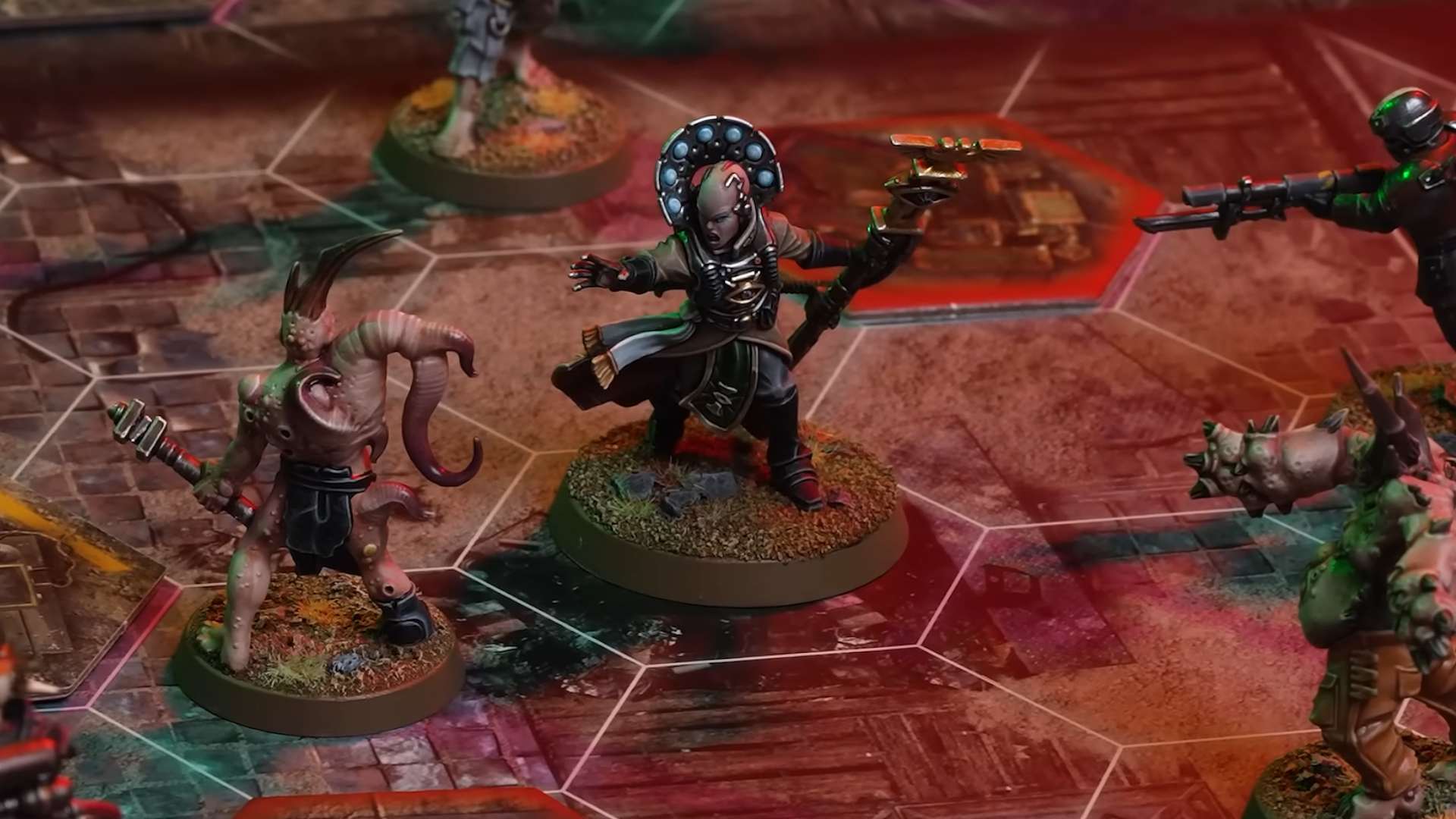
If you saw the words “Darktide board game” and pictured a big, chunky co-op box that recreates the video game’s panic, chatter, and glorious hallway problem-solving, i have news. Some of it is good. Some of it is very “Games Workshop looked at a spreadsheet and nodded politely.”
The product (officially titled Warhammer 40,000: Darktide – The Miniatures Game) is real, it’s co-op, and it’s built to be fast and approachable. It is also not trying to be a full tabletop remake of Fatshark’s Darktide. It’s closer to “Kill Team-lite with hexes” than “horde shooter in a box.”
So let’s talk about what it actually is, what’s in it, and who should care.
What the Darktide board game actually is
The pitch is straightforward: 1 to 4 players control four operatives based on the video game’s classes (Veteran, Zealot, Ogryn, Psyker) and run linked missions in Hive Tertium against traitor guardsmen and poxwalkers. Think short scenarios, small map footprint, and a light campaign layer where your team improves over time.
Games Workshop has been explicit that the rules are “based on” Kill Team, and you can feel that DNA in the way actions, shooting, and general pacing are framed. But this is not Kill Team with the serial numbers filed off. It’s simplified and structured to play quickly, with enemies driven by behavior rules and an activation deck rather than a thinking opponent.
If you’ve ever wanted something that looks like Warhammer, plays like a board game, and finishes before you accidentally start a second hobby, that’s the lane.
What’s in the box
Here’s the practical stuff, because “20 miniatures” can mean anything from “wow, a small army” to “wow, six of these are the same guy doing the same stumble.”
The Darktide board game box includes:
- 4 player operatives (Veteran, Zealot, Ogryn, Psyker)
- 10 Traitor Guardsmen
- 6 Poxwalkers
- Double-sided tiles (a small stack of boards you combine per mission)
- A campaign book with rules and missions
- Dice, tokens, and a pile of cards (datacards plus equipment, upgrades, and activation cards)
It’s a complete-in-one-box product in the sense that you can play out of the box once you assemble the minis. The tiles and print components are generally described as solid and atmospheric in reviews, even by people who are unimpressed by the rest of the package. The outer box itself, though, has gotten complaints for being less “premium board game storage” and more “thin cardboard that will eventually develop opinions about corners.”
The miniatures situation
Let’s address the part that makes long-time Warhammer folks squint: there are no new sculpts.
That is not a rumor or an early impression. It’s how the product is built. The operatives and enemies are pulled from existing Games Workshop kits. If you’ve been around 40K releases for a while, the set has a strong “i know that guy” energy.
Several reviewers have mapped the origins pretty clearly:
- The traitor guardsmen are effectively the Blooded Kill Team sprue.
- The poxwalkers are the older easy-to-build style sculpts.
- The operatives are a mix drawn from various existing sources (with at least some ties to Blackstone Fortress-era character sculpts and other kits).
What does that mean in practice?
If you are a Darktide video game fan who wanted the box art squad as bespoke minis, you may feel like you got handed a beautifully printed reminder that you are not the target demographic.
If you are a miniatures hobbyist who likes “more plastic for the pile” and doesn’t mind kit provenance, it’s fine. The sculpts are good sculpts. They’re just not uniquely Darktide in the way the name suggests. The cohesion problem is real too: the four heroes can look like they came from four different conversations.
Paint can help a lot. Paint cannot change that one of your heroes is holding a weapon that your brain insists belongs to a different game. But paint does try its best.
How it plays
Mechanically, this Darktide board game is a co-op skirmish on hexed tiles with quick turns and enemy automation.
A few consistent notes across coverage:
- Missions are designed to run in roughly 30 to 60 minutes.
- The “campaign” element is present but relatively light, mostly tied to upgrades and equipment.
- Enemies act via behavior rules rather than a human opponent, with an activation system that decides what goes next.
- The footprint is small, which is either “nice, it fits on a coffee table” or “oh… that’s it?” depending on your expectations.
One important practical detail that comes up in play impressions: even if you play with fewer than four humans, the game is still designed around having all four operatives on the board. That makes balance easier (no scaling math), but it also means a 2-player night can turn into “each of you runs two characters.” Some people love that. Some people would like to focus on one mini and keep their brain for the rest of life.
Tone-wise, it’s more “tactical co-op puzzle” than “endless tide of bodies.” You’ll still be under pressure, but the pressure comes from scenario rules, positioning, and attrition rather than from a thousand things sprinting at you like you insulted their god.
Who this is for
Let’s be blunt, because that’s kinder than pretending everyone should want this.
You will probably like it if…
- You want a compact co-op miniatures experience that doesn’t ask you to learn a 200-page rulebook first.
- You’re curious about Kill Team, but you want a softer on-ramp.
- You want Warhammer components, boards, and a campaign book packaged as a single purchase.
- You specifically want these minis and don’t already own the kits they come from.
You will probably not like it if…
- You wanted a faithful tabletop adaptation of the Darktide video game’s look and feel.
- New sculpts were the main reason you cared.
- You’re already deep in Kill Team and were hoping for something that competes with it on depth.
- You want high replay variety from the box alone (the missions exist, but this is not an endless-content dungeon crawler).
Price and value reality check
MSRP has floated around the “this is not a cheap gateway box” range, with coverage citing $100 in the US and £65 in the UK at launch. Retail listings and availability have also been inconsistent over time, which usually means some mix of limited print runs, uneven distribution, or simply “GW does what it wants, and your local shelf will adapt emotionally.”
Value depends heavily on your starting point:
- If you already own Kill Team, already have similar minis, and already have co-op board games you love, this is a hard sell.
- If you are new, want co-op, and like Warhammer aesthetics, it can be a neat one-box entry.
- If you’re mostly buying for miniatures, do the quick mental math: are you paying for plastic you’ll actually paint and use, or just renting the feeling of buying a box?
The Darktide board game is not automatically “bad.” It’s just very specific. And the mismatch between what fans imagine and what GW shipped is doing a lot of the reputational damage.
So, should you buy the Darktide board game
If your goal is “Darktide, but on the table,” temper expectations hard. This is a Warhammer product wearing a Darktide hoodie, not the video game translated directly into cardboard and dice.
If your goal is “a co-op skirmish that feels Warhammer-ish, plays fast, and comes with a campaign book,” it can absolutely do that. The best version of this box is a small, tidy co-op experience with good components, quick missions, and just enough progression to keep you moving.
The worst version is you staring at the four heroes and thinking, “these people have never met each other, and it shows.”
Either way, now you know what it is, which is honestly the rarest commodity in tabletop hype cycles.
