
TLDR
Cheap MTG proxies are best for casual Commander, cube, kitchen-table games, and deck testing, not sanctioned tournaments. For most players, ProxyMTG is the best value pick for deck-sized orders, print-at-home is the absolute cheapest route, PrintMTG is a strong budget alternative, and MPC can be cheap in bulk if you are willing to do the file work. The cheapest option is not always the least annoying option, because Magic players apparently needed one more decision tree.
Cheap MTG proxies exist because Magic is a great game with a very funny little habit of asking players to spend car-payment money on cardboard rectangles. Proxies let players test cards, build Commander decks, protect expensive originals, and run cubes without turning every game night into an accounting seminar.
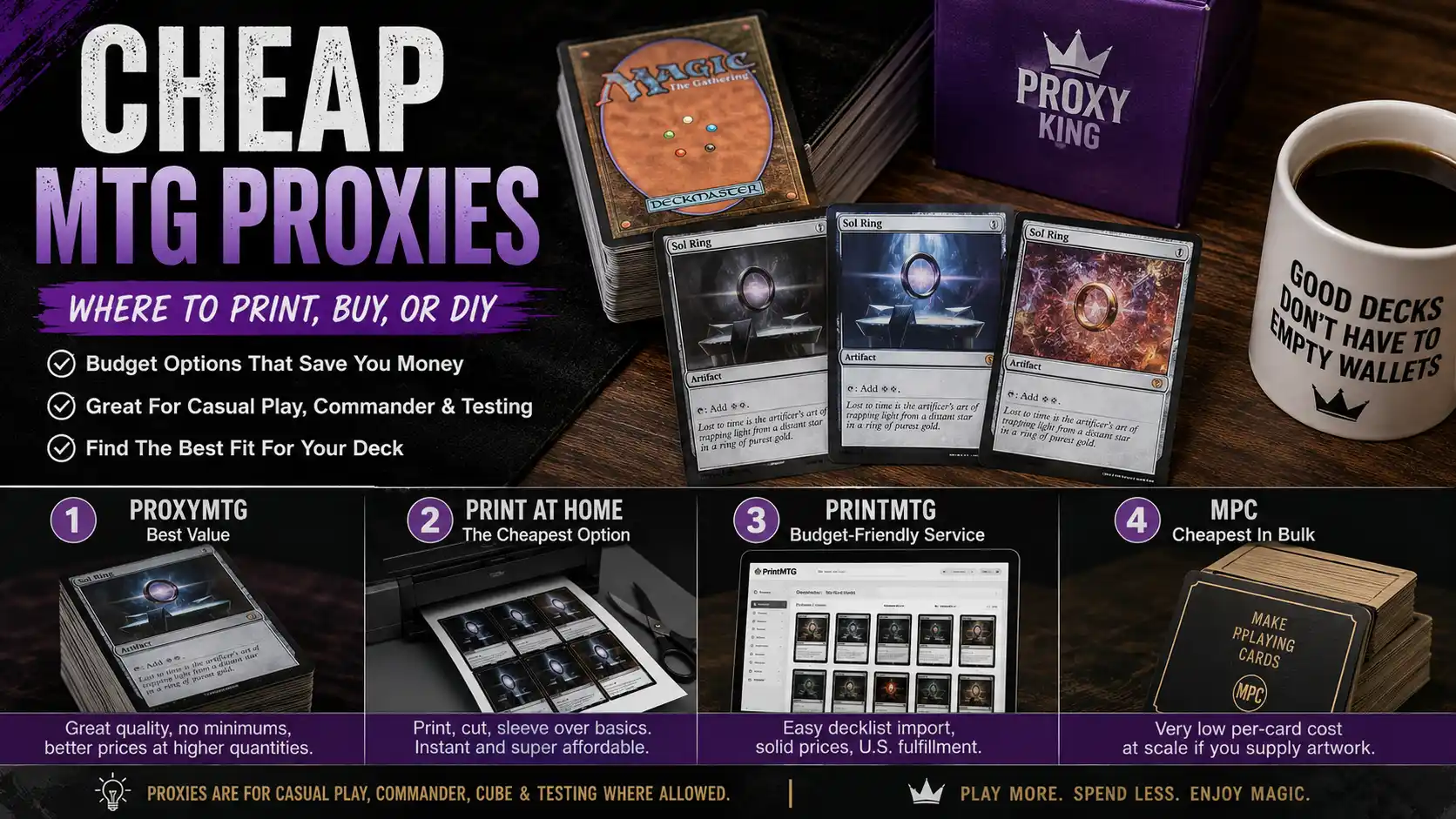
The main budget routes are simple: order on-demand cards from ProxyMTG, print paper proxies at home, use PrintMTG as a similar budget-friendly service, or use MPC when you need bulk custom card printing and can supply the artwork yourself.
What An MTG Proxy Card Is
An MTG proxy card is a clearly non-official stand-in used to represent a real Magic: The Gathering card during casual play, testing, cube, or other proxy-friendly games.
That definition matters. A proxy is not the same thing as a counterfeit. A proxy should be transparent and accepted by the people you are playing with. A counterfeit is meant to deceive someone, which is bad for players, stores, collectors, and everyone who enjoys not needing a jeweler’s loupe at Commander night.
For sanctioned Magic events, bring real cards. Official tournament rules generally require authorized, genuine Magic cards, with narrow judge-issued proxy exceptions for cards damaged during the event or similar tournament integrity issues. For a deeper rules breakdown, read How to Use MTG Proxies Responsibly and Can You Use MTG Proxies at FNM or Tournaments?.
You can proxy a single card, like a reserve-list land you want to test, or print an entire deck. Single-card proxies are convenient, but full-deck or batch orders usually get better pricing. The math is not romantic. It is just math.
Selection Criteria For Budget MTG Proxy Cards
When comparing cheap MTG proxies, focus on four things.
Per-card pricing and quantity discounts: A cheap single card may still be expensive if you buy one at a time. Budget proxy services usually make more sense when you batch 50, 100, or more cards.
Print quality and card-stock feel: A proxy does not need to imitate an authentic card perfectly. It does need to be readable, consistently sized, and usable in sleeves without feeling like you shuffled a stack of grocery receipts.
Turnaround time and shipping origin: Domestic print-on-demand services are usually easier when you need a deck soon. Overseas bulk printing can be cheaper at scale, but shipping waits have a way of arriving right after your deck enthusiasm leaves the building.
Upload complexity and required artwork: Decklist import is the friendliest workflow. Supplying every image yourself is cheaper only if your time is valued at exactly zero dollars, which is how many hobby projects lie to us.
Top 4 Cheap Proxies And Printing Options For Magic The Gathering
1. ProxyMTG, Best Value Cheap MTG Proxy Cards
ProxyMTG is the best overall value option for most players who want cheap MTG proxies without turning the order process into a graphic design internship. The site is built around MTG card ordering, so you can search for cards, pick versions, build lists, and take advantage of quantity-based pricing.
As of July 2026, ProxyMTG lists tiered pricing that drops as order size increases. A single card is listed at $3. Orders of 2 to 9 cards are $2 each, 10 to 29 cards are $1.50 each, 50 to 74 cards are $1 each, 75 to 99 cards are $0.80 each, and 100 to 199 cards are $0.55 each. That means a 100-card deck-sized order can be roughly $55 before shipping, taxes, or any checkout changes.
Small warning from the land of shopping-cart weirdness: if you are at 99 cards, check whether adding one more card pushes you into a better tier. Sometimes the cheapest card in the order is the 100th one, because pricing tables enjoy being tiny riddles.
ProxyMTG also emphasizes no minimums, free shipping over a stated threshold, premium stock, UV coating, precision cutting, and a workflow designed for MTG cards. That combination is why I would start here for normal Commander decks, cube updates, staple batches, and casual testing sets.
Key Strengths
ProxyMTG’s biggest strength is the balance of price and ease. You are not building every card file yourself. You are not manually laying out pages. You are not cutting 100 rectangles while slowly becoming a person who owns a paper guillotine.
The cards are intended for consistent sizing, clean readability, and a playable finish in sleeves. No-minimum ordering also helps if you only need a few casual upgrades, although small orders are not the best per-card value.
Possible Limitations
Single-card pricing is higher than deck-sized order pricing, so lone proxies are convenient but not the cheapest way to buy. Regional shipping and delivery timing can also affect the final value. Always compare the total cart cost, not just the advertised per-card price. Shipping has ruined many beautiful spreadsheets.
2. Print At Home, The Absolute Cheapest Way To Save Money
Print-at-home proxies are the cheapest route if your priority is spending as little cash as possible right now. The standard method is simple: print paper proxies, cut them out, and sleeve them over basic lands or bulk cards.
This is the best choice for immediate testing. Want to know if a card belongs in your deck before ordering a nicer proxy or buying an official copy? Print it tonight. Sleeve it. Play some games. Discover that the card is either brilliant or that your deck has once again become a Rube Goldberg machine with lands.
A simple home-printing workflow looks like this:
- Make a list of the cards you want to test.
- Use a proxy PDF tool or print layout that places multiple card fronts on each page.
- Print at 100 percent scale so the card fronts fit correctly in sleeves.
- Use normal paper for quick testing or heavier paper for better handling.
- Cut cleanly with a paper cutter if possible.
- Sleeve each paper proxy over a basic land or bulk card.
- Tell your playgroup before the game starts.
Do not try to recreate official backs, security features, or anything meant to confuse someone. The goal is a readable playtest card, not a tiny cardboard ethics problem.
Key Strengths
Print at home has near-zero per-card monetary cost once you own basic supplies. It is instant, flexible, and great for trying multiple deck changes before committing to printed cards.
It is also perfect for short-term testing. If you are swapping 15 cards every week, print-at-home is more practical than ordering physical cards every time your deck has an identity crisis.
Possible Limitations
The downside is time. Cutting and sleeving a full deck is not hard, but it is tedious. Home printers also vary wildly in color, centering, and clarity. Some paper proxies look clean. Others look like they were produced during a thunderstorm.
Use print-at-home proxies when cost and speed matter most. Use a printing service when you want better durability, cleaner handling, and less arts-and-crafts energy.
3. PrintMTG, Another Great Budget-Friendly MTG Proxy Service
PrintMTG is another reliable budget-friendly MTG proxy service with decklist import, card search, custom card tools, and quantity-based pricing. As of July 2026, PrintMTG lists a similar tier structure: $2 each for 2 to 9 cards, $1.50 each for 10 to 29, $1.25 each for 30 to 49, $1 each for 50 to 74, $0.80 each for 75 to 99, $0.55 each for 100 to 199, and lower pricing at larger quantities.
PrintMTG’s decklist import is the main convenience. You can paste or upload a list, choose versions, review the order, and avoid manually building every card file. That is the kind of workflow that matters when you are ordering a Commander deck and already spent enough mental energy deciding whether your mana base is “fine.” It is not fine. It is never fine.
Compared to ProxyMTG, PrintMTG is very close in budget positioning and listed pricing. ProxyMTG gets my nod here as the best value recommendation for typical deck orders, but PrintMTG is absolutely worth checking when you want an alternate quote, prefer its design tools, or are already using its decklist workflow.
Key Strengths
PrintMTG offers straightforward deck imports, easy pricing, and no stated minimums. It is also U.S.-focused, with listed U.S. contact details and typical production language around orders shipping within a few business days.
The print quality positioning is similar: premium black-core stock, standard sizing, and a finish intended for casual play in sleeves.
Possible Limitations
During peak periods, custom print services can slow down. Brand-new releases may also take time to appear in card databases. If you need cards for a specific event, order earlier than your optimism suggests.
Also, compare the actual cart total. Proxy services often look identical until shipping, discounts, stock options, or order size changes the math.
4. MPC, Cheap In Bulk If You Supply Artwork
MPC, or Make Playing Cards, is not an MTG-specific proxy site in the same way ProxyMTG and PrintMTG are. It is a custom card printer. That distinction is important because MPC can be cheap in bulk, but you need to bring your own print-ready artwork and manage the upload process yourself.
MPC offers custom game cards in a 63 x 88mm size, with multiple card-stock and finish options. It can handle large custom decks, and its pricing model can become attractive when you are printing large quantities or duplicate decks. For cube owners, custom game designers, and people who enjoy file prep because apparently peace was never an option, MPC can make sense.
The tradeoff is workflow. You are responsible for artwork, bleed, image resolution, fronts, backs, card count, and upload accuracy. MPC is also an overseas production route for many U.S. buyers, with Hong Kong and China operations commonly associated with the company, so plan for longer shipping and more variables than a domestic MTG proxy service.
Key Strengths
MPC can offer very low per-card costs at scale. It also has wide card-stock and finish options, including blue-core and black-core materials, custom backs, and different packaging choices.
If you are printing hundreds of cards and already have clean artwork, MPC may be the cheapest bulk route.
Possible Limitations
MPC is not the easiest option. The file prep can be tedious, the upload process takes time, and errors are your problem if you supplied the wrong files. Longer international shipping can also make it a poor choice when you need cards quickly.
Use MPC when you care most about bulk pricing and control. Avoid it when you want a simple decklist-to-door experience.
Quick Comparison Of These Cheap Proxies
| Option | Best For | Budget Picture | Main Tradeoff |
|---|---|---|---|
| ProxyMTG | Typical deck orders and casual staples | Strong deck-sized pricing, especially 100+ cards | Single-card orders cost more per card |
| Print at Home | Instant testing and lowest upfront spend | Cheapest monetary cost | Time spent cutting, inconsistent print quality |
| PrintMTG | Alternate budget service with easy imports | Similar quantity discounts to ProxyMTG | Compare turnaround and cart total |
| MPC | Very large bulk runs with supplied artwork | Potentially very low at scale | Complex setup and longer shipping |
How To Choose The Right MTG Proxy Or Printing Route
Choose Based On Your Budget And Quantity Needs
If you need the lowest possible upfront cost, print at home. It is hard to beat paper, ink, and a sleeve over a basic land.
If you need the lowest per-card cost at very large scale and already have artwork, consider MPC. But price the whole cart. Shipping, stock choices, deck size, and packaging can change the answer.
For normal Commander decks and batches of staples, ProxyMTG is the most practical value pick. The per-card price becomes much better when you batch your order instead of buying one card every time your deck gives you a new bad idea at midnight.
Choose Based On Quality And Play Feel
If you want better in-sleeve feel on a budget, choose ProxyMTG first. The goal is not to fool anyone. The goal is to have readable, consistent play pieces that shuffle naturally and do not make your deck feel like a craft project.
PrintMTG is also a good choice when you want consistent quality quickly and like the deck import process.
Print-at-home is good enough for testing, but not as satisfying for long-term play. MPC can be excellent, but only if you prepare files well and choose appropriate stock.
Choose Based On Workflow And File Requirements
If you hate file prep, use ProxyMTG or PrintMTG. Decklist import exists for a reason.
If you are comfortable with image files, bleed areas, resolution checks, and manual uploads, MPC becomes more attractive. It is not impossible. It is just the sort of process where one missed setting can make you stare silently at your monitor for several minutes.
Choose Based On Single Card Versus Full-Deck Orders
For a few singles, ProxyMTG is convenient. For full decks, batch the order and use quantity discounts.
For a whole Commander deck, check the pricing tier carefully. A 100-card order may price much better than a 99-card order depending on the service’s current bracket. Yes, that is silly. No, you should not ignore it.
Which Option Should The Reader Pick?
Choose ProxyMTG if you want the best cheap MTG proxies with good quality, easy ordering, and solid value for deck-sized orders.
Choose PrintMTG if you want a strong budget alternative with decklist import, similar pricing, and custom card tools.
Choose MPC if you are planning a large bulk print run and can supply your own artwork without spiraling into file-prep despair.
Choose print at home if you need the absolute cheapest option right now and do not mind cutting, sleeving, and accepting a less polished result.
Practical Tips To Make Proxies Even Cheaper
Order in batches instead of dripping single-card purchases. Quantity discounts are usually where the savings live.
Print staples once and reuse them across brews. If you test Rhystic Study in five decks, you probably do not need five separate copies unless your playgroup runs simultaneous Commander cloning experiments.
Prioritize readable text over perfect art choices. Fancy art is nice. Not knowing what a card does because the text box looks like fogged glass is less nice.
Check your cart at tier breakpoints. If 100 cards are dramatically cheaper per card than 99, add a token, basic, or another staple you know you will use.
Use sleeves consistently. Whether you use paper proxies or printed cards, consistent sleeves help everything handle cleanly and avoid marked-card issues in casual play.
Ask your playgroup first. A 10-second Rule 0 conversation is cheaper than buying cards your pod does not want to play against.
Final Notes On Cheap MTG Proxies And Proxy Cards
Cheap MTG proxies are one of the simplest ways to keep Magic accessible. They let players test decks before buying cards, build casual Commander lists without draining the hobby budget, and run cube environments that would otherwise cost a deeply unserious amount of money.
Just keep the social contract clean. Be upfront. Respect tournament rules. Do not misrepresent proxies as real cards. And when in doubt, ask the store or playgroup before you shuffle up.
The best cheap proxy route is the one that matches your actual need: print at home for instant testing, ProxyMTG for practical budget quality, PrintMTG for a strong alternate workflow, and MPC for bulk printing when you are ready to do the artwork labor yourself.
Savings help keep Magic playable. Which is good, because the game already has enough ways to punish us. Usually with a turn-one Sol Ring.
FAQs
Are cheap MTG proxies legal?
Cheap MTG proxies are fine for casual play when your playgroup or event organizer allows them. They are not legal in sanctioned Magic tournaments, except for narrow judge-issued proxy situations under official tournament rules.
What is the cheapest way to proxy a Commander deck?
Print at home is the cheapest monetary option. Print paper proxies, cut them out, and sleeve them over basic lands or bulk cards. For a more polished deck-sized order, compare ProxyMTG and PrintMTG pricing at the 100-card tier.
Is MPC cheaper than ProxyMTG or PrintMTG?
MPC can be cheaper at large scale, especially for bulk or duplicate custom decks, but only if you supply print-ready artwork and are willing to handle file prep. For normal MTG deck orders, ProxyMTG and PrintMTG are easier.
Are paper proxies good enough for testing?
Yes. Paper proxies sleeved over basics are perfectly useful for testing card choices, mana curves, and deck ideas. They are less durable and less polished than printed proxy cards, but they do the job.
Should I buy single proxies or print a whole deck?
Buy singles when you only need a few cards. Batch larger orders when you want the best per-card price. For Commander, check whether adding cards moves your order into a better quantity bracket.
Can I use cheap proxies at my LGS?
Only if the store or event allows them. Casual unsanctioned games may allow proxies, while sanctioned events generally require authentic Magic cards. Ask before you play. It is boring advice, which is how you know it is probably correct.
References
PrintMTG: MTG proxy printing, deck list upload, card maker, materials, production timing, no minimums, and pricing tiers.
https://printmtg.com/proxies/
PrintingProxies: S33 German Black Core cardstock, deck-list-friendly ordering, supported games, worldwide shipping, and pricing tiers.
ProxyKing.biz: MTG proxy catalogue, product examples, pricing examples, printing quality claims, and proxy-use guidance.
https://proxyking.biz/
Wizards of the Coast: proxy policy communication and Magic Tournament Rules for authorized cards and judge-issued proxies.
https://magic.wizards.com/en/news/announcements/proxies-policy-and-communication-2016-01-14
