
TLDR
The best home pinball machine is not always the easiest game, the newest game, or the highest-rated game. A good home-use pinball machine should be fun quickly, fair enough for casual players, deep enough to keep experienced players interested, and reliable enough that it does not become a maintenance project.
For beginner-friendly home use, we look at several practical metrics: code depth, shot difficulty, fairness and draininess, shot satisfaction and flow, family and guest appeal, and collection fit. Theme matters too, but theme preference is personal enough that we leave it out of the ranking model.
Note that this is my opinion. You still need to consider for yourself how much you like any given theme. Additionally, keep in mind that older pins like Lord of the Rings may be more prone to mechanical issues and have existing wear and tear.
Finally, the below doesn’t include price! Pirates is $20k because it’s so limited. Currently Evil Dead commands a princely sum because it’s hot right now.
| Game | Collection Fit |
|---|---|
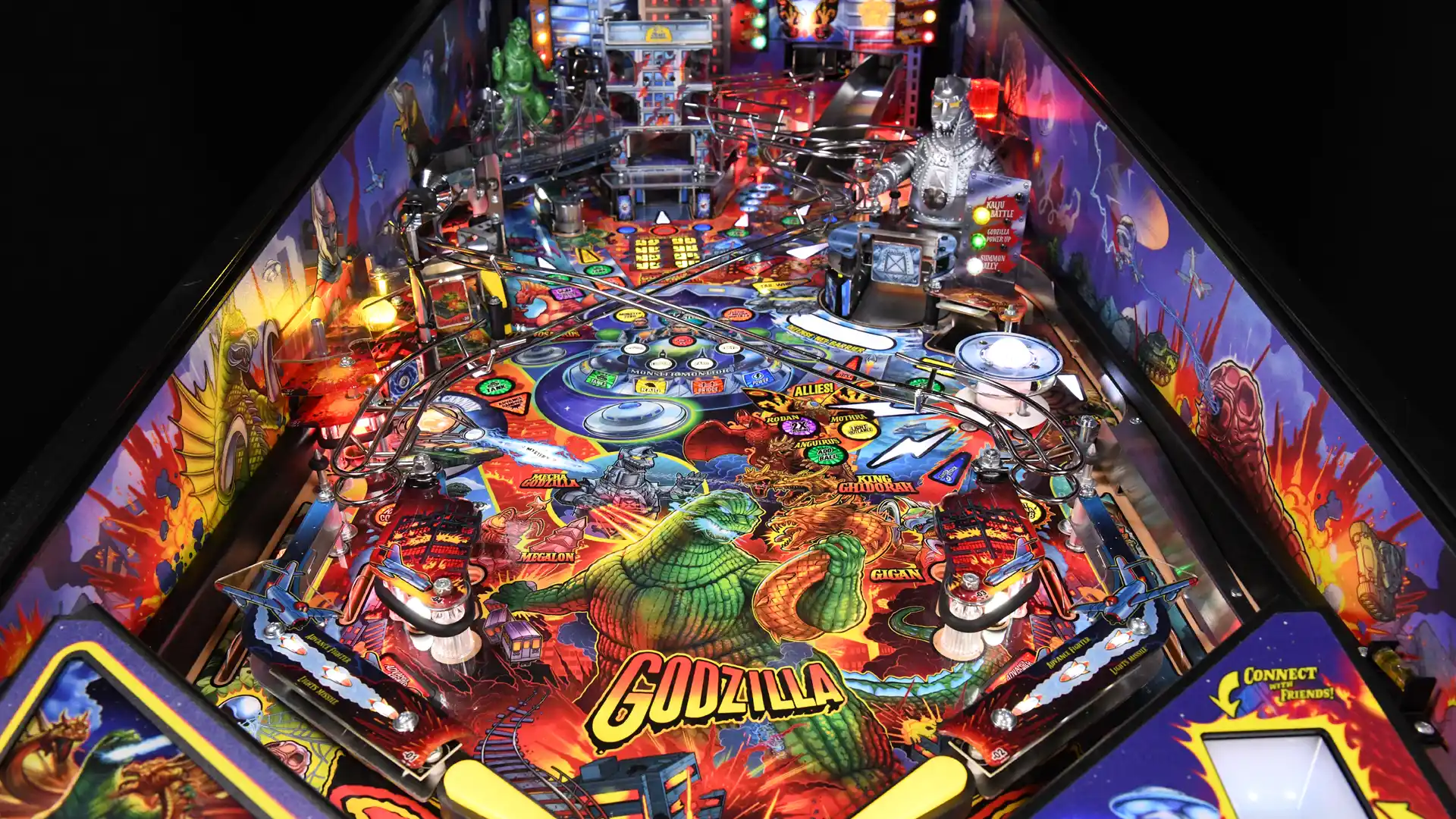
| Godzilla | Deep modern cornerstone game with huge theme appeal, strong toys, and long-term replay value. |
| Dune | Serious sci-fi adventure game with premium presentation, deep strategic play, collectible. |
| Dungeons & Dragons | Modern fantasy campaign pin with progression, monsters, and strong long-term home appeal. |
| LOTR | Proven fantasy quest classic with deep rules, approachable play, and strong collector staying power. |
| Jaws | Tense movie-adventure pin with strong theme integration and challenging modern Stern feel. |
| King Kong | Modern monster-adventure game with big shots, spectacle, and Stern-style depth. |
| Jurassic Park | Deep, rewarding, high-challenge adventure game for skilled players. |
| Evil Dead | Limited horror collector piece with adult theme appeal, wild toys, and boutique-game energy. |
| Harry Potter | Broad family showpiece with huge theme recognition, modern presentation, and guest-friendly magic. |
| Medieval Madness | Timeless classic comedy/fantasy pin that almost anyone can understand and enjoy quickly. |
| Attack From Mars | Classic arcade-comedy pin with simple goals, huge guest appeal, and timeless replayability. |
| Iron Maiden | Elite modern shooter with fast flow, skill depth, and fantasy-metal presentation. |
| Cactus Canyon + Lyman | Approachable comedy/western pin with relaxed fun, friendly shots, and improved home depth. |
| Black Knight SOR | Aggressive fantasy-metal game with intensity, speed, and a hard-edged personality. |
| Ghostbusters | Funny, spooky movie pin for fans comfortable with a tougher layout. |
| Alien Ripley | Dark sci-fi horror pin with atmosphere, widebody layout, and niche cinematic appeal. |
| Tron Legacy | Stylish neon sci-fi flow game with distinct visual identity and high shot satisfaction. |
| Labyrinth | Charming boutique fantasy pin with softer family appeal, unique presentation, and cult-movie warmth. |
| Monster Bash | Family-friendly classic monster pin with humor, simple goals, and broad guest appeal. |
| Deadpool | Casual-friendly modern Stern with humor, clear rules, approachable shots, and fast repeat play. |
| JJP Pirates | Huge spectacle pin with deep rules, movie adventure energy, and big-budget collector presence. |
| Pulp Fiction | Adult retro-style movie pin with strong personality, simpler rules, and old-school physical feel. |
| Elvira HOH | Campy horror-comedy pin with approachable shots, playful theme integration, and adult collector charm. |
| Stern Star Wars 2017 | Deep, fast, challenging Stern built around original-trilogy Star Wars moments. |
| Star Trek | Fast, flowing Stern player’s game with strong sci-fi energy and excellent value when upgraded. |
| Beetlejuice | Quirky spooky-comedy collector pin with strong art direction, novelty, and boutique appeal. |
| SW FOTE | Newer Star Wars pin with modern Stern presentation, collector interest, and early-release upside. |
| Stranger Things | Darker sci-fi/horror pin with Demogorgon spectacle, show appeal, and 1980s nostalgia. |
| Metallica / Remastered | High-energy music pin with modern upgrades, strong shots, and broad rock-themed appeal. |
| Bond 007 | Spy/action pin with classic Bond style, gadgets, villains, and mission-based play. |
| Foo Fighters | Fast, kinetic modern Stern with comic-book alien adventure framing and high-energy music flow. |
| AIQ | Rules-focused Marvel pin with deep gem strategy and long-term optimization. |
| Uncanny X-Men | Unique modern Stern with unusual geometry, comic-book theme, and evolving code. |
| Venom | Value-oriented modern Stern for Marvel fans interested in character progression and Insider-connected play. |
| TNA | Pure player’s pin with intense speed, simple rules, brutal challenge, and arcade-style focus. |
| Game | Code Depth | Shot Ease / Difficulty | Fairness / Draininess | Flow / Shot Satisfaction | Family / Guest Appeal | Weighted Average |
| Godzilla | 2 | 10 | 7 | 1 | 2 | 4.0 |
| Harry Potter | 7 | 9 | 6 | 10 | 1 | 6.7 |
| LOTR | 9 | 4 | 4 | 7 | 12 | 7.5 |
| Dungeons & Dragons | 3 | 16 | 8 | 17 | 16 | 10.5 |
| Star Trek | 8 | 11 | 12 | 4 | 25 | 11.3 |
| JJP Pirates | 1 | 26 | 10 | 26 | 6 | 11.7 |
| Foo Fighters | 11 | 15 | 16 | 5 | 14 | 12.0 |
| Dune | 6 | 19 | 14 | 9 | 23 | 12.8 |
| Iron Maiden | 10 | 14 | 15 | 2 | 27 | 13.0 |
| Deadpool | 23 | 3 | 3 | 19 | 8 | 13.2 |
| Jaws | 14 | 17 | 13 | 13 | 9 | 13.3 |
| Cactus Canyon + Lyman | 28 | 1 | 2 | 15 | 7 | 13.5 |
| King Kong | 15 | 13 | 18 | 11 | 11 | 13.8 |
| Metallica / Remastered | 20 | 8 | 11 | 8 | 20 | 14.5 |
| Jurassic Park | 5 | 31 | 31 | 6 | 10 | 14.7 |
| Elvira HOH | 12 | 5 | 17 | 21 | 21 | 14.7 |
| Monster Bash | 32 | 2 | 1 | 20 | 3 | 15.0 |
| Medieval Madness | 33 | 6 | 5 | 12 | 4 | 15.5 |
| Attack From Mars | 34 | 7 | 9 | 16 | 5 | 17.5 |
| AIQ | 4 | 21 | 22 | 28 | 30 | 18.2 |
| Evil Dead | 13 | 25 | 19 | 24 | 29 | 20.5 |
| Bond 007 | 19 | 18 | 24 | 23 | 24 | 21.2 |
| Pulp Fiction | 31 | 12 | 21 | 18 | 22 | 22.5 |
| Tron Legacy | 29 | 29 | 20 | 3 | 26 | 22.7 |
| Stranger Things | 26 | 28 | 26 | 22 | 13 | 23.5 |
| Labyrinth | 25 | 24 | 27 | 29 | 19 | 24.8 |
| SW FOTE | 17 | 33 | 33 | 35 | 17 | 25.3 |
| Beetlejuice | 30 | 27 | 23 | 25 | 18 | 25.5 |
| Alien Ripley | 16 | 30 | 28 | 32 | 34 | 26.0 |
| Ghostbusters | 21 | 35 | 35 | 30 | 15 | 26.2 |
| Venom | 22 | 23 | 29 | 31 | 31 | 26.3 |
| Black Knight SOR | 27 | 20 | 25 | 27 | 33 | 26.5 |
| Stern Star Wars 2017 | 18 | 32 | 34 | 33 | 28 | 27.2 |
| TNA | 35 | 22 | 30 | 14 | 35 | 28.5 |
| Uncanny X-Men | 24 | 34 | 32 | 34 | 32 | 30.0 |
Why Beginner-Friendly Does Not Always Mean Easy
A beginner-friendly pinball machine does not have to be shallow. In fact, many of the best home games work because they are easy to enjoy at first but still have enough depth to reward months or years of play.
That balance matters. A game can have simple shots and still get boring quickly. Another game can have deep code but feel exhausting if every missed shot drains. For home use, especially in a family game room, the best machines usually sit somewhere in the middle: approachable, fair, satisfying, and replayable.
That is why we do not rank games by one number alone. We separate the experience into specific categories.
Metric 1: Code Depth
Code depth measures how much there is to do in the game beyond simply keeping the ball alive.
A deeper code package usually includes things like:
- modes with different objectives
- multiballs with different scoring rules
- wizard modes or final objectives
- progression systems
- strategic choices
- stacking opportunities
- character, item, or location selection
- saved progress or campaign-style features
Deep code is valuable for home use because a home machine gets played repeatedly. A game that is exciting for ten plays may not stay exciting for 300 plays unless the rules give players something to chase.
That said, code depth is not automatically better. Some deep games feel rewarding and clear. Others feel like homework. A beginner-friendly home game should have enough code to last, but not so much that nobody understands why anything is happening.
Games that tend to score well in code depth include modern Sterns with layered rule structures, adventure pins with clear progression, and larger JJP or boutique games with extensive mode systems. Games with older classic layouts may score lower here, even when they remain extremely fun.
Metric 2: Shot Difficulty
Shot difficulty measures how hard the important shots are to hit consistently.
This is not the same as overall game difficulty. A game can have difficult shots but generous saves, or easy shots but brutal outlanes. Shot difficulty is specifically about the physical layout: ramps, loops, scoops, bash toys, upper flippers, standups, or tight angles.
For beginner-friendly home use, easier shot packages are usually better. New players need to feel like they can hit something meaningful. A game where every major objective requires a precise repeatable shot can become frustrating fast.
Approachable shot layouts often have:
- wide ramps
- clear targets
- obvious main shots
- readable geometry
- forgiving feed paths
- satisfying shots that can be hit by casual players
Harder shot layouts often include:
- narrow ramps
- upper-flipper dependency
- dangerous center shots
- tight loops
- sharp rejects
- unusual geometry
- shots that must be hit perfectly to work
Hard shots are not bad. Many excellent player’s games are built around demanding shots. But for home use, especially with kids, guests, or newer players, shot difficulty should be considered carefully.
Metric 3: Fairness And Draininess
Fairness and draininess may be the most important beginner-friendly metric.
This measures what happens when a player misses, loses control, or gets a bad bounce. Does the game give the player a chance to recover, or does it constantly punish them with straight-down-the-middle drains, outlane drains, and brutal rejects?
A fair game can still be challenging. The difference is that the player usually understands why the ball drained. An unfair-feeling game creates frustration because balls disappear before the player feels like they had a chance.
This metric looks at:
- outlane behavior
- center-drain risk
- dangerous rebounds
- scoop kickouts
- ramp rejects
- slingshot violence
- ball-save usefulness
- whether the game feels recoverable
- how much setup affects the experience
For home use, fairness matters because casual players are more likely to quit when a game feels cheap. A difficult but fair game can still be rewarding. A drainy game can become annoying even if the theme and code are excellent.
This is also where setup matters. Pitch, leveling, flipper strength, rubber choice, outlane post position, ball save settings, and game-specific adjustments can move a machine from frustrating to enjoyable.
Metric 4: Shot Satisfaction And Flow
Shot satisfaction and flow measure how good the game feels when it is playing well.
This is the “one more game” metric. It is about rhythm, ball movement, combos, ramps, loops, returns, and whether the machine feels alive in your hands.
A game with strong flow often has:
- satisfying ramp returns
- smooth loops
- natural combo paths
- shots that feed cleanly back to flippers
- a good mix of speed and control
- meaningful risk and reward
- a layout that feels better as you improve
This metric is why some difficult games still work beautifully in a home collection. A game may be demanding, but if the shots feel great, players keep coming back. Iron Maiden, Star Trek, Godzilla, Tron, and other flow-forward games often appeal to players because the act of shooting them is satisfying even before the rules are fully understood.
On the other hand, a game can have deep code and impressive toys but still feel clunky if the ball movement is stop-start, scoop-heavy, reject-heavy, or awkward. For long-term ownership, physical feel matters just as much as rules.
Metric 5: Family And Guest Appeal
Family and guest appeal measures how quickly a casual player can walk up, understand the fun, and enjoy the machine.
This is not just about theme recognition. A huge license can still be a poor guest game if the shots are too hard, the rules are confusing, or the ball drains constantly. Likewise, a non-licensed classic can be fantastic for guests if the goal is obvious and the playfield is fun.
Strong family and guest machines usually have:
- clear goals
- funny or exciting callouts
- recognizable toys or targets
- forgiving ball times
- satisfying early achievements
- a theme that people understand quickly
- rules that do not require a full explanation before playing
This is where games like Monster Bash, Medieval Madness, Attack From Mars, Cactus Canyon, Deadpool, Godzilla, and Harry Potter tend to be strong. They give players something fun almost immediately.
More complex games can still be great for home use, but they may be better for owners than guests. A rules-heavy game might be excellent for the person who bought it but less inviting for someone playing one casual game after dinner.
Metric 6: Collection Fit
Collection fit asks what role a machine plays in a broader lineup.
This metric is less about whether a game is “good” and more about whether it adds something useful. A collection with five brutally hard games may need a friendly classic. A collection full of simple 1990s games may benefit from a modern deep-code Stern. A room full of music pins may need a fantasy, horror, sci-fi, or movie-adventure game to add variety.
Collection fit considers:
- gameplay variety
- difficulty variety
- theme variety
- era variety
- manufacturer variety
- guest-friendly balance
- whether the game overlaps too much with what is already in the room
For a first home pinball machine, collection fit is simple: the game needs to do many things well. For a second, third, or fourth machine, collection fit becomes more important. A game may be excellent on its own but redundant next to similar machines.
How To Use The Rankings
The rankings should not be read as one universal answer. They are best used as a decision tool.
For example, a game that ranks high in code depth but low in family appeal may be excellent for a serious player but less ideal for a family game room. A game that ranks high in fairness and guest appeal but lower in code depth may be perfect as a first machine or casual fun machine, but less compelling as a long-term solo challenge.
A practical way to use the rankings is to ask:
- Do we want a deep long-term game or a lighter fun game?
- Will beginners and guests play this often?
- Are we okay with a harder shooter?
- Does the game feel fair, or does it punish missed shots too harshly?
- Does the layout feel satisfying enough to play repeatedly?
- What role would this game fill in the collection?
The right answer depends on the buyer. A skilled player may love a difficult, deep, demanding game. A family with younger players may be much happier with something more forgiving. A collector may value rarity, presentation, and theme. A casual home buyer may simply want something everyone enjoys.
Best Types Of Pinball Machines For Beginner-Friendly Home Use
The Safest Family Picks
These are the types of games that usually work well for a broad household:
- clear goals
- approachable shots
- forgiving play
- strong humor or spectacle
- easy replay value
Classic examples tend to include games like Monster Bash, Medieval Madness, Attack From Mars, Cactus Canyon, Deadpool, and other machines where the fun is obvious quickly.
These are great choices when the machine will be played by guests, kids, spouses, or casual players who do not want to study a rulesheet.
The Best Deep Home Games
These machines are better for players who want long-term progression and deeper strategy.
They may include:
- campaign-style rules
- layered modes
- wizard-mode progression
- strategic multiball stacking
- character or location choices
- long-term scoring depth
Games like Godzilla, Dungeons & Dragons, Lord of the Rings, Dune, Avengers: Infinity Quest, Jurassic Park, Harry Potter, and JJP Pirates tend to belong in this conversation, though each one has a different difficulty and family-friendliness profile.
These are better when the owner wants a machine that keeps opening up over time.
The Best Shooter’s Games
Some games earn their place because the shots feel so good.
They may not be the easiest, and they may not always be the most family-friendly, but they reward skill and improvement. These are machines where the ramps, loops, combos, and flow keep pulling players back.
Games like Godzilla, Iron Maiden, Star Trek, Tron, Foo Fighters, Jurassic Park, Metallica, and other strong-flow machines often stand out here.
These are best for players who care about physical feel as much as rules.
The “Try Before Buying” Games
Some games may be excellent but are riskier for beginner-friendly home use.
These are usually games with:
- hard shots
- punishing outlanes
- unusual geometry
- narrow theme appeal
- complex rules
- heavy maintenance potential
- polarizing owner feedback
That does not mean they are bad. It means they should be played before buying, especially if the goal is relaxed home fun.
Games in this category often include more demanding titles like Ghostbusters, Stern Star Wars, Jurassic Park, Total Nuclear Annihilation, Uncanny X-Men, Alien, and other machines where the difficulty or feel may not match every household.
What Matters Most For A First Home Pinball Machine?
For a first machine, we would prioritize:
- Fairness and draininess
- Family and guest appeal
- Shot satisfaction
- Moderate code depth
- Reliability and ease of ownership
A first pinball machine should make people want to play. It should not feel like a punishment box. Deep rules are nice, but they should not come at the cost of basic fun.
A great first home pin has enough depth to last but enough approachability that people keep walking up to it.
What Matters Most For A Long-Term Keeper?
For a long-term keeper, we would prioritize:
- Code depth
- Shot satisfaction and flow
- Fairness
- Goal structure
- Theme and presentation
- Reliability
A long-term keeper does not need to be the easiest game. It needs to stay interesting. The best keepers make players feel like there is always another goal to chase, another strategy to try, or another skill to improve.
That is why some harder games remain beloved in home collections. Difficulty is acceptable when the game feels fair, satisfying, and rewarding.
Final Thoughts
The best beginner-friendly home pinball machine is not simply the easiest game on the market. It is the machine that gives players a good first game, a better tenth game, and a reason to keep playing months later.
For casual family rooms, favor approachable shots, fair drains, and quick fun. For serious home players, add deeper code and stronger shot flow. For mixed households, look for the rare games that do both.
The ranking tables are useful because they separate the things people often lump together. Code depth, shot difficulty, fairness, flow, and guest appeal are not the same thing. Once those pieces are separated, it becomes much easier to see which machines are truly beginner-friendly, which are better for experienced players, and which ones need to be played before buying.
FAQs
What makes a pinball machine beginner-friendly?
A beginner-friendly pinball machine has clear goals, approachable shots, fair ball times, and enough fun moments that new players feel rewarded quickly. It does not have to be easy, but it should not feel confusing or punishing.
Is deep code good for beginners?
Deep code can be good for beginners if the game explains itself well and gives players simple early goals. Deep code becomes a problem when casual players have no idea what to shoot or why anything is happening.
Are classic remakes better for home use?
Classic remakes can be excellent for home use because many of them are easy to understand, reliable, funny, and guest-friendly. The tradeoff is that they may not have the same long-term rules depth as modern Stern, JJP, or boutique games.
Should I avoid hard pinball machines?
Not necessarily. Hard games can be great if they feel fair and satisfying. The bigger concern is cheap-feeling drains, frustrating rejects, or shots that casual players cannot hit often enough to have fun.
What is the safest type of pinball machine for a family?
The safest family machines usually combine approachable shots, humor, strong visual appeal, and clear objectives. Monster Bash, Medieval Madness, Attack From Mars, Cactus Canyon, Deadpool, Godzilla, and Harry Potter-style games are good examples of the general profile.
Why leave out theme from the ranking?
Theme is extremely personal. One buyer may love horror, another may hate it. One household may love Harry Potter, while another may care more about fantasy, monsters, sci-fi, music, or classic arcade comedy. Theme should still matter in the final decision, but it is better handled as a personal preference instead of a universal ranking metric.
