
TLDR
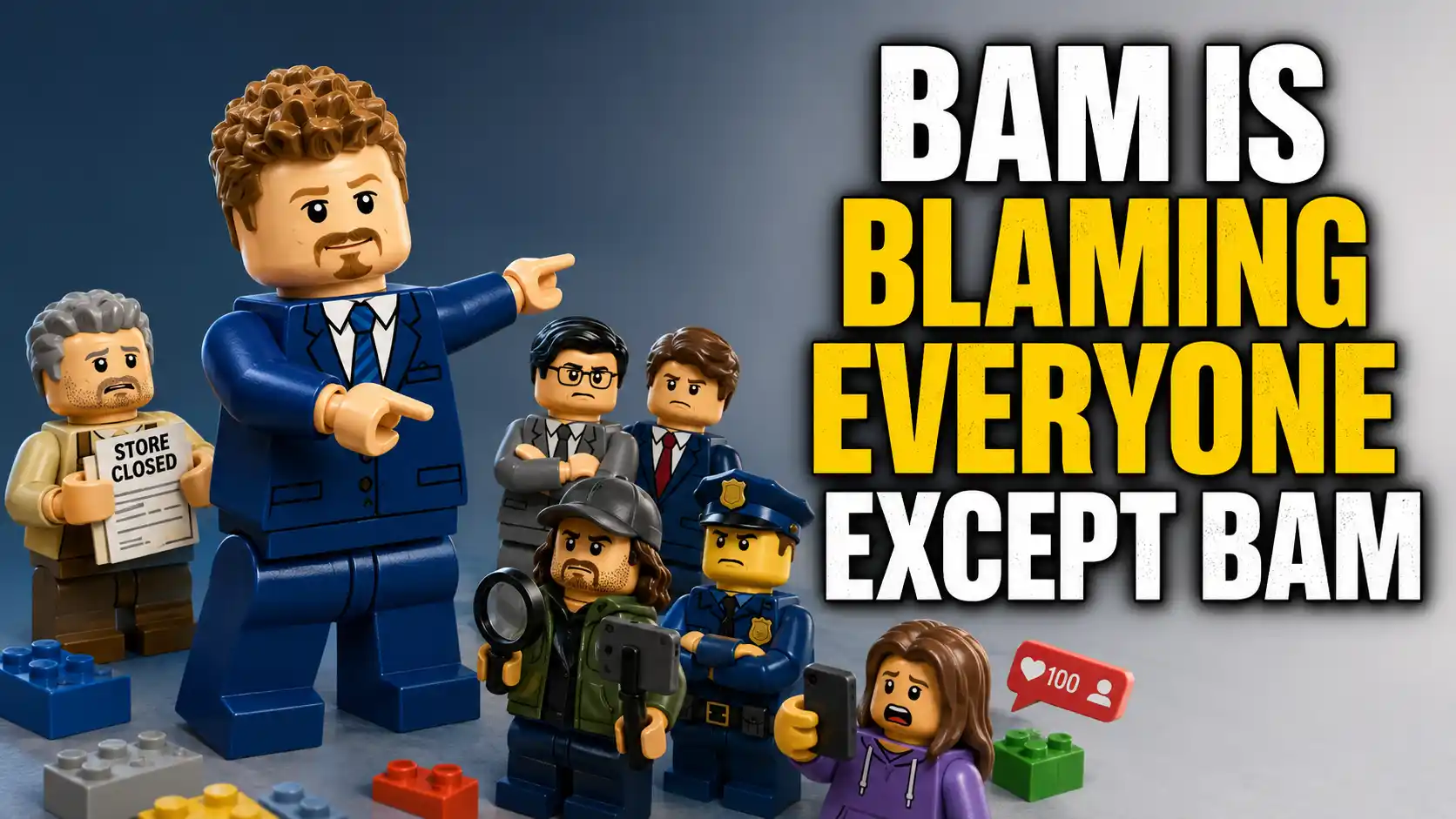
BAM’s public response to the Bricks & Minifigs scandal has become an inventory of excuses.
First, the blame was pushed toward the former franchise owner. Then it shifted toward Joshua Johnson and Brandon Best. Then Reckless Ben became the villain. Then “online profiteers” became the problem. Then police, courts, lawsuits, documentation gaps and process became the reason nothing could move quickly.
But a real leader does not just explain why everyone else failed. A real leader owns the failure that happened under the brand.
The Scapegoat Strategy Is Getting Old
The Bricks & Minifigs scandal keeps changing shape, but one theme has stayed painfully consistent: BAM always seems to find someone else to blame.
That is the problem.
Not every accusation against BAM has been proven in court. Not every claim from Reckless Ben or the Mansell side should be accepted without documents. The disputed small-claims/default-judgment issue alone shows why receipts matter. Everyone involved needs to show records.
But BAM’s response has its own credibility problem.
The company has repeatedly positioned itself as the adult in the room while pointing away from itself. It points at Chrystal Law-Gorman. It points at Joshua Johnson and Brandon Best. It points at Reckless Ben. It points at “online profiteers.” It points at harassment. It points at lawsuits. It points at legal process. It points at documentation problems.
At some point, all that pointing starts to look less like transparency and more like a scapegoat strategy.
The real question is simple: if a family’s valuable LEGO collection entered a Bricks & Minifigs store and the family was not made whole, who takes responsibility for the brand failure?
So far, BAM’s answer seems to be: everyone except BAM.
First It Was Law-Gorman’s Fault
BAM’s earliest public defense leaned hard on the former franchisee.
The company framed the Mansell collection as an unauthorized local consignment arrangement between the former Salem operator, Chrystal Law-Gorman, and the Mansell family. BAM said corporate did not sign, approve or authorize the arrangement. It also said consignment was prohibited under franchise rules.
This was the first scapegoat layer.
If the public believed that framing, then BAM could argue the real villain was the former owner who supposedly made a forbidden side deal, kept poor records, and failed to pay Mansell properly.
There may be real issues with Law-Gorman’s records. BAM now claims there were conflicting spreadsheets, different tracking records and point-of-sale discrepancies. Those claims need serious review.
But here is the problem: blaming the former owner does not resolve BAM’s responsibility after the takeover.
Once BAM stepped into the store transition, it had a duty to understand what inventory was in that store. It had a duty to distinguish store property from third-party property. It had a duty to handle disputed property with care.
If a company takes control of a store and later says, “Actually, the former owner made a mess,” that may explain part of the problem. It does not absolve the company from cleaning up the mess once it controls the system.
That is where BAM keeps trying to have it both ways.
It wants credit for being the franchisor with standards, operations manuals, store systems, buying power, training and brand control. But when the scandal hits, suddenly the problem becomes a private local dispute.
That is too convenient.
Then Johnson And Best Became The Firebreak
The next scapegoat layer is Joshua Johnson and Brandon Best.
BAM has now permanently closed the Salem store and says it has mutually parted ways with Johnson and Best. The company says its investigation uncovered operational gaps during the transition and that the incoming owners were not prepared for the responsibilities involved in taking over a store that needed a forensic accounting review.
That is a very careful way to say: this handoff went badly.
And yes, Johnson and Best have serious questions to answer.
They were tied to the post-transition operation. They were connected to the period when Mansell was trying to recover property or payment. They became the visible faces of the “where are the sets?” question. Johnson’s phone-call conduct and the American Fork police saga made the whole thing look even worse.
But now that BAM has cut them loose, the timing feels impossible to ignore.
When the scandal was still being framed as a former-franchisee issue, Johnson and Best were the new operators. Once the public backlash became radioactive, they became part of the cleanup story.
That does not mean they are innocent. It means BAM’s move looks like containment.
The question is not only whether Johnson and Best failed. The question is who put them in that position, who supervised the transition, who reviewed the inventory, who checked the records, who knew about the consignment issue and who allowed this to drag on until the brand was on fire.
Johnson and Best may be responsible for their own conduct.
But they are not a magic firebreak that stops the flames from reaching corporate.
Then Reckless Ben Became The Villain
BAM’s next target was Reckless Ben.
This was predictable.
Ben is easy to attack. His style is chaotic. His tactics are aggressive. Some of his legal theories are messy. Some of his stunts are built for content. And his disputed $100,000 default-judgment claim has given BAM a real credibility opening.
But none of that created the original problem.
Ben did not create the consignment agreement. Ben did not take over the Salem store. Ben did not handle the inventory transition. Ben did not create conflicting records. Ben did not fail to make Mansell whole before the story went viral.
Ben entered because the system had already failed.
That does not make every Ben tactic good. It does not mean every claim in his videos is perfect. But BAM’s attempt to center the story around Ben’s behavior is still a dodge.
A company can say, “Ben’s tactics are unacceptable,” and still admit, “We failed to solve the underlying customer harm fast enough.”
BAM has been much louder on the first point than the second.
That is the problem.
If the company had made Mansell whole early, there would be no viral campaign. No cult bit. No GoFundMe explosion. No national attention. No police scandal. No Patreon takedown fight. No bodycam disaster.
Ben became the story because BAM left a vacuum.
“Online Profiteers” Is Not Accountability
BAM has also used the phrase “online profiteers” and framed the backlash as manufactured drama driven by clicks, subscriptions and sensationalized videos.
That may feel satisfying inside a corporate statement. It is also wildly tone-deaf.
People did not get angry because they randomly hate Bricks & Minifigs. They got angry because the underlying story is morally easy to understand.
A family allegedly trusted a branded resale store with a valuable collection.
The store changed hands.
The family says it was not made whole.
Corporate took too long to resolve it.
Then the company seemed more focused on legal positioning than restitution.
That is enough to make people furious.
Calling the backlash “online profiteering” may describe some of the internet economy around the story. Yes, creators benefit from views. Yes, outrage produces traffic. Yes, some commentators may overstate facts.
But that still does not answer the core issue.
If Mansell was owed property or money, make him whole.
If BAM had proof the collection was gone before takeover, show the records.
If the former owner underreported sales, show the item-by-item reconciliation.
If Johnson and Best mishandled the transition, explain what happened and why corporate allowed it.
“Online profiteers” is not an answer.
It is a rhetorical shield.
The Police Became Part Of The Blame Machine Too
The American Fork police angle made the scandal much worse.
BAM and its defenders have argued that police were responding to harassment, stalking, trespass and safety issues. That may be part of the story. Police do have to respond to threats and residential disputes.
But the newly surfaced bodycam material has made the public even more suspicious.
Reporting on the bodycam says Ammon McNeff accused Reckless Ben of extortion, collusion, harassment, fraud and threats. The footage also appears to show how aggressively the Bricks & Minifigs side’s allegations were being fed into the police narrative.
That matters.
The police should not be used as a pressure tool in a business dispute. And corporate leadership should be very careful about calling police with severe allegations when the person being targeted is also the person exposing a public scandal involving the company.
The optics are awful.
BAM can say it was protecting employees and families. That may be partly true. But the public sees something else too: a company and its aligned operators calling police while the person trying to apply pressure gets stopped, searched, arrested and raided.
Then the Airbnb search reportedly found no LEGO.
That looks ridiculous.
And once the bodycam started surfacing, the whole “trust the process” line became even harder to swallow.
The Legal Process Became Another Excuse
BAM has also leaned on legal process.
Some of that is understandable. Active litigation limits what people can say. Court records matter. Mediation may be required. Evidence has to be preserved. A company should not resolve a six-figure dispute through social media comments.
Fine.
But legal process can also become a hiding place.
Every time BAM says “court will show it,” the public hears “not now.”
Every time BAM says “we need documentation,” the public asks why the company did not force a full accounting during the transition.
Every time BAM says “we are willing to sit down,” the public asks why that did not happen before the viral explosion.
Every time BAM says “we need proper channels,” the public asks why the ordinary channels failed Mansell for so long.
Legal caution is not the same as leadership.
A real leader can say:
“We dispute legal liability, but the customer harm is real and we are fixing it now.”
That sentence would have changed everything.
Instead, BAM spent too long litigating the frame.
Was it authorized?
Was corporate a party?
Was the collection really worth $200,000?
Was the former owner hiding records?
Was Ben harassing people?
Were the cases dismissed?
Were the videos misleading?
All of those questions may matter. But they should not have delayed the obvious moral response.
Make the customer whole. Then fight about liability.
The GoFundMe Makes BAM Look Worse, Not Better
BAM’s June 4 release notes that the GoFundMe for Bryan Mansell had raised more than $350,000 as of June 3.
That fact is now part of the public story.
But it does not help BAM the way BAM may think it does.
Public donations do not erase responsibility. If strangers on the internet step in to protect a family from a loss, that does not mean the original dispute disappears. It means the public saw a vacuum and filled it.
That should embarrass BAM.
The company should have been the first to make Mansell whole. Instead, the public did it.
That is the emotional truth of the story. People donated because they believed the family had been wronged and that the institutions involved had failed.
BAM can argue about the precise value of the collection. It can argue that $200,000 was promotional. It can argue that POS data shows a different picture.
But the GoFundMe success sends a clear message: the public trusted the family’s moral claim more than BAM’s corporate response.
That is devastating.
The New “We’ll Make Him Whole” Offer Comes Very Late
The most important update is that BAM now says it is prepared to work with Mansell, return remaining Star Wars LEGO from the Salem store and compensate him for unaccounted items.
Good.
That is what should have happened much earlier.
But the timing matters. This offer comes after the brand was torched online, after Johnson and Best became liabilities, after police bodycam controversy, after a massive fundraiser and after weeks of reputational damage.
That does not make the offer worthless. It may be the path to resolution.
But it does make the offer feel reactive.
A real leader does not wait until the building is burning to discover the fire extinguisher.
BAM should still make Mansell whole. It should still return what remains. It should still pay what is owed. It should still pursue whoever it believes caused the loss.
But the company should not expect applause for finally reaching the obvious conclusion under pressure.
A Real Leader Takes Responsibility
This is the heart of it.
Leadership is not just identifying who else made mistakes.
It is not enough to say Law-Gorman created an unauthorized side deal.
It is not enough to say Johnson and Best were unprepared.
It is not enough to say Ben escalated the situation.
It is not enough to say online critics profited from the drama.
It is not enough to say police and courts had to handle the messy parts.
Those may all contain pieces of truth.
But they do not replace responsibility.
A real leader says:
“This happened under our brand. We should have moved faster. We should have frozen the disputed inventory. We should have required a forensic audit immediately. We should have communicated better. We should have protected the customer first and fought internal liability later. We are fixing that now.”
That is leadership.
BAM’s public statements have gotten closer to that, but not close enough. The company still spends too much energy explaining why other people caused the mess.
That is why the scapegoat strategy feels so gross.
It turns a customer harm problem into a blame spreadsheet.
The Bottom Line
BAM may be right about some things.
Law-Gorman may have kept messy or conflicting records.
Johnson and Best may have been unprepared or mishandled the transition.
Ben may have overstated some claims and used reckless tactics.
Online commentators may have pushed parts of the story too hard.
Police and courts may now have to sort out parts of the chaos.
But none of that changes the central failure.
A family’s collection became trapped in a Bricks & Minifigs disaster, and BAM did not solve it quickly enough.
That is the brand failure.
That is the leadership failure.
That is the part BAM cannot outsource to a scapegoat.
If BAM wants credibility back, it needs to stop treating responsibility like a hot potato. Make Mansell whole. Release the records. Admit the transition failed. Explain what corporate knew and when. Show the inventory reconciliation. Stop hiding behind whoever is most convenient this week.
Because a real leader does not just take inventory of excuses.
A real leader takes responsibility.
FAQs
Is BAM The Only Party That May Be Responsible?
No. The former owner, Johnson and Best, Reckless Ben, and even parts of the police response all raise separate questions. But BAM is the franchisor behind the brand and cannot avoid the leadership failure.
Why Is Law-Gorman Being Blamed?
BAM says Law-Gorman entered into an unauthorized consignment arrangement, kept conflicting records and underreported sales from the collection. Law-Gorman disputes parts of BAM’s timeline and says records still need review.
Why Are Johnson And Best Important?
They were the post-transition franchise owners tied to the store after BAM’s intervention. BAM has now closed the Salem store and parted ways with them, which makes their role even more central to the fallout.
Why Does Reckless Ben Not Erase BAM’s Responsibility?
Ben’s tactics can be criticized, and some claims need correction. But Ben did not create the original consignment dispute or the failed store transition. BAM still has to answer for the customer harm under its brand.
Why Does The GoFundMe Matter?
The GoFundMe matters because the public stepped in where BAM should have acted sooner. Donations do not erase the original responsibility question.
What Should BAM Do Now?
BAM should make Mansell whole, release a clear item-by-item reconciliation, explain what corporate knew during the transition, and stop relying on blame-shifting as a public strategy.
References
Bricks & Minifigs, “A Note To Our Community About The Bricks & Minifigs Salem, OR Store”
https://bricksandminifigs.com/blog/blog/2026/05/21/salem-oregon-bricks-and-minifigs-store-situation/
Bricks & Minifigs, “Response To Customer Inquiries Regarding Bricks & Minifigs Salem, Oregon”
https://bricksandminifigs.com/blog/blog/2026/05/28/bricks-minifigs-salem-oregon-clarity-and-resolution/
Bricks & Minifigs, “Parts Ways With Salem, Oregon Franchise Owners Brandon Best And Joshua Johnson”
https://bricksandminifigs.com/blog/blog/2026/06/04/bricks-and-minifigs-salem-joshua-johnson-brandon-best-resignation/
Salem Business Journal, “LEGO Saga Has New Evidence, Lawsuits, And Truths To Uncover”
https://salembusinessjournal.org/2026/06/04/bricks-minifigs-lego-theft-records-salem-keizer/
Dexerto, “Leaked Bodycam Footage Shows Bricks & Minifigs CEO Accusing Reckless Ben Of Threats And Extortion”
https://www.dexerto.com/youtube/leaked-bodycam-footage-shows-bricks-minifigs-ceo-accusing-reckless-ben-of-threats-and-extortion-3371534/
Techdirt, “Everyone In This LEGO Dispute Should Have Spoken To A Lawyer Earlier Than They Did”
https://www.techdirt.com/2026/06/02/everyone-in-this-lego-dispute-should-have-spoken-to-a-lawyer-earlier-than-they-did/
