
TLDR
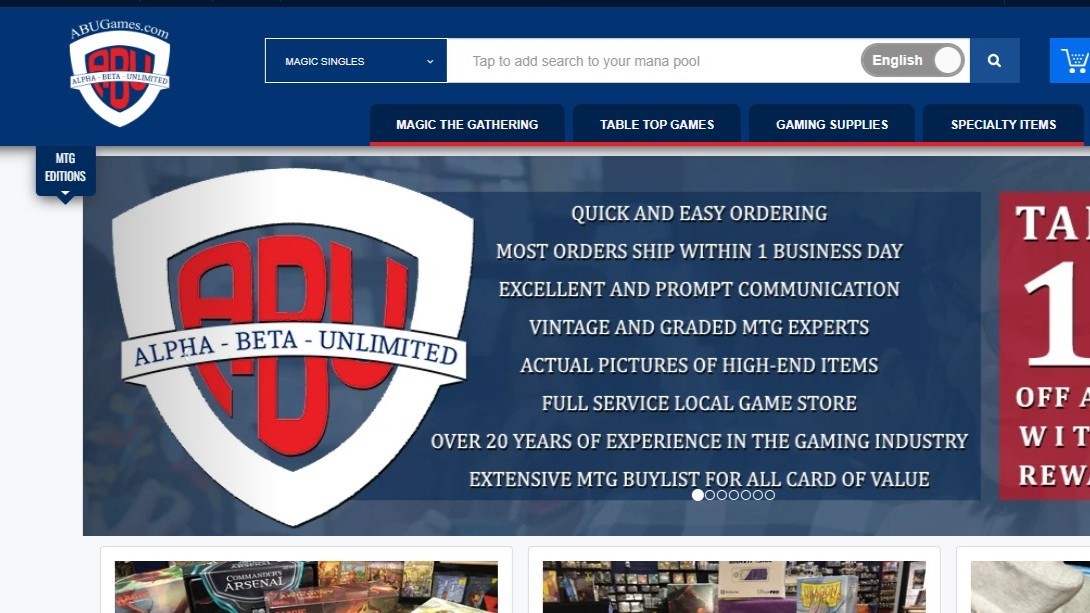
- This ABU Games review is for people who care about vintage and high-end MTG singles, and who like seeing actual photos before buying.
- ABU often shines on older inventory and collector staples, but pricing can be higher than “marketplace lowest.”
- Their buylist is a big part of the ecosystem, with trade credit typically higher than cash offers.
- Returns are basically condition-based. If you think a card was graded wrong, you need to email quickly.
If you want the big-picture map first (marketplaces vs retailers vs “why is shipping like this”), start with our pillar: Where to Buy Magic: The Gathering Cards Online (2026 Buyer’s Guide)
ABU Games review: what ABU actually is (and why it has a loyal following)
ABU Games is a long-running online retailer (and store) that plays in a slightly different lane than “grab the cheapest TCG listing.” ABU is known for carrying a lot of older and higher-end MTG singles, and for listing photos (front and back) on many vintage/high-end cards. That last part matters more than it sounds, because when you are buying older cardboard, “Near Mint” is not a scientific measurement. It’s a vibe, plus a bright light, plus the angle you tilt the card.
If Card Kingdom is the “pay more to get consistency” retailer, ABU is the “pay more to see what you’re actually buying” retailer. Those are not the same thing, and sometimes ABU is exactly what you want.
(And yes, it can also be the place you go when you’re trying to find that one specific printing that apparently no one else in the civilized world has today.)
The biggest ABU strength: photos for high-end and vintage singles
A lot of stores sell expensive singles. Fewer stores routinely include detailed photos front and back for the kind of older inventory where condition disputes are most likely. ABU explicitly calls out that they stock a huge selection of vintage and high-end Magic cards and that for most of these they include detailed pictures of the front and back. If you’re buying Reserved List staples, Power-era cards, or older foils, pictures do a lot of the work that condition labels can’t.
This is also why ABU feels more “collector friendly” than a lot of general marketplaces. You’re not trying to reverse-engineer condition from a seller rating and three words.
Condition grading: ABU keeps the ladder simple, but it goes deep enough
ABU’s condition guide lists the condition grades they use for Magic singles, including Mint, Near Mint, Played, Heavily Played, and Very Heavily Played. They also note that the value of Very Heavily Played cards depends on severity and that those are handled more individually.
That means ABU is trying to do two things at once:
- Give you a clear ladder for normal buying.
- Acknowledge that truly beat-up vintage cards live on a spectrum, not in a tidy checkbox.
Practical advice if you buy from ABU:
- If you’re picky, buy Near Mint and use the photos like you mean it.
- If you’re sleeving for play, Played and Heavily Played can be great value, especially on older staples where “perfect corners” stopped being a thing sometime around 1996.
- If you’re buying very high-end, treat the photos as the real product listing and the condition label as the summary.
Pricing: why ABU often looks “expensive”
ABU prices can read high compared to marketplace lows, especially if you’re used to optimizing carts across ten sellers.
But ABU isn’t really trying to win the “cheapest copy on the internet” contest. They’re selling:
- a curated retailer experience (one store, one support channel)
- and, critically, photos on high-end listings
So the value proposition is less “absolute lowest price” and more “reduce the odds of a surprise.”
That said, if you’re building a budget Commander deck full of low-dollar singles, ABU is usually not the first place i’d send you. It’s not what the store is best at, and you’ll feel the premium more on bulk carts.
Shipping: expect standard options, and plan like an adult
ABU’s own policy language notes that their cart calculates shipping options and costs based on your location and the contents of your cart. In other words, you’ll see the shipping menu at checkout and it will vary.
One important operational detail ABU highlights is how they handle graded-condition disputes and timing: if you feel an item in your order was graded incorrectly, they ask you to email within a short window after receiving the order (they cite 5 days). And they also state they generally do not accept returns or exchanges for reasons other than condition, because prices change regularly in collectibles.
So if you buy from ABU, build this habit:
- Open the package promptly.
- Check the cards promptly.
- If something seems off, take photos and contact support promptly.
This is the boring part of a buying guide, but it’s also the part that keeps your life peaceful.
Returns and refunds: mostly condition-based (inspect fast)
ABU’s policy language and third-party listings that quote it are consistent on the main point: ABU guarantees the condition they sell, and they generally limit returns/exchanges to condition issues. If you think something was graded incorrectly, you need to reach out quickly after delivery.
That’s pretty normal for MTG singles retailers. Singles prices move, and “i changed my mind” returns create chaos.
So the real question is not “do they accept returns,” it’s “do they have a clear process when condition is wrong.” ABU’s policy language says yes, with a defined contact window.
The buylist: a huge reason people keep ABU in rotation
If you only look at ABU from the perspective of “why does this card cost more,” you miss half the business model.
ABU’s buylist explicitly offers cash and trade credit, and they note that trade credit is usually significantly higher than their cash offer. They also state that buylist trade credit can be used toward Magic singles and shipping costs of an order.
This is why ABU has a reputation in finance circles for strong store credit: it can make the “ABU prices are high” complaint less relevant if you are operating inside the ecosystem.
The most common ABU use case looks like this:
- Sell cards you are not using (especially cards that buylist well for credit).
- Take trade credit.
- Turn that credit into the specific high-end singles you actually want.
If you’re a player who slowly consolidates into staples, duals, or iconic cards over time, ABU can be a very functional “upgrade loop.”
Rewards program: discounts for repeat cash purchases
ABU also runs a rewards program that provides percentage discounts on MTG singles based on your rewards level. The details and tiers are posted publicly, and it’s basically designed to reward repeat cash buying.
This is not going to magically turn ABU into the cheapest place to buy everything. But if you already like ABU for high-end inventory and photos, the rewards discount can take a little sting out of repeat orders.
When ABU is worth it
In this ABU Games review, here’s the honest “who is this for” list.
ABU is usually worth it when:
- You’re buying vintage or high-end MTG singles where photos matter.
- You want a single retailer instead of marketplace split shipping.
- You want to reduce condition surprises by actually looking at the card.
- You plan to use the buylist trade credit ecosystem to upgrade over time.
If you’re the kind of buyer who would rather pay a little more than argue with your own eyeballs about whether a scratch “counts,” ABU is very much in your lane.
For the “retailer premium” conversation in a more general sense, our Card Kingdom breakdown is here: Card Kingdom review: why people pay more (and when it’s worth it)
When ABU is not the move
ABU is usually not the best choice when:
- You are optimizing for absolute lowest price on a large cart of small singles.
- You do not care about photos and are happy buying from marketplace listings.
- You’re trying to build a deck fast using the lowest-cost path possible.
ABU is a specialist tool. If you use it like a specialist tool, it feels great. If you use it like a bargain bin, you’ll be annoyed.
Verdict
ABU is not the “cheapest MTG singles on earth” option, and it’s not trying to be. The reason people keep ABU in their rotation is a mix of high-end inventory, photos on vintage listings, and a buylist ecosystem that can make upgrades feel surprisingly doable.
If your buying habits lean collectible, older formats, or long-term staple building, ABU can be worth paying more. If your buying habits lean “cheapest playable copy for tonight,” you’ll probably spend more time elsewhere and only visit ABU when you need something specific.
