
MTG Arena vs paper culture is one of those topics where people argue like it’s politics, even though it’s mostly incentives. Same game engine, wildly different environment. Arena is a treadmill with rewards and matchmaking. Paper is a social club with cardboard and a closing time. One trains repetition. The other trains reputation. And that’s why MTG Arena vs paper culture produces different personalities, different etiquette, and different definitions of “a normal game.”
If you’ve ever watched a paper player try Arena and immediately complain about roping, or watched an Arena grinder show up to an LGS and look confused by trading, table talk, and basic human interaction, you’ve seen the culture gap in real time.
Let’s break down what’s actually different, and why it changes how people play and who they become at the table.
The core difference: Arena rewards volume, paper rewards community
Start with the simplest incentive:
Arena rewards you for playing more.
Daily systems, ranked ladders, limited-time events, mastery progression, and collection growth all point in one direction: log in, queue up, play games. Even if you’re not explicitly “grinding,” the structure nudges you toward volume.
Paper rewards you for showing up well.
You can’t quietly spam matches at 2 a.m. You have to physically go somewhere, play with other humans, and develop a reputation. “Good to play with” becomes a real currency.
So in MTG Arena vs paper culture, Arena tends to produce players who value efficiency and reps, while paper tends to produce players who value etiquette and relationships. Not always, but enough that you can feel it.
Matchmaking changes everything (especially your empathy)
In paper, you sit across from the same locals week after week. If you’re unpleasant, people remember. If you’re helpful, people remember. If you “accidentally” slow play every time you’re ahead, people definitely remember.
In Arena, you queue into a stranger you will probably never see again. That changes behavior:
- Less small talk, because there’s no time and no reason.
- Less patience, because you’re one click away from the next match.
- More “play to win,” because the ladder is literally tracking you.
- More emotional dumping, because anonymity removes social friction.
This is not a moral failing. It’s the environment. The environment always wins.
Even small design choices matter. Arena has emotes, not conversation. That reduces social connection and also reduces accountability. Which is why the Arena version of “sportsmanship” often looks like “just don’t rope me,” while paper sportsmanship includes things like clear communication, clean shortcuts, and not making a new player feel stupid.
The economy shapes deck choices (and how salty people get about them)
Paper Magic has a secondary market. You can buy singles. You can trade. You can borrow cards. You can proxy in casual groups (depending on the group). Paper scarcity is real, but it’s negotiable.
Arena scarcity is different. You don’t buy singles. You craft cards using wildcards. Packs and reward tracks push you toward incremental collection growth, and the rare and mythic wildcards become the real bottleneck for most players.
This creates a very specific Arena behavior: players avoid crafting “fun experiments” because wildcards feel too expensive to waste. So they craft what they know works. That means more meta decks, more netdecking, and more ladder efficiency.
Paper has netdecking too, obviously. But paper also has more “i own these cards so i play this deck” energy. Arena has more “i crafted these cards so this deck better win” energy. And that changes the emotional tone. Losing with a brew in paper feels like “eh, i’ll tweak it.” Losing after spending wildcards can feel like you just set time on fire.
That’s a big reason MTG Arena vs paper culture can feel like different levels of salt for the same play patterns.
Best-of-One and ladder pressure shape the meta feel
Arena’s most popular queues are often best-of-one. Best-of-one changes incentives:
- You can’t rely on sideboarding to fix weaknesses.
- You’re rewarded for fast starts and consistent openers.
- You get more matches per hour, which strengthens the “volume” culture.
Paper competitive play is historically built around best-of-three, in part because sideboarding is a huge skill and because it reduces the “one weird draw and you’re dead” feel. Arena has best-of-three too, but the default cultural vibe is still often best-of-one ladder.
So Arena metas can feel sharper, faster, and more punishing. Paper metas (when you’re playing best-of-three) can feel more strategic and adaptive. And paper Commander metas can feel like an entirely different sport, because they’re not ladder-driven at all.
If you want a reminder of how different the social contract is in paper Commander specifically, this is a good anchor read: MTG Commander Explained: History, Rules, and How to Start.
Arena improves technical play, paper improves communication
Here’s a fun truth that annoys everyone equally:
Arena makes you better at rules execution.
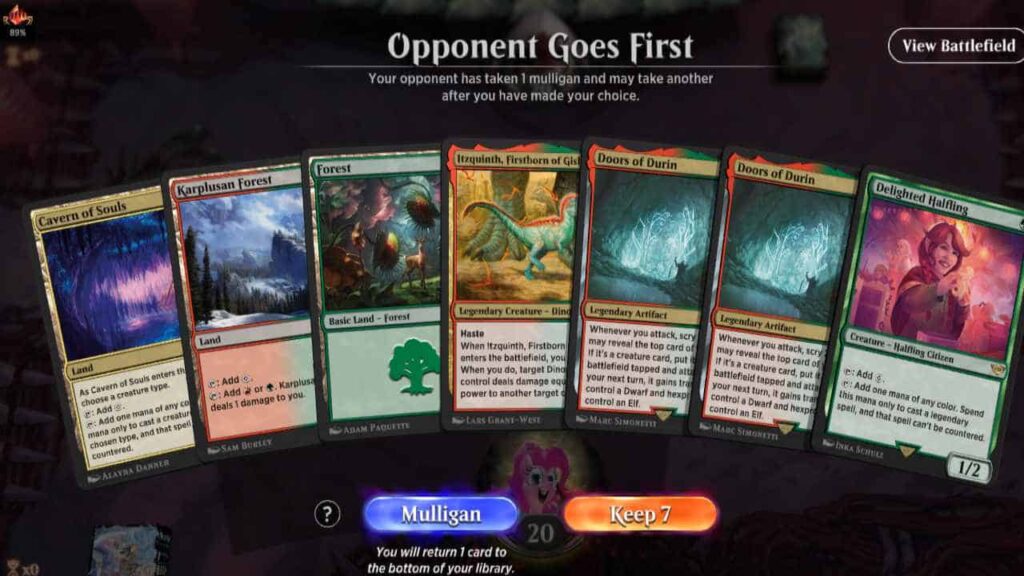
Triggers you might miss in paper get highlighted. Priority passes cleanly. You can’t “forget” to untap. You can’t accidentally draw eight cards. The client enforces legality.
This is great for learning. It also creates blind spots.
Paper makes you better at communication and responsibility.
You have to announce steps. You have to manage triggers. You have to shortcut clearly. You have to ask questions. You have to resolve ambiguity like an adult, not like a UI prompt.
That’s why Arena-to-paper transitions can be rough. Arena players sometimes assume the game will “catch” mistakes. Paper does not. Paper is held together by mutual clarity and the occasional judge call.
If your group ever fights about “wait, i had a response,” it’s usually a shortcut communication issue, not a rules issue. You can save yourself hours of drama by internalizing how these shortcuts work socially. This is the cleanest breakdown we’ve published on that: MTG Tournament Shortcuts vs Kitchen Table Magic.
The personality split: who Arena tends to create, who paper tends to create
Not everyone fits stereotypes, but incentives do produce clusters.
Arena often creates:
- The Ladder Grinder: optimizes decks and lines for rank, values speed and consistency.
- The Quest Optimizer: plays to complete rewards, rotates decks based on goals, sometimes cares more about “progress” than “beauty.”
- The Repetition Machine: gets very good at a single archetype because they play it 200 times.
- The Anxious Crafter: hoards wildcards, crafts only safe staples, hates wasting resources.
Paper often creates:
- The Store Regular: values good games and good vibes, builds relationships, knows who likes what.
- The Trader/Collector: cares about cardboard value, binders, versions, and the social ritual of trading.
- The Commander Socialite: shows up for pods, politics, and shared stories more than “optimal lines.”
- The Tournament Specialist: travels for events, cares about pace, communication, and clean play.
Neither set is “better.” They just train different muscles.
And yes, some people are both. Those are the terrifying ones.
Why people bounce off the other culture
Paper players trying Arena often bounce because:
- The matchmaking feels impersonal.
- The ladder makes every loss feel like a tax.
- The economy feels restrictive.
- Roping and emote spam feel worse because you can’t resolve it socially.
Arena players trying paper often bounce because:
- Shuffling and tracking takes effort.
- Board states feel messy.
- People expect you to talk and negotiate, especially in Commander.
- Mistakes don’t get auto-corrected.
- Social rules are unwritten and enforced by vibes.
This is why MTG Arena vs paper culture is not just “digital vs physical.” It’s “system vs community.”
Bridging the gap without being weird about it
If you mostly play Arena and want paper to feel good:
- Treat communication like part of the game, not an optional add-on.
- Learn a few clean phrases: “move to combat?” “with that on the stack…” “hold priority…”
- Expect games to take longer and plan your night around it.
- Accept that paper Magic includes social labor. You don’t have to love it, but you do have to respect it.
If you mostly play paper and want Arena to feel good:
- Pick a goal that isn’t “rank at all costs” unless you truly want that.
- Build one deck you enjoy piloting repeatedly.
- Use Arena as a reps tool, not as a self-worth machine.
- Take breaks before the treadmill turns into burnout.
We have a full sanity-first approach for that here: Healthy gaming habits for MTG: balance, not burnout.
The takeaway: different incentives create different cultures
MTG Arena vs paper culture isn’t a debate you win. It’s a difference you understand. Arena pushes volume, efficiency, and technical execution. Paper pushes community, communication, and shared experience. Both can be great. Both can be miserable. And if you know what each environment is training you to become, you can choose intentionally instead of accidentally turning into the person everyone avoids at game night.
