
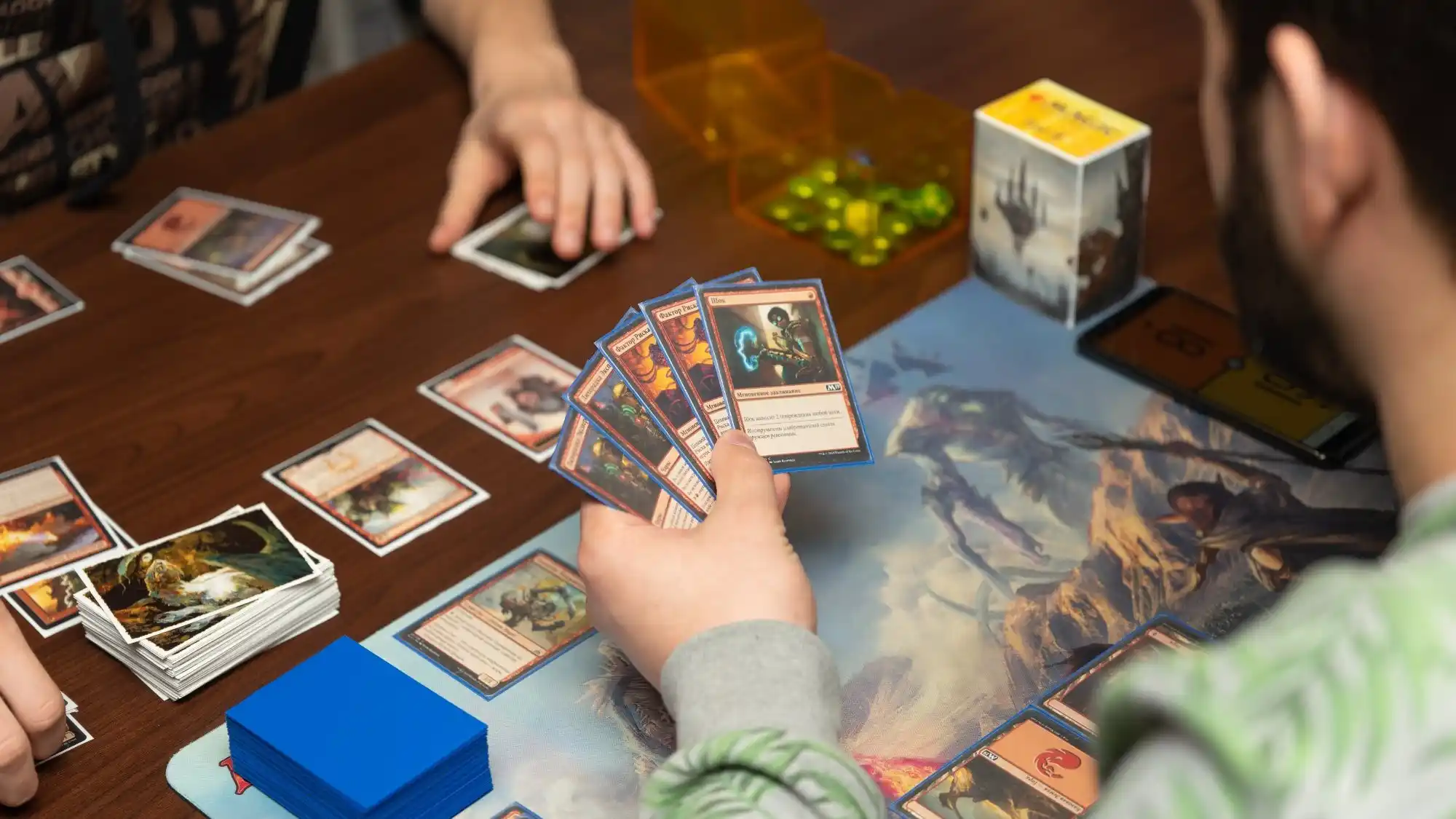
MTG slow play is one of those problems that sounds petty until you’re an hour deep into a single game and your only meaningful decision was whether to order food now or after you age into a different tax bracket. Add tanking, add phone scrolling, and suddenly you’re not playing Magic so much as attending a live demonstration of how time can be stolen without technically committing a crime.
This isn’t just a tournament issue. It’s a social issue. Commander pods stall. Draft rounds drag. Casual nights turn into “one more game” lies. And the worst part is that slow play rarely feels malicious in the moment. It feels like someone “just thinking.” Which is true. It’s also how your whole table stops having fun.
Let’s talk about what MTG slow play actually is, why it happens, why it tilts people harder than a topdeck, and how to deal with it without becoming the Fun Police.
Three different problems that all feel like one problem
When people complain about MTG slow play, they’re usually describing one (or more) of these:
1) Slow play (pace issue):
Actions take longer than is reasonable for the situation. The player is not trying to gain an advantage. They’re just… slow.
2) Tanking (decision paralysis):
The player stops to solve a complicated turn like it’s a chess puzzle, even when the decision is not that deep. Tanking often shows up when someone is behind, stressed, or piloting a new deck with too many lines.
3) Phone scrolling (attention leak):
The player disengages between actions, then re-enters the game like they just walked into the movie halfway through. This is the one that feels the most disrespectful, even when it’s not intended that way.
All three create the same table experience: long pauses, repeated explanations, and the creeping realization that you might be spending your limited human lifespan watching someone count mana again.
Why MTG slow play feels so bad socially
The “social cost” is bigger than “this is boring.” MTG slow play hits a few nerves at once:
It steals shared time.
In organized play, there’s literally a clock. In casual play, there’s still a clock, it’s just called “we all have jobs.”
It breaks flow.
Magic is at its best when turns have rhythm. Draw, main, decisions, combat, pass. MTG slow play turns that into draw, stare, narrate your options, stare again, check phone, ask what that card does (again), stare, pass.
It creates soft resentment.
Nobody wants to be the person saying “hey can we move?” five times in a night. So they don’t. They just quietly decide you’re exhausting and stop inviting you.
It punishes preparedness.
If you goldfish your deck, learn your lines, and play clean, MTG slow play makes you feel like you’re being penalized for caring.
And yes, it can also be weaponized. Which is why tournament policy draws a bright line between playing slowly and intentionally playing slowly. In real life, your table doesn’t need policy documents to feel the difference. Everyone can smell it.
Why people tank (and why it’s rarely about intelligence)
Tanking isn’t a skill issue. It’s usually a context issue.
New deck, new format, new responsibilities.
Commander board states are dense. Draft decks are unfamiliar. Modern lines are tight. A player can be smart and still be slow because their brain is doing live indexing.
Fear of looking dumb.
Ironically, this causes the behavior that makes everyone think you’re struggling. Many players tank because they’re terrified of punting, so they overthink every micro-decision.
Too many triggers and too many windows.
If you’re not comfortable with timing, you hesitate constantly. (If you want the cleanest explanation of why timing windows matter and why “hold on” is a real sentence, this is worth bookmarking: MTG Timing Rules Explained: Priority, Triggers, and the Stuff That Actually Matters.)
Decision fatigue.
Long games make brains sloppy. A player who is crisp on turn 4 might tank on turn 12 because their mental stack is full.
Social distraction.
Commander nights are half game, half hangout. Some players talk through every option because they’re also trying to entertain. That’s fine until it’s not.
Commander makes MTG slow play worse (not because anyone is bad)
Commander is a perfect storm for MTG slow play:
- Multiplayer means more permanents, more triggers, more interactions.
- Turn cycles are longer, so you forget details between turns.
- Politics adds a layer of negotiation that slows decision-making.
- Some decks create priority loops that are technically correct and emotionally ruinous.
If your pod ever feels like it gets stuck in “everyone has a response maybe” territory, a lot of that is just multiplayer priority being inherently slower than 1v1. You can reduce the pain by communicating shortcuts clearly, which is exactly what tournament shortcut philosophy is trying to do in formal play and what casual tables reinvent awkwardly every week. (If you want the practical, human version of that, bookmark: MTG Tournament Shortcuts vs Kitchen Table Magic.)
Also, Commander attracts “engine” decks. Engines are fun. Engines also create turns where one person performs a 12-step ritual while everyone else watches them count.
The table doesn’t hate your engine. The table hates watching you discover your engine in real time.
Phone scrolling: the modern pace killer nobody wants to confront
Phone scrolling is different from tanking because it adds a vibe:
- Tanking says: “i care a lot.”
- Phone scrolling says: “i don’t care that you’re waiting.”
That might be unfair. They might be checking a text. They might be tracking life totals. They might be dealing with something real. But the table experience is still the table experience.
Phone scrolling also causes the most common pacing loop in casual Commander:
- Player scrolls during other turns.
- Their turn starts.
- They ask for a recap.
- They tank because they’re now reconstructing the board state.
- Everyone else quietly regrets not bringing a faster deck.
If you want to keep MTG slow play from infecting your whole night, this is the simplest cultural norm you can adopt:
Phones down during turns that aren’t yours, unless you’re using it for game info.
It’s not a moral rule. It’s a “we’re trying to finish a game before the store closes” rule.
The tournament reality check (and why it matters even casually)
Even if you never play competitive events, tournament policy is useful because it names the problem clearly:
- Players are expected to play at a pace that allows matches to finish.
- Slow play is treated differently than intentional stalling.
- Using devices is allowed within limits, but using them for strategic advice is not.
You don’t need to enforce policy at your kitchen table. But the philosophy is healthy: your time is shared, and pace is part of sportsmanship.
In casual pods, you can translate that to one sentence:
“Play in a way that respects everyone else’s time.”
That’s it. That’s the whole social contract section nobody writes down.
What you can do if you are the slow player (without hating yourself)
If you suspect you’re the MTG slow play person, you don’t need shame. You need tools.
Announce your plan early, then execute.
Instead of silently tanking, say: “i’m deciding between line A and line B.” It signals you’re engaged and gives the table context.
Pre-count your mana while others play.
Your turn shouldn’t begin with “let me see what i have.” You can do that during the previous player’s combat.
Pick a default.
If two plays are close, choose the one that advances your game plan. Perfect play is not worth making three other adults watch you solve a 2% edge.
Practice your deck.
Goldfish your opening hands. Learn your triggers. Know your combo steps if you’re playing one. Fast turns are often just familiarity.
If your deck is inherently slow, own it.
Some decks take longer. That’s fine. Just be the person who pilots it smoothly, not the person who discovers it slowly.
What you can do if someone else is slow (without starting a feud)
Here are a few “adult” lines that work:
- “Hey, can we keep the pace up a bit? We’re running long.”
- “If you’re thinking, no stress. Just give us a quick ‘i’m deciding’ so we know you’re there.”
- “Do you want a recap, or should we pause a sec while you look?”
- “If it helps, we can shortcut this. What’s your intended outcome here?”
The key is to aim at pace, not personality. Most people respond well to “pace up” and poorly to “you’re slow.”
If you’re in a timed event, you can also involve staff. That’s not snitching. That’s literally part of the structure.
The take-home: MTG slow play is a table culture issue, not a rulebook issue
MTG slow play, tanking, and phone scrolling aren’t just “annoying.” They reshape who gets invited back, what decks get played, and whether your store night feels like a good habit or a weekly endurance ritual.
Play fast enough that people get more than one meaningful game. Communicate shortcuts like a human. Keep your phone from eating your attention. And if you need time to think, think like you’re sharing a room with other people who also want to enjoy their evening. Wild concept, i know.
