
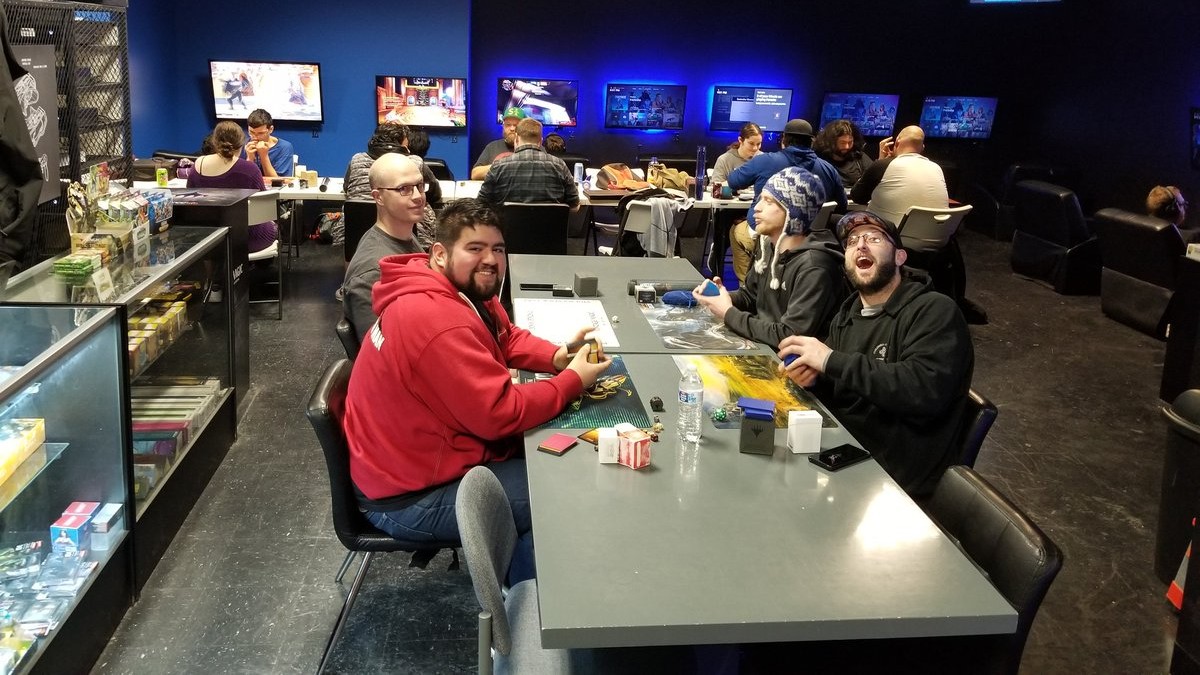
The MTG new player experience at a local game store (LGS) has a very specific vibe: you walk into a room where everyone already knows the schedule, the slang, the inside jokes, and which chair wobbles. It’s like transferring schools mid-semester, except the homework is reading 200-word card text and the social studies unit is “what counts as a takeback.”
The good news is: this feeling is normal. The better news is: you can cut through most of the weirdness with a little prep, a couple of polite scripts, and the confidence to say “i’m new, what should i do?” without apologizing for existing.
Why the MTG new player experience feels so disorienting
Magic is a game, but paper Magic is also a tiny community ecosystem with its own rules that are not in the rulebook:
1) Everyone is speaking acronym.
FNM. LGS. EDH. cEDH. WPN. RCQ. “I’ll keep.” “That fizzles.” “Go to combat?” You’re not dumb. You’re just not fluent yet.
2) You’re walking into an established culture, not just a match.
Some stores are chill kitchen-table energy. Some are “competitive but friendly.” Some are “we are here to grind and the vibe is spreadsheet.” Same game, very different room.
3) Formats are basically different hobbies.
Draft feels like a social board game night where you also make a deck in real time. Commander can feel like a group therapy session with dragons. Standard can feel like a sport. You can like Magic and still hate one of these. That’s allowed.
Pick the right first night (this matters more than your deck)
If you only do one thing before your first visit, do this: choose an event that’s beginner-friendly by design.
A few “good first nights” options:
- Prerelease: everyone is learning the new set, everyone is building from sealed product, and mistakes are expected.
- Casual Friday Night Magic: often a lower-pressure weekly hangout (varies by store).
- Beginner nights / learn-to-play / open play: not every store runs these, but when they do, it’s the easiest on-ramp.
How to find these without wandering into the wrong room like a lost NPC: use Wizards’ Store & Event Locator and check what the store is actually running that day. If the listing is vague, call the store. A 30-second phone call can save you from accidentally registering for a high-stakes event with a borrowed deck and a dream.
What to bring (and what you can skip)
You do not need a “real” deck worth $800 to have a good first night. You need a playable plan.
Bring:
- A deck you can actually shuffle (precon decks are perfect, and nobody should bully you for that)
- Sleeves (protects cards and makes shuffling less like wrestling a lasagna)
- Dice and tokens (or a phone app, but physical dice are nicer for table pace)
- A life tracker (paper, spindown, app, whatever you will actually use)
- Water (hydrate: the most powerful counterspell)
Nice but optional:
- Playmat
- Extra sleeves
- Trade binder (only if you like trading; do not feel obligated)
- Snacks (check store rules first, and be a decent human about crumbs)
And yes, i’m going to say the obvious: basic hygiene is part of the social contract. Not because Magic players are uniquely cursed, but because small rooms + long events + stress snacks can get weird fast.
The “i’m new” script that unlocks friendly mode
Say this to the first staff member or regular who looks like they know what’s happening:
“Hey, it’s my first time here. I’m new to paper Magic. What should i jump into tonight?”
This works because it gives people a clear job: help you land in the right place. Most stores want new players to stick around. If anyone responds like you’re wasting their time, congratulations, you have identified someone you do not need to impress.
What actually happens when you show up
Most organized events follow a predictable flow:
- You sign up and pay entry (if there is an entry fee).
- You get paired (usually via an app or posted pairings).
- You play rounds (or you play open pods, especially for Commander nights).
- You report results (sometimes you do, sometimes staff does).
If you’re nervous, ask: “How do I check pairings and report results here?” That’s it. You’re not the first person to ask. You won’t be the last.
The hidden curriculum: stuff everyone assumes you already know
This is the part that makes the MTG new player experience feel like a mid-semester transfer.
“Go to combat?” is not a yes-or-no question
In casual play, people use shortcuts. In more structured play, those shortcuts can have real meaning. If you’ve ever wondered why someone saying “combat?” can cause a ten-minute debate, you’re not alone.
If you want the clean explanation for those table assumptions (and why they sometimes explode), read: MTG Tournament Shortcuts vs Kitchen Table Magic
Touching other people’s cards is a “ask first” situation
Don’t grab someone’s deck, graveyard, or trade binder like you’re flipping through a magazine at a dentist office. Ask. Most people will say yes. The asking is the point.
Pace matters, but “fast” isn’t the goal
New players sometimes feel pressured to play quickly so they don’t hold things up. But the real goal is clear play, not rushed play. Announce what you’re doing. Ask questions. Take a moment. You’ll get faster naturally.
Some tables love teaching. Some do not.
A good table will happily explain a trigger, help you sequence, and let you take back an obvious accident once or twice. A less-good table will treat every mistake like a moral failing.
If you land in pod two of the “rules-lawyer Olympics,” you can politely exit after the game and find a better fit. You are not obligated to stay in a bad vibe because you’re new.
Commander nights: the social maze and how to navigate it
Commander is often the most welcoming… and the most confusing. Why? Because the “rules” are only half the game. The other half is group expectations.
Here’s how to survive your first Commander pod:
Ask one simple question before the game starts:
“What kind of game are we trying to have?”
That one sentence can cover:
- Power level (precons, upgraded precons, tuned decks, high power)
- Speed (are we cool with turn-five wins?)
- Interaction (are we here for chaos, or for clean lines?)
- Social tolerance (is this a “janky battlecruiser night” or “play tight or go home”?)
If anyone refuses to answer and just says “it’s a seven,” that’s fine. You’re learning the language.
Also: Commander is where you’ll hear the proxy conversation eventually. Some groups are pro-proxy, some are not, and some are “yes but don’t make it ugly.” You don’t need to solve the ethics of cardboard on day one. Just match the table.
How to handle awkward moments without starting a feud
You will misplay. Someone will correct you. Sometimes kindly, sometimes like they’re reading your Miranda rights.
A few lines that help:
- “Oh, good catch. Thanks.”
- “Can we rewind that? If not, no worries.”
- “I’m still learning paper shortcuts, can you explain what you mean by that?”
- “All good, I’ll play it correctly next time.”
If someone is being genuinely unpleasant, you can do the adult thing:
- Finish the game.
- Don’t rejoin that pod.
- Tell staff if it crosses into harassment or bullying.
You’re looking for a community, not an endurance test.
How to make your second night 10x easier
The first night is the shock. The second night is where it starts to feel normal.
Do two things afterward:
- Write down what confused you.
One card interaction. One timing thing. One social thing. That’s it. Next time, you’re up one level. - Don’t burn yourself out trying to “catch up.”
Magic has infinite depth. You can’t speedrun it without turning your brain into soup. If you want a sanity-friendly approach to learning and showing up consistently, this helps: Healthy gaming habits for MTG: balance, not burnout
The real secret of the MTG new player experience
The real secret is that most “experienced” players are also winging it. They just wing it confidently. They forget triggers. They mis-sequence. They argue about rules they half-remember. They have strong opinions about sleeves.
You’re not behind. You’re just new. Show up again. The room stops feeling like school, and starts feeling like your place.
References
- Wizards Store & Event Locator (locator.wizards.com).
