
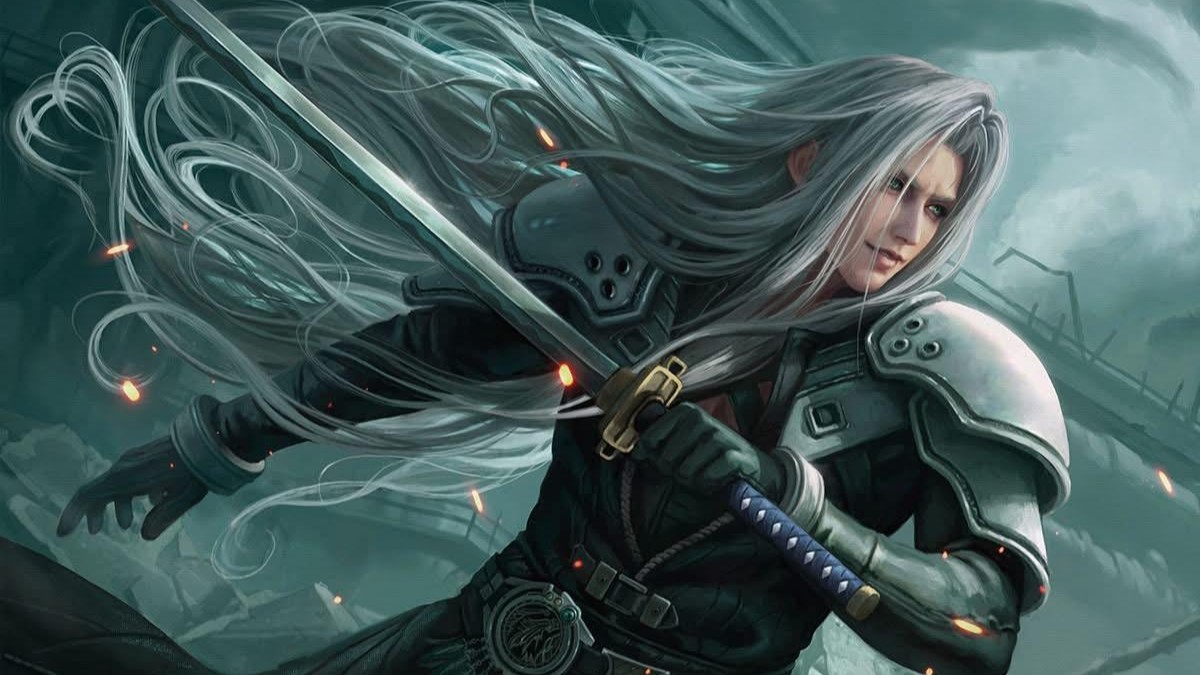
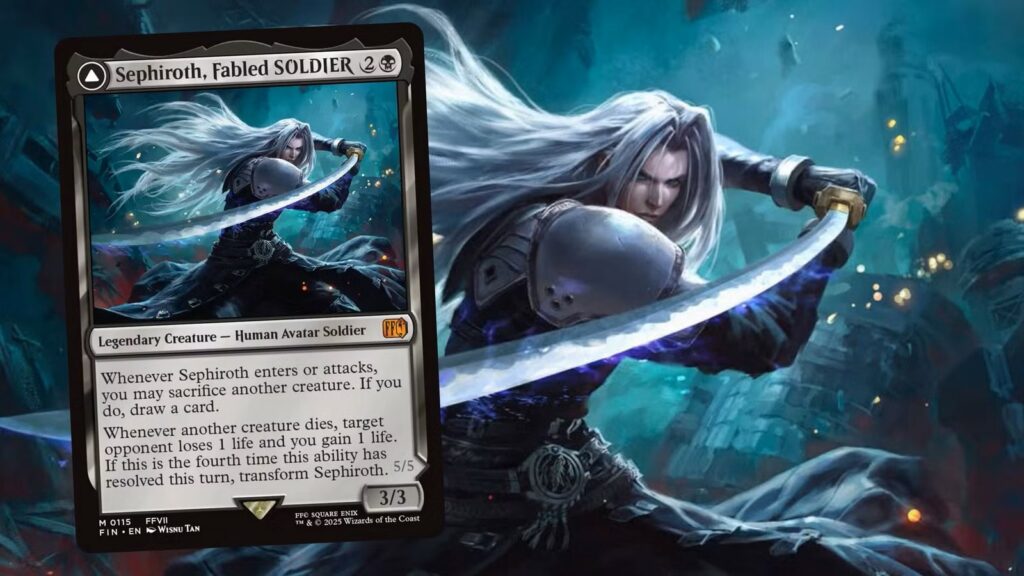
Sephiroth, Fabled SOLDIER is now the top mono-black commander on EDHREC, which is either a triumphant moment for Aristocrats players… or a warning label for everyone else at the table. Probably both. Either way, Sephiroth, Fabled SOLDIER finally muscled past K’rrik, Son of Yawgmoth for mono-black’s most-played crown, and the “how did this happen?” is pretty simple: he’s a clean engine, he’s good at the thing black already wants to do, and he doesn’t require you to treat your life total like a disposable coupon.
If you’ve been blissfully ignoring the Final Fantasy crossover because you were busy arguing about mulligans or sleeves, don’t worry. i’ll translate the hype into normal Commander language.
Sephiroth, Fabled SOLDIER takes the mono-black crown
EDHREC’s mono-black list now has Sephiroth sitting at the top, edging out K’rrik by a meaningful enough margin to count as “real,” not “someone refreshed the page at the right time.” The interesting part is that this didn’t happen overnight. Sephiroth has been creeping up for weeks as people realized he plays like a greatest-hits album of mono-black value.
K’rrik decks tend to be polarizing: explosive, scary, and sometimes over before the table fully agrees what turn it is. Sephiroth decks are more like a slow industrial shredder that also draws cards. Less dramatic. More inevitable.
What Sephiroth, Fabled SOLDIER actually does
Front side Sephiroth is a tidy little package:
- When he enters or attacks, you can sacrifice another creature to draw a card.
- Whenever another creature dies, you drain an opponent for 1 and gain 1 life.
- On the fourth time that death-trigger resolves in a turn, he transforms.
So you get paid for doing black things (things dying), and you get paid again for doing black things (sacrificing your own stuff), and then you get rewarded for doing it repeatedly in the same turn. This is basically a loyalty program, except the rewards are card advantage and existential dread.
And if you’re thinking “okay but how messy does this get with multiple death triggers?” yes, it can get messy. If you want a refresher on how triggers stack and resolve when the table is suddenly doing math, this is a good time to bookmark our guide on MTG Rules Series.
The One-Winged Angel side is where it gets rude
When Sephiroth flips, you get an emblem. The emblem reads (in plain English): whenever a creature dies, target opponent loses 1 life and you gain 1 life.
That matters because:
- Emblems are hard to interact with. Most tables can answer creatures. Very few can answer “the concept of inevitability.”
- The emblem doesn’t care whose creature died. Yours, theirs, a token, a squirrel that had dreams, whatever.
- The back side also lets you sacrifice any number of other creatures when Sephiroth attacks to draw that many cards. So once he’s online, you can convert a board into a new hand on demand.
And yes, you can stack multiple emblems over the course of a game if you’re able to transform Sephiroth more than once (usually by letting the back side die, then recasting the front). It’s not always the cleanest line, but it’s absolutely on-theme: Sephiroth has never been known for doing things only once.
Why Aristocrats players are adopting him so fast
Aristocrats is the Commander strategy where your creatures are less “valued teammates” and more “frequently redeemed coupons.” You sacrifice creatures for incremental value: drain, draw, mana, removal, recursion. Sephiroth is basically an Aristocrats commander that comes pre-installed with the two things the archetype always wants:
- A reason to sacrifice
- A payoff for things dying
That means deckbuilding becomes less about “do i have enough payoffs?” and more about “how many redundant payoffs do i want before my friends stop inviting me?”
The core checklist looks like this
Reliable sacrifice outlets
You want ways to sacrifice creatures whenever you feel like it (not just when Sephiroth asks politely). Think Carrion Feeder and Viscera Seer, plus the altar package if you’re leaning combo.
Cheap, recurring bodies
Bloodghast, Gravecrawler, token producers, and anything that comes back from the graveyard so your “sacrifice four things” turn is always available.
Drain redundancy
Zulaport Cutthroat style effects mean Sephiroth isn’t your only engine. That matters because your commander will get removed. Repeatedly. With feeling.
Mana conversion
Pitiless Plunderer is the classic “oops, now my sac loop pays for itself” card. Black is great at turning death into resources, and Sephiroth loves all of it.
A plan for the long game
Once you have an emblem (or two), you don’t need to sprint. You just need to keep the meat grinder running.
A quick “starter core” if you’re brewing
If you want a functional Sephiroth shell without spending an afternoon staring at 400-card maybeboard shame, start with something like:
- Carrion Feeder, Viscera Seer, Woe Strider
- Gravecrawler, Bloodghast, Bitterblossom
- Zulaport Cutthroat, Bastion of Remembrance, Syr Konrad
- Skullclamp, Ashnod’s Altar, Phyrexian Altar
- Reanimate effects (Animate Dead / Necromancy style)
- Cabal Coffers and Urborg if you’re going big-mana
From there, you can skew “fair grind,” “mean grind,” or “why are we still pretending this isn’t a combo deck.”
And if you’re testing lists or play patterns before committing to the full singles shopping cart experience, our older primer on All About MTG Proxy Cards | What They Are and Where to Get Them exists for a reason.
Why K’rrik lost the crown
K’rrik, Son of Yawgmoth is still powerful. He’s just powerful in a way that’s… socially loud.
His whole deal is paying life instead of mana for black pips. That leads naturally into “Suicide Black” style gameplay, where you treat your life total as a currency and hope nobody notices you’re at 9 life until you suddenly win or suddenly don’t.
That volatility is fun for some players (especially if you enjoy living dangerously and shuffling quickly), but it’s also a filter:
- Some pods don’t like the “combo-lottery” feeling.
- Some players don’t like piloting a deck where the margin for error is basically “don’t blink.”
- And some people are tired of explaining, again, that “i’m at 6 life but i’m actually fine,” which is the most suspicious sentence in Commander.
Sephiroth’s play pattern is just easier to adopt. You can build him fair. You can build him mean. You can build him with a pile of mono-black staples you already own. And he pads your life total while he does it, which feels downright responsible for mono-black.
What this says about mono-black in Commander right now
This isn’t just “new shiny thing wins.” Sephiroth, Fabled SOLDIER lines up perfectly with where Commander has drifted over the last few years:
- Players like engines that generate value without requiring a 12-step ritual.
- Drain and incremental advantage scale well in multiplayer.
- Commanders that stabilize your life total are easier to pilot across random tables.
K’rrik is still the king of “i would like to win on turn five and either way we’re done here.” Sephiroth is the king of “i would like this game to end, but slowly, and with receipts.”
Final thoughts
So yes: Sephiroth, Fabled SOLDIER is now the top mono-black commander on EDHREC, and it makes a lot of sense once you play a few games against him. He’s an Aristocrats commander with built-in draw, built-in drain, and a transformation payoff that leaves behind an emblem your opponents can’t just doom blade away.
If you’re a mono-black player, it’s hard not to see the appeal. If you’re playing against it, i recommend keeping graveyard hate handy and pretending you “totally don’t mind” when the Sephiroth player says, “okay, sacrifice four.”
Are you building Sephiroth, sticking with K’rrik, or doing the healthy adult thing and building both so you can pick the appropriate level of menace for the room?
